Showing posts with label green sandpiper. Show all posts

Monday, 6 November 2023

The season of letting go

So then, farewell to October. At a pinch one of my absolute favourite months of the year and which this year produced five local year ticks and a pleasing selection of memorable moments, in spite of birding with my arm in a sling for the most part and being unable to drive. 

This last ten-day period of the month always feels somewhat tinged with melancholy. It's hard not to feel as though autumn has peaked somewhat by the last week of October and that we are inescapably careering into the long darkness of winter, especially when the clocks change and any last hopes of evening birding are extinguished for the next three or four months. 

This year, October went out with a bang, as a series of Atlantic weather systems brought torrential rain which, combined with a period of spring tides, saw the Arun overtopping its banks in many places in the Pulborough area. The flooding in turn attracted my first local Little Gull of the year on the 31st - just a couple of days after my second local record of Long-tailed Duck in two years - and I finally joined the Short-eared Owl party in what looks to be the best autumn/winter for the species in several years. 

21st October

Not loads of time for birding today owing to family stuff but the loop from home to Waltham Brooks and back through the farmland produced a few bits of interest. Over 200 ducks were on the main lake at Waltham, mostly Teal and Mallard though with a handful of Shoveler (2), Gadwall (3-4) and Wigeon (8) mixed in. They were very flighty and at one stage had a single Snipe among them as they flew circuits around the place. Oddly, the only raptors noted were two rather distant Red Kites, so I'm not entirely sure what the wildfowl were getting upset about! A few Siskins and Redpolls were about and there were two Stonechats in the scrub near the railway line.

Wigeon
                                            
Teal
22nd October

No real birding today but notable by their movement at both Bignor and Fittleworth during family activities were a steady stream of Red Admirals moving through, mostly south-west.

23rd October

I was at Knepp all day today for an excellent beaver workshop so not much birding time, but of note here were three Fieldfares and a single Siskin over towards the western side of the estate (near the beaver enclosure, in fact). 
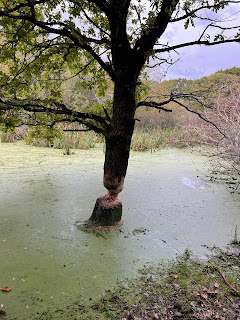
Here be beavers!

24th October

A mixed bag this morning started with 80 minutes' vismigging from the high ground above Watersfield. It was generally fairly quiet, certainly in terms of thrushes and finches, though there was a distinct increase in Woodpigeons and Stock Doves moving south-west, though still only modest numbers (150 and 69, respectively). Best of all were 20 Pintail (15 south/5 north) over Lodge Hill which may have been local wintering birds arriving in the area, but it was still quite cool to see them 'migging' over open country.

A stroll over to Waltham Brooks later in the morning produced a Great White Egret dropping in near the main lake, a few Skylarks and Siskins over, and a flock of 40 Wigeon flying towards Widney Brooks. A Woodlark flew north-east over the farmland near home. My seventh record of this species within the 1km area in the past four weeks - pretty remarkable!

An evening vigil at Thorndale Bridge proved to be enjoyable but didn't yield the hoped-for Short-eared Owl, despite one seen upriver near Pulborough this afternoon. At least six Marsh Harriers flew past to roost, while one of the adult White-tailed Eagles was upsetting the geese over at Amberley and a Yellowhammer flew over among the many Reed Buntings heading to roost. 

25th October

Rain early morning was slow to clear but mid-morning I headed up to Alban Head for a couple of hours' vismigging which proved quite lively. Highlights were two more single Woodlarks east, 54 Wigeon north (20, 11 and 23), 31 Fieldfare north/north-west and a few Redpolls about. I also heard Crossbill but didn't see it. Back home for lunch and another Woodlark flew north/north-east past the bedroom window. It really is remarkable how many records of this species I've had locally recently.

Another late afternoon session on the river bank at Thorndale Bridge wasn't quite as exciting as yesterday but produced a single juvenile Marsh Harrier, a White-tailed Eagle in the usual tree over at Amberley, around 100 Teal flying upriver and a pair of Mandarins flying downriver. 

26th October

A late start this morning owing to unwelcome rain which put paid to any planned attempts at another proper vismig session. I decided instead to head to Waltham Brooks via the local farmland. Almost immediately I realised there were actually a few bits moving after the rain with first a couple of Grey Wagtails west followed by a Peregrine circling briefly overhead before flying towards Amberley. Even better, this was followed around ten minutes later by a smart adult Mediterranean Gull cruising south with a couple of Black-headed Gulls - my fifth 1km area record this year and the first since June. 

As I approached the railway line at Waltham Brooks I heard a Golden Plover calling somewhere to the east but never got eyes on it. Still, it was my 133rd species for the reserve. It proved quite lively here this morning, with 57 species recorded in two hours including Kingfisher, Marsh Harrier, Water Rail and two Stonechats. Wigeon numbers have really increased locally now, as evidenced by the flock of ~200 which flew north, in addition to the 11 kicking about on the reserve. A distant second winter Great Black-backed Gull south-west over Lodge Hill was only my second record for the reserve. 
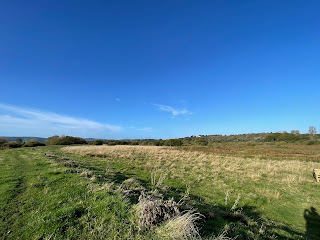
Looking west from the river bank at Waltham Brooks
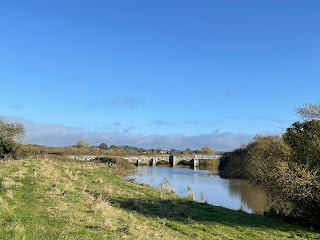
Greatham Bridge
Late afternoon I again headed over to Thorndale Bridge in the hope of a Short-eared Owl but no such luck. In fact the only real highlight here was a lone juvenile Marsh Harrier which powered south over Amberley, presumably heading to roost.

27th October

Kate kindly dropped me at Pulborough Brooks this morning for a couple of hours, my first visit here for almost three weeks! It's amazing to think that once upon a time I could barely tolerate missing a day here. The water levels had increased a great deal since my last visit and all the action was on the now very wet South Brooks which held two Ruff, five Dunlin and around 80 Black-tailed Godwits among the usual Lapwings and wildfowl. It was nice to see quite a few Pintail among the ducks here (at least ten) including my first proper smart drakes of the season. At least five each of Redpoll and Fieldfare were about around the trail while the North Brooks was curiously quiet save for a couple of hundred Canada Geese and a lone Shelduck. 

Another early evening stakeout on the river at Thorndale Bridge again proved fruitless on the owl front but I was rewarded for wading almost up to welly depth through flood water by a smart adult male Marsh Harrier (plus sub-adult male and juvenile) hunting just the other side of the river, flushing 25 Snipe in the process. 
Marsh Harrier
Snipe
Nocmig has been very quiet so far this autumn, but last night the microphone picked up a nice Barn Owl calling close to the garden. 

28th October

Family stuff today so no real birding but a short local walk early afternoon produced a Marsh Harrier briefly circling over Watersfield before drifting north-west over Lodge Hill. 

29th October

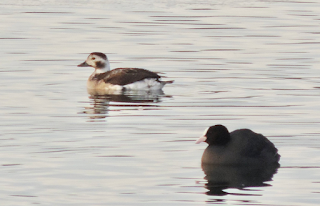
A very wet night gave way to a morning of sunny spells and squally showers. A short break in the downpours allowed for a quick check of the private reservoir near Petworth (thanks to a lift from Mrs Matt) which produced a couple of surprises. Firstly, a late Swallow over the ploughed field to the north of the reservoir which also held 25 Pied Wagtails and a few Meadow Pipits and Linnets. Secondly, a Long-tailed Duck on the reservoir itself. This was particularly unexpected, as it's coming up a year to when I found one here during a WeBS count in November 2022, that bird went on to stay until the end of December. I really struggle with aging and sexing female type Long-tailed Ducks in winter garb, so would welcome any comment, but have included photos below of today's bird and last winter's bird. Could it be the same one? If so, the likelihood is it surely must be a roaming feral bird. If not, perhaps today's is a genuine storm-blown individual which by some extraordinary coincidence has found its way to the same site as its predecessor. Otherwise, it is was usual fare on the reservoir, though a Great Crested Grebe was my first here since July. 
Today's Long-tailed Duck
And the 2022 bird...
Pied Wagtail
30th October

More heavy rain this morning delayed me heading out on foot from home, and scrapping my planned attempt at a vismig session. Instead I did the full loop out to Waltham Brooks, around the main lake and down the river bank. The water levels had increased dramatically since my last visit, with some of the paths entirely impassable (I had to get out onto the road in order to access the river bank from the north-western corner of the reserve. Avian highlights included a late group of eight Swallows feeding over the river and the north-western side of Amberley, a flock of ~40 Fieldfares over Greatham Bridge and good numbers of ducks - perhaps unsurprising given the water! Around 90 Wigeon flew north while at least 140 Teal were flying about plus a few Shoveler and Gadwall. As I was heading bak from the river bank towards the sewage works a Hummingbird Hawkmoth whizzed past heading purposefully south towards Amberley. 
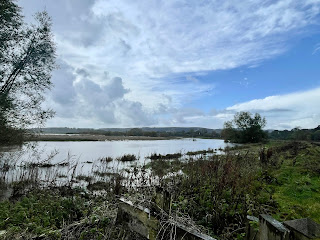
Looking across the swollen River Arun towards Amberley
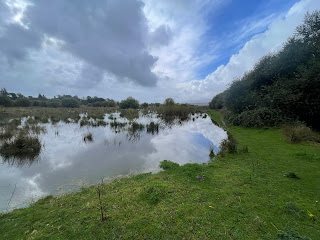
A very flooded Waltham Brooks
Continuing the theme of summer migrant stragglers, while working on the computer at home mid-afternoon I glanced up and out of the window towards Waltham Brooks and noticed a bird that on initial appearance seemed to be moving like a large hirundine. When I got bins on and realised it was a falcon and that it was clearly feeding on flying insects, the penny dropped that I was looking at my latest ever Hobby in the UK! I watched it for a minute or two before it drifted off south and I lost it behind trees. 

Late afternoon I decided to attempt my first drive for over a month. I didn't go far but had a quick look at the now very flooded scrape at Hadworth Farm in West Burton (my first check of this site since it dried up back in May) which produced a distant Green Sandpiper, a pair of Gadwall and seven Red-legged Partridge - the latter a good bird this close to home. I don't tend to see many of them away from the Downs round here. I then carried on a bit further to Burton Mill Pond, for my first visit here since before my accident (so around six weeks). An hour stakeout from the viewing platform produced the usual Cormorants flying in to roost (51 tonight) plus a few Little Egrets (9), Pied Wagtails (at least 25), Starlings (70) and Jackdaws (230). Two Water Rails were squealing in the reeds and a Kingfisher flew across the pond a couple of times.
Green Sandpiper
Little Egrets
31st October

A mostly fine morning after overnight rain and seemingly the last calm one of the week, with stormy conditions on the way as October gives way to November. I started this morning's local birding session with a relatively short vismig session up at Alban Head to the west of Watersfield. Despite the clement conditions, there really didn't appear to be much moving at all, despite some large counts of Woodpigeon in other locations in the south this morning. Highlights from 90 minutes here were singles of Crossbill and Yellowhammer north-west and a few Skylarks going in various directions, and two Red Admirals

I decided to head up to Watersfield Common and Waltham Park for a bit of a change, in the hope of finding some finches and other passerines. Watersfield Common delivered straight away with a single Crossbill and a flock of at least 15 Lesser Redpoll, followed by two showy Firecrests. Crossbill featured again at Waltham Park with one flying south at the same moment two late House Martins flew high south-east - not quite my latest ever in the UK but it's still pretty remarkable I've had Hobby and two hirundine species on the last two days of October! Other bits from here were seven Siskin and 11 Redpoll flying over, presumably all Lesser.             

A great little afternoon session up at Pulborough proved to be a perfect way to finish my October local birding campaign. I'd actually just popped up to the village to get a few bits from the shops when news broke of a Little Gull over the floodwater between the North Brooks and the village hall. I dashed down to near our old house and quickly picked up the gull - an adult - resting on the water, before taking flight again and hawking for a few minutes. It repeated this routine a few times before eventually flying off with a small group of Black-headed Gulls. While this was going on my attention was drawn to a bird sailing right over my head which I quickly realised was a Short-eared Owl! Steve Chalmers reported one from his nearby garden a few days ago and presumably the same bird was seen over the North Brooks at the weekend, so it wasn't a surprise to see, but something about an SEO always gets the blood pumping! It dropped in towards the river bank where it was promptly chased off by a Magpie, then it gained height and flew towards the North Brooks. Here it continued to gained height, with an irate Rook in tow, until it was just a dot, then drifted off south - presumably in search of somewhere less flooded to hunt.
Short-eared Owl
Little Gull

Friday, 13 October 2023

The wider horizon more clearly seen

While obviously less than ideal from the perspective of not being able to drive or lead Knepp safaris, etc, I have to say I am weirdly enjoying this period of enforced reduced travel and hyper local nature study. I have always said I am someone who would struggle to ever become bored and have kept myself busy the past couple of weeks with regular 1km area walks as well as rekindling my love for vismigging and nocmigging, and occasionally moth trapping when time allows (although this is a little trickier to manage with only one fully functioning arm!)

From a migration point of view, it's clear we have very much turned a corner now from the dregs of summer to the days of peak autumn proper. It's still a little on the slow side but as I write this I have just enjoyed a spectacular day of Redwing passage as well as my first Fieldfares and Merlins of the season, while the straggling hirundines are still to be seen trickling south most days. It's not just migrant birds that have featured either. This morning there was another Hummingbird Hawkmoth in the garden (my third record of the autumn after a relatively poor summer for them) and southward Red Admiral migration on a scale I haven't seen for many years has been a daily feature of late. A few migrant moths have been turning up in the trap too... All in all, perhaps not the most spectacular or memorable autumn so far (albeit not for good reasons!) but it's always nice to see the seasons changing gear at this point in the year.

Again, sadly rather a lack of decent photos this time, due to not being able to use my proper camera. 

1st October

So, a whole week into my shoulder injury recovery, and with the weather looking good I decided to give one-armed moth trapping a bash. It proved a worthwhile decision as it produced various new for the garden species, including Red-green Carpet, Lunar Underwing and the migrant Clancy's Rustic.

Clancy's Rustic
Red-green Carpet
Before emptying the trap I tried a spot of vismigging from the high ground to the west of home, which proved quiet aside from 55 Meadow Pipits mostly west and a few Swallows south. Late morning, Kate dropped me off at Pulborough for a whizz round, where I had a catch up with Steve B and Josie N. Highlights here included the lingering Curlew Sandpiper (my first anywhere this year!) among the usual waders, increased numbers of ducks, a Marsh Harrier and two Hobbies.

2nd October

A walk from home to Waltham Brooks this morning was fairly quiet. Highlights on the reserve were two Little Grebes, 20 Swallows, singles of Kingfisher and Snipe and a rather late Willow Warbler among the Chiffchaffs by the main lake. Down at Thorndale Bridge were a Stonechat, a flock of 25 Siskins spooked from Alders by a Kestrel, and another 17 Swallows south. 

While having lunch in the garden I picked up an Osprey circling quite low just to the east. It was in view for a couple of minutes as it gained height before drifting south. My first record anywhere this year, and just in time as it was one that I thought was going to evade me altogether as I'd reached October without seeing one. Unfortunately I was only able to get a very ropey one-handed record shot with my little bridge camera - better than nothing though I suppose! 

Osprey
3rd October

A check of Waltham Brooks this morning produced my first Pintail of the autumn here among the Teal, Shoveler and Gadwall on the main lake, plus a single Little Grebe and heard-only Kingfisher. A few Swallows were moving south which bode well for a follow-up skywatch from the field near home. In an hour, around 160 hirundines moved south here, roughly half and half Swallow and House Martin. The only other movers during this session were a single Linnet and two Herring Gulls south, and a few Siskins south-west. Another hour vismigging later in the day proved very quiet in almost summer-like conditions, with just a few hirundines and Meadow Pipits south, although two Lesser Black-backed Gulls going the same way were my first locally for a while. The warm sunshine also encouraged a few raptors into the air including a trio of Buzzards, a Red Kite and one of the White-tailed Eagles over Amberley.

4th October

Following on from my first Merlin of the autumn north-west over the garden first thing, a lively skywatch from the high ground on the western side of Watersfield produced a pleasing selection of species including a single late Sand Martin among 114 Swallows and 62 House Martins heading south, three Skylarks west and the first Redpolls of the season here (two north-east and three south). I had planned to have a good go at vismigging locally this autumn and it's already proving rewarding, although by all accounts not a vintage vismig autumn yet.
My vismig watchpoint this morning
5th October

In sharp contrast to yesterday, this morning's skywatch from the high ground near home failed to produce much excitement, despite early promise in the form of a Snipe flying north-west. Swallows and House Martins were in notably smaller numbers. 

Late afternoon I headed over to Thorndale Bridge which produced a juvenile Marsh Harrier flushing at least three Snipe from the near side of Amberley Wildbrooks, a light southerly passage of Swallows and House Martins (16 and 7, respectively) and a weird calling Chiffchaff in the scrub by the railway, which seemingly was just a vocally aberrant collybita rather than anything more interesting. 


6th October

A skywatch from the local farmland produced a bit of movement in the form of 30 House Martins south, four Skylarks west, a couple of Siskins south and a Chiffchaff 'bush hopping' its way south through the landscape. 

Waltham Brooks, meanwhile, held singles of Marsh Harrier, Snipe and Little Grebe, a couple of Stonechat, 34 House Martin and three Swallows flying south and a single Redpoll flying south-west.
Swallow
7th October

An early morning stroll out to Thorndale Bridge to skywatch from the river bank here proved reasonably lively with a pleasing trickle of Swallows, House Martins, Meadow Pipits and Siskins overhead plus a couple of Redpolls. Two Stonechats were kicking about and a Kingfisher briefly perched up on a post near where I was stood. The alarm call of a Green Sandpiper alerted me to two birds flying up from just across the river on the near side of Amberley with a Sparrowhawk in hot pursuit, which narrowly missed catching one of them. As I was heading for home a Yellowhammer flew west, not a particularly common bird here.

Mid-morning, Kate kindly dropped me off at Pulborough Brooks where I met up with Steve Baines (and later Paul Davy) for a stroll round the trail. Highlights included the continuing Curlew Sandpiper on the North Brooks with two Ruff, around 80 Lapwing, 50+ Snipe and 550 Teal; the whole lot flushed by a passing Marsh Harrier a few times. A rather late Yellow Wagtail flew south over the Hanger, while the South Brooks held three Cattle Egrets among the cattle and a couple of Stonechats. Three Clouded Yellows were noted during the circuit.

Early after a cream cap Marsh Harrier made an appearance drifting south high over the garden, my first record of the species from here.

8th October

Despite huge numbers of Redwings arriving further north yesterday and this morning, the conditions just weren't in my favour in Watersfield and an hour up above the recreation ground in clear skies and virtually no wind produced little in the way of movement aside from 20 Linnets south-west, 18 Swallows, a few Meadow Pipits and a single Skylark south. Perhaps most interesting was a single flock of 13 Lesser Black-backed Gulls high south, which tallied with similar movements over Capel in Surrey (per Wes Attridge). Clearly a few of these on the move today. 
Looking east from the hill above Watersfield
Fast forward a couple of hours and I arrived in Merrow in Surrey to visit my mother-in-law. A 15-20 minute watch from her garden proved lively, with a few Swallows, Linnets, Meadow Pipits and Siskins over, topped off by my first two Fieldfares of the autumn chuckling their way south. 

9th October

Well, it had to happen at some point. This morning was evidently the day that the vismig tap was turned fully on in the south-east. Heading out on foot from home at around 07:45 I immediately started seeing and hearing Redwings - my first of the autumn. Fast forward two and a half hours later and I had seen over 1,500 of them, streaming mostly west in waves, with around 200 being the biggest single flock. Watching from Thorndale Bridge, it was far and away my most enjoyable local vismig session to date, with 52 species recorded including a Merlin powering west, two Woodlarks south-west (and one grounded at Waltham Brooks), Cattle Egret and Peregrine south, plus Fieldfares, Skylarks and Swallows among many others. 

A rather frustrating moment came towards the end of the session, when I noticed a line of geese tracking south-west distantly over the Downs. I'm sure they had to be Brent Geese, but the distance, lack of scope or DSLR camera and only being able to hold bins with one hand, meant I just couldn't get enough on them to be 100% certain. Still, an amazing session and a timely reminder of just how enthralling vismigging can be when it's good! It also nicely took my Thorndale Bridge eBird hotspot list to 100 species with the addition of the various aforementioned goodies!

10th October

After yesterday's vismig fireworks I was hoping for more of the same but it sadly never quite delivered despite two bites of the cherry, first at Thorndale Bridge then later up on the hill to the west of Watersfield. After an initial flurry of 70 Redwings west between 07:50 and about 08:10, no more were recorded. Indeed, there were considerably fewer birds moving in general. A few late hirundines were drifting south/south-west late morning and Skylarks were trickling south-west throughout the morning. The main mover in the second session though was Red Admiral, with 31 flying strongly south in around 90 minutes. It really has been a remarkable year for this species and the spectacle of so many of them vismigging at this time of year never fails to impress. 

Thursday, 20 July 2023

Is it autumn yet?

It's always tricky to get back into the swing of things after any trip away from home, and returning to the later stages of summer in Sussex after a week away in Spain has proved no exception.

Of course, July can be a very exciting time of year, with spring migration well and truly done and dusted and the first subtle hints of return migration beginning to get into gear as the breeding season starts to wrap up for a lot of species. 

Certainly it felt rather longer than a week we had been away, when one sees how things have progressed in the natural world at this time of year. Take the Purple Emperors at Knepp for example, which were just a fortnight into their season when I was last there at the start of July, and are now already burning out fast like a spent firework as I write this in the third week of the month. 

The birds too are rapidly coming to the end of their various breeding cycles, with the cacophony of song that defines April, May and early June now reduced to just a few bursts, and most migrant species now just content to give their various whistles, tacks, croaks and squeaks in the bushes as we pass.

So it is to this backdrop of summer winding down and autumn just beginning to poke its head above the parapet that we ease into this rather brief summary of a somewhat unspectacular ten-day period of local birding. It's still been good, but don't expect any fireworks!

10th July

Our first full day back in the UK and, after dropping B at nursery, I decided to swing by Pulborough for a quick look at the North Brooks (I didn't have time for the full reserve loop today) which produced a tasty selection of waders: 2 each of Greenshank, Green Sandpiper and Avocet, 10 Black-tailed Godwits, at least 8 Little Ringed Plovers and a single Common Sandpiper. 

A short walk and skywatch round the local fields at lunchtime produced a light trickle of Sand Martins moving through, roughly south, and my first UK Painted Lady of the year nectaring on bramble flower. 

11th July

A check of local water bodies today proved fairly quiet. A Common Sandpiper was at a private site, while Burton Mill Pond yielded juvenile Grey Wagtails and Reed Warblers from a quick look in passing. An afternoon check of Waltham Brooks yielded just usual fare.

In fact, the resounding highlight of the day was not a bird but a butterfly - a Brown Argus, to be precise - which briefly alighted on a Viola in our garden at lunchtime, just as I had sat down to eat my sandwich! My first record for the garden here.

Brown Argus

12th July

A sweep of local water bodies today either side of a garden safari at Knepp. The afternoon saw some lively showers moving through with one in particular producing a substantial amount of rain. A private site near Petworth produced a Common Sandpiper and two juvenile Little Ringed Plovers, while a Common Sandpiper was also found on the pool at Southlands Farm, West Chiltington on my way back from Knepp.

Common Sandpiper
Knepp itself was good too (it always is, to be fair!) with heard only Lesser Spotted Woodpecker calling in trees near the Walled Garden and at least one Spotted Flycatcher about too. 

13th July

Another busy non-birding day but I managed to squeeze out for an hour round the local farmland and a brief look at Waltham Brooks at lunchtime. Highlights included the two White-tailed Eagles soaring together north of Greatham Bridge (the first time I've seen both together for quite some time), at least a dozen Sand Martins feeding over the main lake and a few Swifts trickling south-west. 

14th July

A cool, grey and squally day, more akin to October than mid-July. A whizz round Pulborough this morning proved quite productive, especially for waders. Highlights were 28 Black-tailed Godwit, 9 Green Sandpiper, 3 Greenshank, 2 Little Ringed Plover, 2 Common Sandpiper and 2 Avocet. A Grey Wagtail flew over Green Lane as I was walking back to the car park, and around 8-10 each of Sand Martin and House Martin were feeding over Uppertons Field, Fattengates and the South Brooks.
North Brooks looking autumnal
15th July

A particularly autumnal day with severe winds (gusting up to almost 50mph), leading to the cancellation of various summer fayres and other events (Goodwood Festival of Speed included). I was also looking after B all day, so no birding today.

16th July

For the first time in a while I got out early for the loop up the river from home to Waltham Brooks and back past the sewage works. The clear highlight of an otherwise relatively uneventful couple of hours was a Grasshopper Warbler reeling intermittently on the north-western side of Amberley Wildbrooks, just across the river east of Thorndale Bridge. It was hard to pinpoint exactly where it was, given the still blustery wind, but it was unmistakable nonetheless. My first record of the year, taking the local year list to 147 and the 1km area list to 117.

Also of note were a female Teal with six juveniles on the main lake at Waltham Brooks and a family group of Nightingales flitting about and calling constantly in the scrub right next to Thorndale Bridge. There was just a hint of some south-westerly movement of Swifts overhead throughout the session, but still nothing spectacular - still waiting for a really big day for these this summer. A pair of Stonechats were by the railway crossing at Waltham Brooks and there were several juvenile Whitethroats about. 
Stonechat
Despite the wind, there were plenty of butterflies out, even at this early time of day, including a couple of box fresh Peacocks sunning themselves on a fence near home. There seem to be so many of these and Red Admirals about at the moment!
Peacock
17th July

A day where I was all over the place but didn't squeeze in a whole lot of birding. Perhaps the most notable bird of the day was at least one flyover Crossbill (heard only) while I was surveying some private land near North Chailey in East Sussex - only my second record of this species anywhere this year!

At Knepp in the afternoon, the remarkable Turtle Dove summer there continued with a single bird low over the heads of my safari group in the Southern Block - a pleasing Knepp first for one of the staff members present. Also of note here was my first Willow Emerald of the year. 

On the way home a quick look at Southlands Farm in West Chiltington produced a Green Sandpiper, while a family group of 5 Peregrines were noisily flying around over Amberley Station as the female brought back prey. 
Green Sandpiper

18th July

No birding today. 

19th July

An early walk from home out to Waltham Brooks and back proved fairly quiet, aside from the usual fare at the main lake (7 Shoveler, Cetti's Warbler, Water Rail) and 25 Swallows perched on the telegraph wires near home. 

Later in the morning I headed out to the private site near Petworth which produced a single Common Sandpiper and 25 Egyptian Geese, including two striking leucistic individuals. 
Egyptian Geese
On the way home from Knepp in the afternoon I stopped at Southlands Farm to check the pool there, which again held a Green Sandpiper, presumably the same bird from a couple of days ago.  

Tuesday, 11 August 2020

Hotting up!

The weather might be doing its utmost to convince us that we're still in summer, but it's clear that we're getting into ornithological autumn proper now, and there's been a fair bit of excitement at Pulborough Brooks recently.

Waders have really got moving in the past couple weeks, with highlights including two Wood Sandpipers on 8th August (plus a couple of other heard only records), up to three Greenshank (31st July), a splendid summer plumage adult Spotted Redshank (31st July) and an impressive count of 17 Green Sandpipers (31st July) along with the usual fare for the time of year. Sadly one of this year's juvenile Avocets didn't make it, as it was looking senescent on 31st July and was finally finished off by a Lesser Black-backed Gull on 1st August, despite the efforts of the RSPB staff to catch it and take it into care.
Spotted Redshank and Greenshank
                                                        
Avocets

Other recent highlights have include five Cattle Egrets and three Med Gulls on the North Brooks on 30th July, the former of which I managed to get from the attic. The Egrets were preceded by their larger cousins on the 19th when three Great White Egrets dropped in on the North Brooks, followed by one on the 24th. A Curlew flew south down the Arun calling loudly early on 6th August followed by another west over the garden on the 10th (which Pete Hughes had earlier had on the North Brooks), while early on the 7th the first Tree Pipit of the autumn/year flew south over the horse paddocks just north of Wiggonholt Church. The same morning also produced a Pied Flycatcher in the Oaks near the church, found by Alan Baker - perhaps a species we'll record again this autumn, given the amount turning up in the southeast this week!
Cattle Egrets, photo: Phil Thornton

Great Egrets, photo: Mark Bloss

As many other birders have been noticing it's turned into an extraordinary summer for Crossbills. In the three years I've been patch watching Pulborough, I'd had maybe half a dozen records of the species before this summer. Since this irruption kicked off in June their unmistakable 'jupp'ing calls have become a regular feature of my visits to the reserve. Recent records include what sounded like a small flock over the visitor centre on 13th July, one south over the North Brooks on 14th July, five south on 17th July, four on 20th July, two north on 21st July, heard only records on 2nd and 3rd August, six west over the church on 4th August, two north on 8th August and one over on 10th August (David Campbell).

With my patch yearlist now on 145 and easterlies forecast for a couple more days followed by more early next week, I'm quietly confident that this could be the year I hit 150...

Garden Warbler

Stonechat

Spotted Flycatcher


Thursday, 19 July 2018

Summertime Blues

Continuing the 'it's a bit quiet' theme from my previous blog post early July didn't really produce much in the way of avian fireworks at Pulborough. Thankfully though the first waves of returning waders have been keeping the interest up and of course there's also plenty of invertebrate interest at this time of year, but more on that later.
Early morning looking across Winpenny Brook to Hanger Wood
The waders really started getting going as June gave way to July with the usual early movers beginning to arrive in the form of some good accumulations of Little Ringed Plover (peaking at eleven on 28th June), Green Sandpiper (nine on 10th July), Black-tailed Godwit (ten on 10th July), Common Sandpiper (three on 17th July) and odds ones and twos of Dunlin and Greenshank. The breeding Redshanks and their offspring have all but cleared out with just the odd juvenile lingering now, while Lapwing numbers are beginning to increase with presumably many of the local breeders among them. Mind you, like many wetland sites across the UK this summer, the Brooks is in need of a good top up soon to maintain interest for any waders or wildfowl.
Green Sandpiper

Green Sandpiper

Green Sandpiper
Talking of wildfowl, well it's a bit quiet there too really, with just handfuls of Teal and the odd couple of Shoveler mixed in amongst the hoards of eclipse plumage Mallards lately, all crammed into what's left of the water on the North Brooks.

Gulls are rarely numerous at Pulborough so it's been good to hear a few reports of Mediterranean Gulls dropping in recently, although I've missed most of them myself! I also managed to miss another local Osprey when one flew over Hardham a couple of Sundays ago. The observer (Martin Lanaway) reported the alarm calls of Herring Gulls drawing the bird to his attention which is particularly frustrating as I was at home at the time and remember hearing some Gulls calling but foolishly was in a bit of a rush to leave the house and so didn't investigate further. I bet it must have flown right over the Brooks/garden!

As is typical for the time of year, most of the migrant passerines are keeping their heads down now, with odd squeaks, tuts and whistles from Lesser Whitethroats, Nightingales and others staying largely hidden in the undergrowth. There seem to be more Meadow Pipits around the past few days and I've noted the odd Sand Martin flying strongly south, so some small signs of change there. I'm hopeful that the coming weeks will deliver a few of the glaring omissions from my patch year list such as Yellow Wagtail and Redstart but only time will tell.
Grey Heron
Somewhat unexpected towards the end of June and early July was a singing Woodlark, rather bizarrely favouring the area between Uppertons Field and Hanger Wood. Whether it was the male of the pair that had been holding territory on the heath up until the 'Beast from The East' arrived or a new individual is of course impossible to know but it was still lovely to hear that lilting song echoing around the Brooks again for a few days - it seems to have moved on again now. Despite increasing numbers of Starlings (over a hundred on the 13th of this month) I've still been unsuccessful in gleaning out a Pastor roseus to add to the patch list. Indeed, I've not had a patch tick of any kind since the Common Terns on 20th June, so another reason to look forward to the autumn!

As I mentioned in my intro though, Pulborough is a great place to find all manner of non-avian wildlife, especially in the extraordinarily hot and dry summer we're currently experiencing. I told myself I'd try to sharpen my Odonata ID skills this year and Black Pond in particular is the perfect place to do just that. Black Darter is a species I'd never knowingly seen before until this year, so I was particularly pleased to see several here after a tip-off tweet from Alan Kitson. The woodland butterflies have been out in force too, with White Admiral and Silver-washed Fritillary putting on good shows in Black Wood, and still plenty of Purple Hairstreaks around, while the first Brown Hairstreaks have also begun to emerge now - best seen along the paths near the Hanger or down to Nettley's Hide.
Black Darter
Large Red Damselfly
Emerald Damselfy
Another place that's always worth a visit at this time of year - particularly for butterflies - is Knepp Wildlands. After reading of the incredible numbers of Purple Emperors being recorded at the end of June, I visited on the 30th with Kate and in just a couple of hours we saw at least forty of these majestic butterflies cruising about all over the place, along with a similar number of Purple Hairstreak. I've been aware of the White Stork re-introduction project for a while but even so it was quite surreal to see one casually gliding overhead at one point. I returned again a couple of weeks later with Charlie Peverett and Chris Ball, neither of whom had been before. As our visit was earlier in the day and a little later in the season we 'only' saw a handful of Purple Emperors this time but also had a bonus couple of Turtle Doves in flight. It's amazing to think Knepp only started recording this species again in 2007 and this year they have had eighteen singing males.
Purple Emperor

Silver-washed Fritillary

White Stork

Purple Hairstreak

"There ain't no cure for the summertime blues", sang Eddie Cochran. Well, all I can say is Eddie clearly wasn't much of a naturalist. The summer may be quiet for birding but there's always stacks of other stuff to look at and autumn proper really isn't too far away now, and that's a heartening thought to cheer up any birder suffering with the blues.