Showing posts with label goosander. Show all posts

Saturday, 20 January 2024

Mid-January

11th January

No sooner had I arrived at Pulborough Brooks early this morning and just started to scan the flooded and frozen South Brooks than I received a call from Mrs Matt saying she needed me to help her with a flat tyre, so that put paid to that particular effort! 

Fast forward 45 minutes or so and the tyre was all sorted, so I decided to drop in for a quick look at Waltham Brooks on my way home. It proved to be a good decision as, while I was enjoying the sunshine and the loud cracking sounds of the ice giving way above receding water levels, two ducks appeared into view from the north which revealed themselves to be Goosanders as they powered on over the main lake towards the Arun, where they seemed to drop in a little way downstream. A Great White Egret was also heading the same way, albeit at a more leisurely pace. My first record of Goosander anywhere this year and only my third ever record at Waltham Brooks. Funnily enough, Ed and I had literally just been chatting about the species, as he'd just found two at Frensham Great Pond. Amazing how often that happens!

Goosanders powering off downriver... sadly too slow with the camera this time!
12th January

Back to grey today after a few days of crisp winter sunshine. An early loop of Pulborough Brooks proved to be fairly uneventful, not entirely surprising given the extent of flood water. There were still several hundred dabbling ducks around, mostly Wigeon and Teal, although a lone Tufted Duck drake was on the South Brooks. I missed the Redshank and two Ruff seen by Chris and Juliet Moore but did manage to find a couple of Dunlin among ~500 Black-tailed Godwits huddled on the South Brooks. 

A day with no year ticks was salvaged late afternoon by a Peregrine which flew north over Watersfield, just as I happened to take a screen break and look out of the window (amazing how often that happens!), taking my local list to 90, and 69 within the 1km area. 

13th January

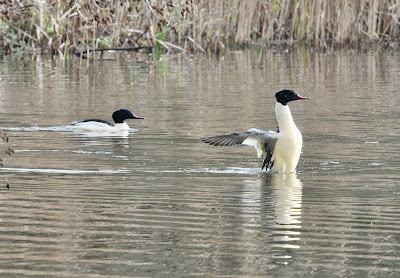
Another gloomy, grey start to the day saw me heading over to the private reservoir near Petworth to carry out my WeBS count a day early. It turned into a surprisingly decent session here, with two site ticks. As I got out of my car, I was greeted by the sound of a Blackbird softly singing nearby, always a heart-lifting sound in the depth of winter. A little further down the track to the reservoir I was surprised by a small falcon which suddenly flew up from the field to my right and gained height before flying off east - a Merlin! The first of two site ticks and no sooner had I processed it than I made my way closer to the reservoir only to discover three Goosanders on the water! Unfortunately they were evidently just as surprised to see me so quickly took flight and, in the half light, I only managed some ropey record shots. The Long-tailed Duck was still present too, which got me to thinking whether I had ever seen those two duck species at the same location before, the answer to which, I'm pretty sure, is no!
Goosanders
On the way home I stopped briefly at Hadworth Farm in West Burton to check out the flooded field here. This also proved decent, as it produced three site ticks in the form of Wigeon, Little Egret and Raven. The former were on the water, the two Little Egrets dropped in to feed along the waters edge and the latter (Ravens) were noisily flying to and from Bignor Park, where I suspect they must nest. 

Later in the day I headed down to Arundel with Kate and B for a stroll round, and to feed the ducks at Swanbourne Lake (of course!). A brief stop at the church in Burpham yielded the nine adult Bewick's Swans in the water meadows there plus at least seven Cattle Egrets in the fields beyond. 
Bewick's Swans
Multiple Cattle Egrets were later seen coming into roost from the Black Rabbit pub by the Arun, along with at least eight Marsh Harriers. 

14th January

A Wildstarts tour saw me spending the morning at Pulborough Brooks, leading a mother and her son around the trail. Highlights included a brief Great White Egret on the North Brooks, which also held ~200 skittish Black-tailed Godwits. The South Brooks were livelier, with singles of Ruff (a local year tick) and Marsh Harrier, ten Shelduck at West Mead and one of the adult White-tailed Eagles in a tree near the Arun which briefly flew and showed off its gleaming white tail before returning to a similar perch. On the way back up to the visitors centre we bumped into the flighty Redpoll flock near Fattengates, all Lessers as far as I could see.
Lesser Redpoll
Lapwing
Teal
A brief check of Waltham Brooks on the way home yielded four Tufted Ducks on the main lake and around 55 Lapwings in flight over Amberley. 

15th January

A whistle-stop tour of likely Waxwing sites around Pulborough before work this morning drew a blank again. It was a beautiful, crisp sunny winter's day so I couldn't resist getting out for a walk at lunchtime, to Waltham Brooks via the local farmland. No new species for the local year list, although I did add three species to the 1km from home list. First up a Little Egret circling overhead near the sewage works before heading south, then later two Shelduck flying downriver and finally two Grey Wagtails at the sewage works. On the lake it was usual fare, with a dozen Tufted Ducks the most noteworthy among the standard set of dabbling species.
Shelducks
16th January

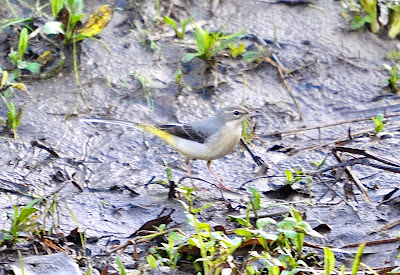
No time for birding for work today, perhaps not too bad given it was -7c when I left the house! A lunchtime walk at Woods Mill in glorious sunshine did wonders for the soul, with four species added to my site list here including two Little Egrets which flew west, presumably looking for unfrozen water. Despite the cold, many species were singing and visibly pairing up including Coal Tit, Blue Tit, Collared Dove and Dunnock, and a Great Spotted Woodpecker was heard drumming. A lovely first winter Grey Wagtail was feeding around one of the frozen pools. 
Grey Wagtail

17th January

After dropping B at nursery first thing I headed up the Downs for a quick walk at The Burgh. Both Red-legged and Grey Partridge were added to the year list almost immediately, followed closely by a Hen Harrier ringtail which was quartering around the fields near Canada Barn. A little walk eastwards from the barn produced the usual array of small birds, including 100+ Linnet, 50+ Redwing and Fieldfare, ~200 Starling, and the odd Yellowhammer. Returning to my car I tried again to scope the Bewick's Swans down in the valley and sure enough found eight adults. There were also at least nine Cattle Egrets in the fields up towards Offham. All in all a very successful 45 minutes or so which produced five local year ticks and three eBird hotspot ticks.
Spot the Bewick's Swans!
Hen Harrier
A lunchtime check of the flooded field/scrape at Hadworth Farm/Bignor Park produced 26 species including at least six Snipe feeding in the grass by the water's edge - a new species for me here - plus 8 Wigeon, 4 Gadwall, 6 Coots and a Little Grebe on the flood. The local Ravens were again very active and vocal, flying in and out of Bignor Park. 

18th January

Another bitterly cold but beautiful morning with the deep frost lit up by golden sunshine. I decided on a bit of woodland birding after dropping B off at nursery this morning so headed over to Fittleworth for a brisk (very brisk!) walk there. It was largely uneventful but pleasant with highlights being a few Redpoll (uncooperatively not landing to allow me to check them for Mealy), Siskin, drumming Great Spotted Woodpecker and a tumbling pair of Ravens. Just as I was about to leave though, I caught sight of a male Goshawk drifting overhead, quite high, and only in view for a few seconds. This is a site I have seen the species at before, so it's reassuring to know they're still around. It really is amazing how fast the species seems to spreading in this area now, based on how often I bump into one without really looking for them.

A lunchtime check of Hadworth Farm/Bignor Park revealed the flooded field/scrape to be holding the largest number I've birds I've seen on it to date, including 37 Teal, eight Wigeon, four Gadwall and presumably the same Little Grebe as yesterday. 25 Canada Geese were gathered on the shore along with a single Greylag Goose.
The scrape at Hadworth Farm, West Burton
19th January

I was up near Haslemere for work this morning, so decided to drop in at Benbow Pond near Midhurst on the way home, to have a quick look for the Waxwings found by Penny Green at the weekend. I am starting to get just a little anxious I might miss out on seeing this species in what is proving to be a bumper winter for them - especially since my own attempts at finding some locally have so far proved unsuccessful. Today it wasn't to be either, although the area where they had been - a grove of massive old Lime trees absolutely draped in Mistletoe - was a pretty special spot and busy with Redwings, Mistle Thrushes and various small birds. The Black Swans down at the pond showed nicely anyway, as did a Buzzard low overhead.
Black Swan
Buzzard
A brief check of the private site near Petworth afterwards revealed the Long-tailed Duck to not be present, though there was an impressive 78 Shoveler and 32 Tufted Duck (plus a single Pochard), clearly evidence of birds displaced from frozen ponds and lakes elsewhere. Finally, a very quick look at the Hadworth Farm scrape revealed at least one Green Sandpiper and three Snipe still present, although duck numbers had reduced since yesterday, presumably owing to even greater ice cover. 

20th January

A whistle stop tour of local sites this morning, starting with a scan from the river bank near Greatham Bridge, which proved pretty quiet aside from seven Shoveler flying north. Next up, Hail's View to scan the South Brooks in the hope of locating the Water Pipit found by Alan Baker yesterday. Sadly no joy, but it was nice to catch up with Michael and Daniel Booker here. 20 Dunlin were out on the ice, a pretty remarkable count here for this time of year, and these and 30 or so Lapwing were flushed up by an adult White-tailed Eagle which flew through and landed in one of its favourite trees by the river. Very few ducks, which was unsurprising given the lack of unfrozen water. 

Talking of ducks, my last stop of the morning was the Hadworth Farm scrape, which I have been checking most days lately owing to it having a bit of a purple patch due to some remaining unfrozen water. Today produced undoubtedly the most birds I've seen there yet, including 72 Teal, 70 Canada Geese (and a single Greylag), nine Wigeon, a female Pintail and two Green Sandpipers again, one of which flew up and over my head a couple of times.
Green Sandpiper
Assorted wildfowl on the ice at Hadworth Farm
Later in the day, just as I had finished chopping some firewood in the garden I glanced up to see a Woodcock flying east, low overhead. A garden first and first for the 1k area list this year. 

Sunday, 10 December 2023

Magic again?

The photos in this blog post say a lot about the time of year. Yes, as Christmas approaches, it's all getting very grey and very gloomy, and on sometimes it feels as though it's barely got light at all before the evening returns. 

Still, it's not all doom and gloom. We are now fully into meterological winter, and all that that entails, ornithologically-speaking. Wildfowl and thrushes have dominated this ten-day period, with increasing numbers of the former at local wetland sites and a late push of the latter, presumably due to colder weather further north. Surely there will be Waxwings turning up locally any day...

1st December

The first day of meteorological winter and it certainly felt like it, as daylight fell on a frosty landscape and the heavy grey sky again threatened snow (which never came). The main lake at Waltham Brooks held a ~75% covering of thin ice, meaning the 200 or so ducks present were huddled on the unfrozen northern side. Even a Marsh Harrier wasn't enough to spook them from their freezing stasis. There wasn't much else of note going on here really, despite the promise of some cold weather movement. Maybe tomorrow...

Teal and Mallard on the frozen lake at Waltham Brooks
On my way home from Woods Mill I briefly stuck my head in at Pulborough, specifically Wiggonholt Common and the Triangle, in the hope of finding some finches, specifically Redpolls. It might have escaped your notice but there is currently a pretty impressive influx of Mealy Redpoll going on, a species I haven't seen for several years. Today I only managed to find a group of four Lesser Redpoll, although one rather streakier, colder-toned bird did have me going for a short while. 

2nd December

Not loads of birding today, partly owing to other commitments but also not helped by the thick fog which only got worse as the day went on, aside from a brief bit of brightness around lunchtime. A short local walk with B in the morning produced a Raven and a couple of small Redwing flocks.

En route to my mum's late morning we briefly stopped off at one of my old haunts, Cutt Mill Ponds near Farnham, where I found ten Goosanders (one drake) right in the middle of The Tarn. Sadly I only had my little bridge camera with me, so not brilliant photos!
Goosanders
3rd December

A good stomp around Pulborough this morning with Paul Davy and Steve Baines produced 64 species, with highlights including the lingering White-fronted Goose trio (more often found at Amberley recently) showing reasonably well from West Mead, one of the adult White-tailed Eagles in a tree by the river (briefly showing off its gleaming white tail in flight before returning to its perch), a female Merlin on the deck on the South Brooks, 10 Dunlin, ~50 Black-tailed Godwits, and singles of Great White Egret, Peregrine and Marsh Harrier. It was great to run into Pulborough veteran Jon Winder too, who I've not seen for several months. 
White-fronted Geese
A brief half hour stop off at the private reservoir near Petworth early afternoon revealed the female Long-tailed Duck still present for at least its 35th day, along with a female Pintail (only my fifth record of this species here), ten Shoveler, 27 Tufted Duck and just a single female Pochard. Quite a change from 57 of the latter species here just a few weeks back. 

4th December

Not much birding today owing to time constraints and poor weather. It was also another one of those winter days where it felt like it never got properly light before the evening started to rear its head again by around 3pm. 

An early afternoon stroll over to Waltham Brooks from home proved fairly quiet (and murky) with highlights of half a dozen Tufted Duck and 35 Gadwall on the main lake, and a flock of a dozen Siskin flying about. A single male Stonechat was in the scrub near the railway line. 
Tufted Duck
5th December

For fear of repeating myself... it was another gloomy, damp start to the day, so I headed out for a quick sweep of some local water bodies before work. The farm scrape at West Burton - now very flooded - held half a dozen Coots and a pair of Gadwall, while a quick look at Burton Mill Pond revealed the usual Great Crested Grebe pair, two Little Grebes, 40 Cormorants leaving roost, and a Cetti's Warbler calling in the reed. Finally, at the private reservoir near Petworth, the female Long-tailed Duck was still present for at least her 37th day.

Later in the day a Snipe flew south-west over the garden, while a lunchtime walk out to the nearby farmland produced a little flock of Wigeon (~20) and two Mute Swans in flight over Waltham Brooks and flock of around 30 Siskins which flew over towards Lodge Hill. 

6th December

Not loads of birding today but I did manage to squeeze in half an hour at Waltham Brooks before work, and I was glad I did as the forecast fog didn't materialise and it was actually a beautifully crisp and sunny winter's morning. Within minutes of entering the reserve I picked up a high flying falcon powering north-west overhead - a lovely adult male Merlin. Only my third record of the species here. This was followed a little while later by a heard-only Brambling flying over. On and around the lake it was business as usual with at least three Tufted Ducks still bobbing up and down among the dabblers, and at least two each of Water Rail and Cetti's Warbler calling in the marginal vegetation.
Merlin
Song Thrush
7th December

En route to dropping B off at nursery this morning I noticed a lone Cattle Egret in a cow field that I check pretty much every day in passing from the car. Nice when that happens!

A lunchtime walk round Woods Mill before the worst of the rain set in produced singles of Firecrest and Chiffchaff, a good number of Redwings, a few Fieldfares, and a reserve tick Lesser Black-backed Gull flying west. 

8th December

Another beautiful crisp morning which, although a little frosty first thing, soon turned into a pleasantly mild and mostly sunny day. A quick wander over to Waltham Brooks from home before work proved relatively quiet, with half a dozen Tufted Ducks still on the main lake and a flock of 22 Fieldfares plus a few Redwings about. 
Sunrise over Watersfield/Waltham Brooks
Later in the day while tidying up by the shed at home, I inadvertently disturbed a Herald moth from its hibernation spot in a stack of cardboard. After taking a couple of photos I popped it back in a safe spot.
Herald
9th December

Not lots of birding today but I did manage a brief check of a couple of local water bodies late morning. The scrape at Hadworth Farm - now very full! - held a pair of Teal (new for me at this site) plus a Grey Heron and a few Mallards. Rather appallingly, on the distant shore was a group of 38 Pheasants.

Continuing the landfowl theme, the private reservoir and farmland near Petworth held a covey of nine Red-legged Partridges, but sadly the long-staying Long-tailed Duck appeared to have finally departed after around 40 days here. 
Red-legged Partridges
10th December

A break in the rain (forecast again for late morning) allowed for a good stomp around Pulborough Brooks for a couple of hours this morning, which produced 63 species. Wildfowl were well represented, especially Pintail, of which there were at least 190 around, mostly on the North Brooks. Also on the North Brooks were ~290 roosting Black-tailed Godwits, while highlights on the South Brooks were a Kingfisher and a male Marsh Harrier. The most notable bird of the morning though was Redwing, with a surprising late push of birds seemingly vismigging overhead, mostly going west/north-west. At least 520 flew over in the two hours I was on-site, including a single flock of ~150 high north-west.
Redwing
Pintail
A late afternoon visit to Burton Mill Pond with Mrs Matt and B again reminded me how great this site can be, with pretty much the first bird we saw being a/the red-ringed Great White Egret in flight towards the north-east corner - presumably 'ACA' from Somerset again, although I never got a chance to read the ring code. The usual Cormorants, Starlings and Pied Wagtails were gathering to roost, while a few Little Egrets drifted south to roost. At about 15:50 an explosion of Woodpigeons from the trees all around had me looking up, just in time to see a beast of a Goshawk powering west over the mill house before disappearing over the trees towards Burton Park Farm. My second record of the species here (previously on 31st January this year) and in exactly the same circumstances as the last one; a bird heading purposefully west at dusk. Unfortunately, I was a bit slow with the camera which, combined with the poor light, meant I only managed a very ropey record shot. 
Goshawk

Thursday, 26 October 2023

Mid-October

My shoulder injury recovery continues so it was pretty much exclusively 1km from home birding on foot again for this ten day period. It certainly feels as though we have turned a corner, seasonally speaking, as we move into the second half of October. There were still a few summery stragglers making an appearance but I also finally recorded my first Brambling of the autumn (of the entire year in fact, so dire a finch winter as we had last year!). The unusually warm weather has also all but gone now, as I write this, and we have had the first couple of frosts of the year plus the expected October wind and rain. Indeed, parts of the 1km area are getting decidedly soggy now, though not entirely impassable yet.

11th October

A grey and drizzly start to the day saw me checking the moth trap which held a respectable 39 individuals of 21 species, including new for the garden Red-line Quaker, Black Rustic (x 4), Large Wainscot, Barred Sallow, the spectacular Merveille du Jour (x 2) and the migrant Rusty-dot Pearl. Talking of migrants, it seemed relatively quiet on the vismig front overhead while I was emptying the trap, but I did note a couple of Redwings over and eight Swallows powering south.

Merveille du Jour
Rusty-dot Pearl
Black Rustic
Once the trap was emptied I headed out for a loop of Thorndale Bridge, the local farmland and Waltham Brooks. Aside from another group of Swallows heading south-east and a couple of Skylarks south, the low cloud and mizzle seemed to be hampering any migratory activity, so I didn't linger too long at Thorndale Bridge. Highlights here were four Snipe flying about (presumably the same group seen yesterday), a Stonechat, and a female Marsh Harrier which flew upriver. Up at Waltham Brooks the best were two Pintail, three Little Grebes and a single Tufted Duck among the usual wildfowl on the lake plus heard-only Kingfisher, a couple of Swallows and Redwings over. It was also noticeable that Chiffchaff numbers are on the up, with a conservative count of 15 recorded, especially congregating in the sallows on the western side. There was again a curiously calling individual here giving the plaintive 'hew' call, as heard at Thorndale Bridge recently. 

12th October

A similar morning to yesterday. A check of Waltham Brooks again produced two Pintail on the lake along with 10 Shoveler, 13 Gadwall and 15 Teal. Presumably the same quartet of Snipe were again flying about overhead, around 50 Lapwings were up in the air over Widney Brooks and two Green Sandpipers flew over my head near the railway line and dropped down towards the main lake. 

It had been decidedly quiet overhead early morning but on the way home I noticed a bit of a movement of hirundines, so decided to stop off for a skywatch, which proved to be fairly lively. Aside from over 100 House Martins and 20-odd Swallows moving south, the clear highlights were a heard only Golden Plover and a beautiful adult male Merlin which flew fast and quite low over the field where I was watching from, before turning, gaining height and powering off south towards the Downs. Actually my first record for this particular eBird hotspot, although my third record of the autumn locally. 

13th October

A proper October day of wind and rain. Late morning a break in the rain saw me heading out to the local farmland for a bit of a skywatch, perhaps rather over-optimistic given the brisk south-westerly (F5, gusting 6-7). Surprisingly, it was actually a decent 90 minutes, with highlights including three Woodlarks east together (it really is turning into a good autumn for them locally) and a light trickle of hirundines pushing straight into the wind. Particularly impressive was a group of ~20 Swallows which after making one failed attempt to get through fairly high up then dropped down to just a few metres above the ground and powered on into the headwind. 

14th October

The cold morning after the squally night before. Today felt like the first proper crisp morning of the autumn, and I headed out on foot just before 7am wondering if I had under-dressed given the brisk westerly. An hour's skywatching from the local farmland proved fairly lively with a steady stream of Siskins and a few Redpolls, Meadow Pipits, Chaffinches, etc, mostly heading south-west. One species I certainly didn't have on my radar for the third weekend of October was Common Redstart so it took me a moment or two to process what I was looking at when I noticed a passerine flicking about in a nearby hedgerow. Indeed, the way it was lit in the morning sunlight initially brought to mind Red-flanked Bluetail, and it was a heartstopping couple of seconds before I realised I was looking at something rather more mundane, albeit very late. My first record of the species locally since 7th September and undoubtedly my last one of the year. Strangely enough, Ed Stubbs also had one this morning up in Surrey, so perhaps a little late push of Scandinavian ones moving through?

Redstart
The rest of the day didn't include much birding, although a trip down to Worthing with Kate and B (primarily to deliver a Knepp talk) did also include stopping at Marine Gardens for lunch, which featured flyover Siskins (5) and Redpolls (3). 

15th October

WeBS count day today so Kate kindly drove me over to the private reservoir near Petworth to carry out the survey; my first visit here for four weeks (I normally tend to visit at least once a week). It was usual fare on offer really, though 55 Tufted Ducks represented my highest count here, while 20 Pochards was one short of equaling the record count. Otherwise, highlights were 54 Egyptian Geese on the shore of the reservoir and at least 15 Swallows and a couple of House Martins feeding over the nearby farmland.

Later in the day I went for a stroll from home, highlights of which included at least five Lesser Redpolls at Thorndale Bridge plus the three White-tailed Eagles thermalling together distantly towards the Downs. Despite the chilly air temperature the warm sun was clearly coaxing plenty of raptors into the sky, as I also had a Goshawk sparring with a Buzzard to the south of Watersfield. Single Stonechats were at Thorndale Bridge and Waltham Brooks while a few Swallows, Siskins and a couple of Skylarks were noted flying over, heading south/south-west.

16th October

A lively morning of local vismig, first from the farmland near home and then up on the high ground to the west, began with two vocal Merlins briefly dogfighting overhead a couple of hundred metres from home before separating and flying off west and south-east. Another Woodlark flew high-northeast, while there was just the slightest hint of some early Woodpigeon movement. Finches were clearly moving in good numbers but seemed to be for the most part too high, hence the change in watchpoint an hour or so into my watch. From here, almost immediately I was seeing and hearing Chaffinches, while after 15 minutes the distinctive call of Crossbills signalled the approach of a flock flying from north to south which I somehow never managed to get eyes on, but it sounded like quite a few. Just a few minutes later another flock of 14 flew south. Finch totals from the morning included 87 Chaffinches (mostly west), 50 Siskins (mostly west) plus a few Redpolls, Linnets, Goldfinches, etc. Curiously notable by their absence again were thrushes with just five Redwings leaving roost along River Lane the only ones noted. 
Looking south-east from the high ground above Watersfield

17th October

With this welcome spell of easterlies continuing, this morning saw me back up at the high ground to the west of Watersfield for another vismig session. Initially the wind was calm and it was a surprisingly brighter morning than had been forecast, which didn't necessarily suggest much in the way of movement. I was wrong though as, twenty minutes into the watch, I noticed a line of geese approaching high from the north/north-east which I quickly realised had to be Brent Geese, owing to their dark colouration, short necks and generally compact shape, plus the distinctive wavy line flock formation. They weren't calling or, if they were, I couldn't hear it over the strengthening breeze, and because they were really pretty high I also spectacularly failed to achieve anything in the way of a useable record shot with my one-handed bridge camera attempts. Still, one of those memorable vismig moments that put it all into context, as these Arctic travellers near the end of the journey, likely bound for the south coast via Watersfield! Other highlights this morning included the first clearly moving Grey Herons I've seen locally this autumn (two lots of three west), a few Redwings and Fieldfares west (60 and 54), three Swallows south, four Crossbills west and a steady trickle of Skylarks. 

A check of Thorndale Bridge late afternoon produced three Marsh Harriers over Amberley, including a beautiful adult male hunting low over the marsh just the other side of the river from where I was stood, plus a White-tailed Eagle briefly in flight and a female Mandarin flying downriver. 

18th October

A remarkable 58 species in just over an hour at Waltham Brooks this morning including my first Brambling anywhere this year (!) heard flying over, a first winter Goosander on the lake and two Great White Egrets which came in from the west and dropped down near the main lake. There has been clearly been quite an arrival of this species in Sussex as there were also records of seven at Arundel WWT this morning and five at Pulborough Brooks later in the day (perhaps all relating to the same birds) following on from a count of 11 flying past Climping yesterday. 

A rather late flock of House Martins flew over towards Amberley with a Swallow in tow and, on a more wintry note, the easterlies had clearly delivered more ducks to the reserve, especially Wigeon, of which at least 25 flew to the main lake. A flock of 11 Fieldfares were flying about in the scrub while around 30 Siskins were near the sewage works. A few gulls were flying over too, including two Common Gulls.
Goosander (another ropey record shot with my little bridge camera)

19th October

I was giving a Knepp talk in Staines last night, after which I stayed with friends in Surrey before making my way home mid-morning. The walk home from Pulborough station took me past Widney Brooks and through Waltham Brooks and the local farmland. It was all distinctly less lively than yesterday, with barely 30 species recorded at Waltham Brooks this time around. Teal numbers had increased to at least 130 but otherwise waterbird diversity was rather poor with just 80 Mallard, 3 Gadwall, a few Coots and a single Little Grebe. Away from the lake, there were two Stonechats in the scrub and a Mandarin flew downriver. 

20th October

A loop of Thorndale Bridge and Waltham Brooks this morning produced a few bits, especially at the former looking over towards Amberley where there were clearly lots of Black-headed Gulls on the flood water, evidently having just been flushed by a White-tailed Eagle. A Kingfisher flew upriver and several Skylarks flew west. Waltham Brooks was relatively quiet aside from the two Great White Egrets again which circled over the main lake briefly before flying off towards Widney Brooks. Again, several Skylarks flew over and a flock of 17 Redpolls flew over the sewage works. There has been a real absence of winter thrushes the past couple of days, aside from five today over the local farmland.
River Arun near Thorndale Bridge, water level getting high now!
An evening stroll out to Thorndale Bridge revealed another Great White Egret feeding in a ditch just across the river and a smaller egret species in flight over Amberley Wildbrooks which was probably a Cattle Egret. Two fast flying raptors caught my eye and quickly revealed themselves to be an adult male Merlin being chased by a female. They dashed off low through the trees past Quell Farm at high speed and off towards Parham. 

Tuesday, 18 January 2022

All change

 As I said in my 2021 Pulborough review, last year was a record breaking and memorable year in so many ways. I'd decided by the autumn though, once I reached my 150 target, that 2022 would be a year for change. Not least, in part, due to becoming a father in October, my priorities changed somewhat. It seemed rather a fruitless exercise to go through the same routine as last year and try to beat my own record Pulborough year list.

Instead, I decided this year would be about exploring, adventures and enjoying birding for its own sake. Indeed, I have made it my goal, within reason to visit as many new places as possible, and try to go somewhere different every day. Discovering new places and species right on my doorstep. Coincidentally, Birdwatch/BirdGuides then announced their #LocalBigYear challenge, which fitted perfectly with what I'd already been planning for the new year.

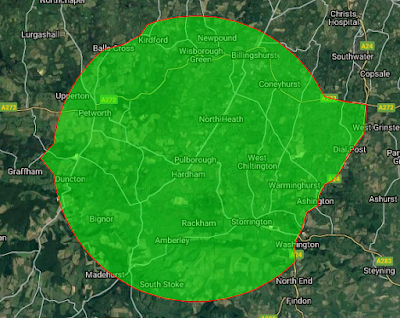
So, I set about studying maps and decided a rough 10km radius around Pulborough would offer plenty of interesting and diverse habitat to get stuck into. Some of it, like Pulborough Brooks, Waltham Brooks and Amberley Wildbrooks, I know very well or reasonably well, other areas I have been to far less, if at all. I also tweaked the radius slightly to include the Knepp Estate where I'll be spending a lot of time this year, as I start leading safaris there in the spring.

The new 'uber patch'

There are some good stretches of woodland, particularly to the northwest and southwest of Pulborough, and also various intriguing flooded patches along the various rivers that crisscross the recording area. The South Downs offer plenty of opportunities for sky-watching as well as some enticing patches of farmland. 

As of the time of writing I've already notched up 100 species within the recording area. Highlights have included a Little Gull on the flood behind the house on the 4th, a Hen Harrier at Waltham Brooks on the 1st, Cattle Egret and 3 Great White Egrets at Burton Mill & Chingford Ponds on the 10th, the eleven Bewick's Swans at Amberley also on the 10th, Merlin and Corn Buntings galore up Chantry Hill on the 15th and my first ever local Dartford Warblers at Lavington Common on the 17th.

After just under three weeks I already feel as though I have a greater understanding of the mosaic of habitats within this corner of West Sussex, and I'm excited to see what else I discover in the months to come.

Grey Wagtail

Goosanders

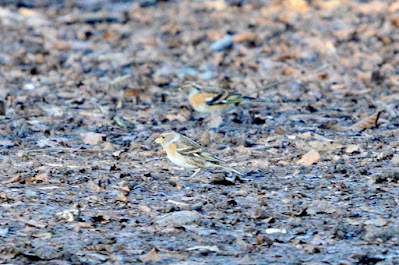
Bramblings

Corn Buntings

Little Gull


Monday, 11 January 2021

New year, new list

 As I said in my recent end of year round-up, I'm absolutely determined that 2021 will be the year I reach 150 on my Pulborough year list.

It's been a good start so far with 91 already on the scoreboard from five patch visits which, based on previous years attempts, sets me roughly on course to hit 100 by March.

Highlights so far have included a flock of 39 White-fronted Geese on the 10th, 7 Goosanders and 2 Tufted Ducks (also on the 10th), the celebrity Marsh Tit at Fattengates, the long-staying Cetti's Warbler on the east side of the North Brooks, the wintering flock of Woodlarks in Uppertons Field, a couple of Chiffchaffs near the sewage works and a bonus early Blackcap in our neighbour's garden on the 3rd. A gripping miss was a Lesser Spotted Woodpecker seen by Mike Unwin on the 2nd, as this is a species I've still yet to catch up with on the patch, despite the RSPB having recording drumming birds in spring on audio recorders dotted about the place. I'm going to be helping the RSPB with this project this year though so hopefully will finally catch up with one.

Some photo highlights of 2021 so far...

Marsh Tit

Firecrest

Blackcap

Raven

White-fronted Geese leaving the North Brooks

Tufted Ducks on the Arun

Stonechat

White-fronted Geese heading off

Goosanders on the Arun, five of the seven.