Showing posts with label reed warbler. Show all posts

Wednesday, 10 July 2024

The year is turning

1st July

A day off today so I managed to squeeze in few hours birding in the morning. First up, Pulborough Brooks which produced 55 species in a couple of hours. Highlights included 15 Cattle Egrets dropping in among the cows on the North Brooks; interestingly, exactly two years to the day since I stumbled across over 20 at Waltham Brooks. As was the case that day, it was good to see at least a couple of juveniles among the assembled birds at Pulborough today. Unsurprisingly, given the date, the other species of note were waders, with 22 Black-tailed Godwits and two Green Sandpipers busy feeding in the mud on the North Brooks, while the Greenshank found by Paul Evans yesterday was still present at West Mead when I arrived, although evidently had flown by the time I left.

Stonechats
Cattle Egrets
Black-tailed Godwits
Next up, I headed over to the private reservoir near Petworth, hoping the wader gods had delivered something here too. Sadly not, and there really wasn't much to write home about here at all really, aside from an obvious increase in Tufted Duck and Coot numbers (14 and 21, respectively). Ten Herring Gulls were gathered on the water, not all that common a sight here. 

Late afternoon I very briefly dropped in at Amberley Mount where a dozen or so Swallows were whizzing about over Downs Farm and a couple of Swifts flew south-west. 

2nd July

After a non-birding morning in sunny Brighton, I returned to the Pulborough just as light rain began to fall. I decided a check of a couple of water bodies was in order. First up, Petworth which again failed to produce any waders, but a few Swifts were feeding overhead and it was nice to confirm local breeding of Kestrel with at least three noisy youngsters about. 

Burton Mill Pond had a similar rather uninspiring feel to it. The Great Crested Grebe pair were busy feeding their three young, while there were also a couple of newly fledged Reed Warblers in the reeds by the roadside. A light south-westerly movement of Sand Martins gave just the slightest hint of the exodus of migrant species to come in the next few weeks and months.

Reed Warbler
Pied Wagtail
Later in the day I stopped off for a fairly brief stroll at Waltham Brooks which proved surprisingly lively given the time of day/year. 41 species was the total including one of the White-tailed Eagles drifting about just the other side of the river, seemingly flushing a Great White Egret in the process which flew through north low over the main lake. The farmer was cutting the hay up at Widney Brooks which seemed to be attracting the attention of a fair few raptors including at least three each of Buzzard and Red Kite and a single Hobby. Well over a hundred Swifts and 15 or so Sand Martins were also feeding overhead, while a Garden Warbler calling in scrub near the main lake was the first I've heard here in a little while. 
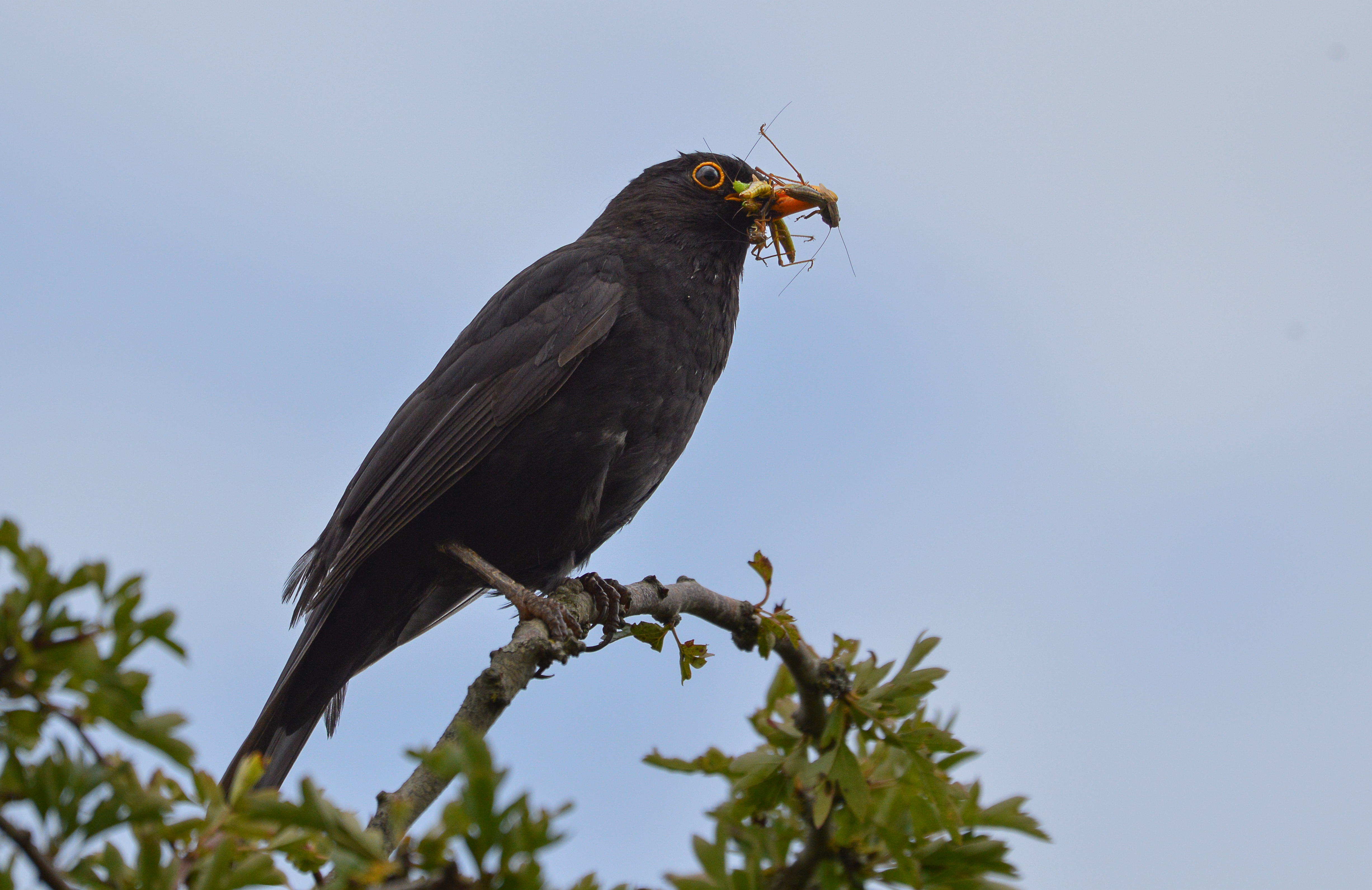
Blackbird (and some unfortunate crickets!)
Great White Egret
White-tailed Eagle
3rd July

Not much birding today aside from a quick stop in Petworth which failed to produce much of interest aside from a few Swifts (20+) and a calling Willow Warbler near the reservoir. 

4th July

I managed to squeeze in a bit of birding today despite all the election business and lots of work meetings. Waltham Brooks was relatively quiet, though it was good to see plenty of young birds about including recently fledged Whitethroat, Sedge Warbler and Greenfinch. Also a few Swifts around, though hard to detect any clear direction of travel. At least two very vocal Water Rails were along the river, with one briefly seen in flight. 
Sedge Warbler
A lunch break stroll round the local farm fields proved similarly quiet, not helped by the strengthening breeze which also put paid to my attempts to lure any clearwing moths. The newly cut sileage field south of River Lane was attracting a fair number of Swallows, feeding low over the sward. 

Perhaps the best birding action of the day though came from the garden in the evening when first a Hobby flew low overhead, worrying the local Swallows, followed a little later by two adult Great Black-backed Gulls powerfully skulling north towards Lodge Hill. A garden tick and first record in the 1k area in 2024. 

5th July

A pretty foul start to the day with intermittent rain, heavy at times, blown in on a brisk southwesterly. I decided a loop of Pulborough Brooks was in order before work. The lingering Greenshank that has been on the pool at West Mead most of the week was still present, feeding in the shallow puddle left there (soon to be topped up) along with four Little Egrets. The North Brooks, meanwhile, again held the bulk of the wader interest in the form of eight Little Ringed Plovers (including two juveniles), six Green Sandpipers and a single Common Sandpiper. 

A lunchtime walk at Waltham Brooks yielded a rather lowly 32 species, with the highlight being a Peregrine drifting north high overhead. 

6th July

An early start this morning to check out a couple of local water bodies. Petworth proved fairly quiet on the waterbird side of things but again produced a male Honey Buzzard giving a nice flypast, in view for several minutes as it drifted west. 

Next up, I dropped in at Burton Mill Pond for my first proper session here in a while (I've concluded it really does take a good hour and a half or more to check the area properly). Burton Pond itself was typically rather quiet aside from the resident Great Crested Grebe pair continuing to feed their three young. A check of Black Pond and Burton Park Farm revealed a Little Owl perched on the fence near the farm buildings. This is a traditional site for the species but this was my first record here this year. 

As is often the case, most of the action was at Chingford Pond where highlights included a female Tufted Duck with three ducklings, and some 250 or so Swifts and Sand Martins (roughly 50/50 between the two species) feeding overhead which, perhaps unsurprisingly, attracted the attentions of a passing Hobby which briefly stopped to have a go at a few of them. 
Juvenile Great Spotted Woodpecker
Grey Wagtail
Tufted Ducks
Hobby
Later in the day I took a trip down to Arundel with B. A boat trip on Swanbourne Lake brought us into close proximity with a female Gadwall with six ducklings in tow - my first confirmed breeding record of this species locally this year. Mill Road Watermeadows, meanwhile, held at least five Cattle Egrets around the cattle.
Gadwall family
Back home in the afternoon, the call of a Buzzard drew my attention skywards where I saw one of the White-tailed Eagles drifting over, mobbed by a couple of the aforementioned Buzzards as it drifted off south-east. 

7th July

This morning started with a check of the moth trap which produced a few goodies, including several species new for the garden. The highlights were five Elephant Hawk-moths and the localised micro moth Synaphe punctalis. After we'd finished this, B and I headed out for a little local walk which produced a Peregrine drifting overhead. 
Synaphe punctalis
Elephant Hawkmoths
All of us headed down to Littlehampton late morning for a stroll at West Beach. An interesting mix of species were recorded here including a Curlew and four Mediterranean Gulls flying west, and a Sand Martin flying purposefully out to sea. 

In the evening I met up with Roger and Caroline Morgan-Grenville for a walk at Lavington Common, hoping for Nightjars of course. As the light faded and the last of the Dartford Warbler and Stonechat calls faded away around us, so the Nightjars began tuning up. Soon, there was churring and 'kwicking' coming from seemingly every direction and the next half an hour or so produced perhaps some of my most memorable Nightjar moments to date. Best of all was undoubtedly when a pair decided to perform several close fly-bys right around us as we stopped, gawping, in the middle of the footpath junction at the centre of the common. 
Nightjar
8th July

A check of the North Brooks at Pulborough before work this morning produced a fairly typical selection of waders for the time of year: ten Black-tailed Godwits, five Little Ringed Plover, singles of Common Sandpiper and Green Sandpiper, and a heard-only Greenshank.

The rest of the day was mostly grey with on-off light rain. I did manage a brief stroll out from home after work for a check of the local fields and a brief skywatch, the highlight of which was a single group of 28 Sand Martins south and a Sparrowhawk carrying prey. 

9th July

Today proved to be unexpectedly action packed. The shift to an east/south-easterly airflow on Monday evening and shifting to more southerly in the small hours of today, combined with some rain near dawn, certainly looked to have the potential to deliver some goodies, despite the early date. Early on in the morning I was getting excited messages from Ed up in Surrey, telling me he was having a great morning, so I was keen to get in the field. 

After dropping B at nursery I dashed over to Petworth, where I was greeted by the sight of an eclipse drake Garganey, associating with an eclipse drake Teal. This was my first record of Garganey here, and an unusual plumage I don't see all that often, so a good learning opportunity, especially when it flew around showing off its very obvious pale wing panels. While I was here, news broke of a Wood Sandpiper at Pulborough - an overdue local year tick for me. It seemed that it had only been seen in flight, however, so I waited for news to break of it being relocated on the deck, which it was a little later, before I headed over there in my lunch break. The weather was decidedly filthy now and I was lucky to find the bird (after a bit of a wait) still on the North Brooks before the heavens really opened and I dashed back to my car. It was good to catch up with Pulborough regular Gary Trew here too. 
Garganey
Wood Sandpiper
10th July

In contrast to yesterday's excitement, today just didn't feel anywhere near as rare, despite the still rather inclement conditions. Another check at Petworth didn't produce anything of note on the waterbird front, though a flock of 50-60 House Sparrows flying between a hedgerow and a wheat field was a welcome sight. A little later in the morning I checked out Waltham Brooks which was also pretty quiet, aside from a Garden Warbler briefly showing quite well in the scrub near the lake, and a light but pronounced southerly trickle of Sand Martins and Swifts overhead. 
House Sparrow
Garden Warbler

Saturday, 24 June 2023

Dust and lowering skies

Given that this is supposed to be the relatively quiet period in the birding year, the past fortnight or so has actually been one of the most enjoyable periods of 2023 so far for me, from a local birding perspective. The clear highlight, of course, was finding a Marsh Warbler just a few hundred metres from home, which was still present at the time of writing (update: it has since departed, it seems).

Otherwise it's been a fairly steady stream of waders, Cuckoos and various less common breeding species, plus some of the first high summer butterflies and odonata of the year.

Weather-wise, it's been a relief to get some much-needed rain in the past week or so, including some particularly impressive thunderstorms. I have been once again reminded how spectacular lightning is when it flashes around the South Downs, as storm fronts slowly approach Sussex from the English Channel.

12th June

A fairly brief whizz round Pulborough Brooks this morning produced a pleasing selection of species including 3 Little Ringed Plover, Cuckoo, Dunlin, 10 Avocet, my first Redshank chick of the year, a single White Stork on the North Brooks and at least three Nightingales still singing. 

13th June

I was out of the house before 05:30 this morning (not something that has happened often lately) with my plan being to head up the Arun to Waltham Brooks then back via the sewage works. In the end I never even made it as far as the river as around 500m from home my attention was drawn to an odd Acro song coming from an area of mixed rank vegetation right next to the railway line at Thorndale Bridge. I've often heard Cetti's Warbler in this spot but not Reed Warbler as far as I can remember, so it instantly stood out as rather out of context. This, combined with the fact I was hearing elements of mimicry (including Goldfinch, Swallow, Blackbird, Blue Tit and even Bee-eater) immediately rang alarm bells and my thoughts quickly turned to Marsh Warbler. I positioned myself near the railway bridge and, over the course of the next hour, hoped that the bird would show itself well enough to get some record shorts and audio recordings, which it dutifully did, and I left site at 07:00 very happy I had self-found my first Sussex Marsh Warbler and, indeed my first anywhere in the UK for around ten years!

Marsh Warbler


14th June

A decent session at Burton Mill Pond this morning produced 43 species in 100 minutes. Highlights included a female Mandarin with young on the outflow near the mill house, the Great Crested Grebe pair feeding three young on the main pond and a Little Owl hunting along the fenceline at Burton Park Farm. Two Siskins over Newpiece Moor were also noteworthy, given what a poor first half of the year it's been for the species. Apparently, they were once known as 'barley birds' owing to their tendency to reappear around the onset of high summer (i.e. the time that barley is ripening for harvest), presumably due to dispersing young birds and post-breeding adults.

15th June

Not much birding today aside from an hour or so at Thorndale Bridge in the evening, where I bumped into Michael and Dan Booker, hoping to connect with the Marsh Warbler. Sadly, we didn't have any luck this time, despite a Reed Warbler doing its best to convince us otherwise, by throwing in occasional bursts of Goldfinch mimicry into its song - strange, considering I hadn't heard Reed Warbler here before, but a quick Google search on my phone brought up a BB paper which suggested Reed Warblers which spend any length of time in the vicinity of Marsh Warblers have been known to incorporate mimicry into their songs. A Barn Owl kept us entertained, hunting around Wharf Field, while there were again plenty of Swallows flying about overhead and a Nightingale called briefly by the railway line as I was heading for home. 

16th June

An early two hour session at Pulborough this morning proved to be quite lively. Highlights included all three egrets (9 Little Egret and one each of Great Egret and Cattle Egret), two each of Ringed Plover and Little Ringed Plover together on the North Brooks (which was a bit confusing at first as it's very unusual to see these two species together here at this time of year), singles of Dunlin, Black-tailed Godwit and White-tailed Eagle and three White Storks (GB0S, GB6S and GB3U from Knepp). There was still plenty of birdsong around including Yellowhammer and Stonechat near Winpenny and a few bursts of Nightingale around the main trail. There were plenty of young birds about too, especially Whitethroat, with at least three family groups seen. 
White Storks
In the afternoon, I headed down to Worthing with B for a walk around Brooklands Park where the highlights were a newly fledged Reed Warbler, a few Swifts and House Martins, two Cetti's Warblers and two Great Black-backed Gulls. On the way home we dropped in at Knepp to watch a bit of the White Stork ringing.
Reed Warbler

White Stork ringing
17th June

Not much birding today other than a short local walk in the morning which was uneventful. While I was at Knepp in the afternoon and evening, news emerged that the Marsh Warbler had been rediscovered along the riverbank at Waltham Brooks so I swung by on my way home in the hope it might still be singing well after sunset. Sadly no luck, just the odd burst of song from Sedge and Reed Warblers. It was quite impressive and more than a little unnerving to be out on the riverbank as lightning flickered distantly all around, but I was glad to get home before the big storm hit in the small hours!

18th June

WeBS day today so I headed over to the private reservoir near Petworth, which produced the usual fare on the water - Coots, Tufted Ducks, Mallards and singles of Mute Swan and Great Crested Grebe - plus two Little Ringed Plovers on the shore. The best in this area though was discovering an active Barn Owl nest in a farm building, with an adult seen leaving a box which I was able to see contained three small chicks.

The owl theme continued later in the day, as a dusk safari at Knepp produced heard-only Barn Owl and at least two squeaking juvenile Tawny Owls near the campsite. Anecdotally, it seems to have been an excellent year for breeding Tawny Owls, as I've been seeing and hearing them all over the place, especially at Knepp, where at least three pairs have bred in the Southern Block. Also of note this evening was a Peregrine over the Southern Block, not a raptor I see here all that often. 

19th June

Not a great amount of birding today due to other life stuff.

20th June

The first butterfly safari of the season at Knepp this morning produced my first White-letter Hairstreaks of the year, but otherwise not a massive amount of lepidopteran interest, as it was decidedly cool and grey, with even a bit of light rain in the air at times.

21st June

An hour early afternoon checking out the local fields near home for the first time in a while didn't produce much in the way of birds, but it was great to discover a colony of White-letter Hairstreaks in some hedgerow Elms just a couple of hundred metres from the house - in an area I had actually earmarked for the species a few weeks back. It's always nice when that happens! Typically they were either whizzing about at high speed above the trees or hidden up in the foliage, so no useable photos really...

An evening session at Thorndale Bridge and the very south-western corner of Waltham Brooks produced a great selection of species, most notably the Marsh Warbler singing in reeds/willow on the south side of the river. This is the first time I've managed to catch up with this elusive bird since finding it last week. It does seem to be splitting its time between the original location and this spot along the river. It was really belting out its song this evening, until just before 22:00 when it went quiet. Mimicry included Goldfinch, Swallow, Wren, Bee-eater, Blue Tit and Nightingale. 
22nd June

Proving the old adage that it's better to get in the field for a few minutes than not at all, this morning I dropped in at Waltham Brooks for all of 15 minutes on my way to Knepp, but it turned into a surprisingly great little session. The Cuckoo was still singing away along the river, my first 1k Little Grebe for a while was on the main lake but, best of all, a Common Sandpiper was perched up on the post in the middle of the lake before taking flight and disappearing out of view towards the western end. A 1k year tick for me, taking the local total to 116 (146 for the wider 10k). Also my first locally for four weeks - too early to call it the first returning bird of autumn?
Song Thrush
After a great butterfly safari at Knepp which yielded my first Purple Emperors of the year, an evening session in the Beaver enclosure produced some equally breathtaking encounters with the resident pair, including a spectacular tail slap just as we were about to leave! It really is astonishing what a great job they have done of engineering the wetland habitat in this part of the estate in the past 18 months or so. Avian highlights here included multiple singing Chiffchaffs, a couple of croaking and whistling Nightingales and what sounded like at least two fledgling Bullfinches calling in the scrub.
Purple Emperor
 
The Beaver enclosure at Knepp

23rd June

The planned early start didn't happen this morning but, after dropping B at nursery, I headed over to Amberley for an hour walk from the castle entrance up to the river bank and back. A pleasing selection of 40 species were recorded including Cuckoo, Hobby (putting the wind up around 40 Swifts gathered over the castle) and a Mute Swan pair with seven cygnets.
Mute Swans
An evening session up the river from home to Waltham Brooks sadly didn't produce the Marsh Warbler, but three singing male Cuckoos were pretty remarkable to hear so late in June (as reported by Pete Hughes the previous evening too), and a female Mandarin with eight ducklings on the main lake represented my first confirmed breeding for the site.

Friday, 7 September 2018

Pulborough (mostly), early September

A decent session today, the third consecutive day I've visited the patch after a brief hiatus for our wedding and 'mini-moon' - the latter a very pleasant couple of days in Lyme Regis which produced only my third UK Dipper on the river near the town mill.
Dipper, Lyme Regis
Back to Pulborough and today saw me spend a very rewarding eight hours at the Brooks. Aside from the usual 110+ Lapwings, wader interest was provided by just 3-4 Green Sandpipers and a Common Sandpiper on the North Brooks. The ongoing ditch clearance work here is starting to attract the attention of certain other species, with at least five Whinchats hopping about on the freshly dredged mud and a single Wheatear perched on a nearby fence. Yellow Wagtail and Raven were heard but not seen.

A female Redstart was on the fence near West Mead while three males of various ages were working their way along the fence near Winpenny, along with a Reed Warbler. At Redstart Corner three Lesser Whitethroats were feeding on blackberries in the same scope view; my first record of this species here this month.
Reed Warbler
A good day for raptors with four or five Hobbies about, at least five each of Buzzard and Kestrel and singles of Sparrowhawk, Red Kite and Marsh Harrier. A juvenile Peregrine caused chaos on the North Brooks but spectacularly failed to catch anything.

An almost constant movement of House Martins was going on throughout the day, but as our location changed it was almost impossible to keep track of numbers. Certainly many hundreds of birds involved with probably fewer than one in fifty of them a Swallow.

Away from the patch, a trip down to the coast yesterday produced at least seven Yellow Wagtails and five Wheatears along the beach at Climping, while at least ten Sandwich Terns fed just offshore and six Oystercatchers flew east. At Littlehampton there were a few more Oystercatchers along the beach along with a rather incongruous Little Egret wading about in the surf with the Herring Gulls.
Yellow Wagtail on the beach at Climping
Nocmigging has taken a bit of a back seat in the past couple of weeks but my most recent attempt on the night of 25th/26th August was the best of the autumn so far. From now on I'm going to be recording all my nocmig data on Trektellen; results from the aforementioned night below along with one of the Oystercatcher call sequences.