Showing posts with label white storks. Show all posts

Thursday, 5 October 2023

Eyes to the skies

Expect the unexpected is a good rule to abide by in birding, and it's fair to say the period covered in this blog post has produced some surprises. Firstly, I didn't think I would be writing this with one arm in a sling (more on that later) and that I would have got very good at using my binoculars with the remaining good arm. Secondly, I didn't have such an inland wader curveball as Knot on my list of expected species when I set out on this year's local big year list effort a few months ago, having only had one previous local record six years ago. Even more unexpected was the fact that it was a migrating individual flying over the farmland a few hundred metres from home! Again, more on that later. 

It's fair to say though that September has been unexpectedly good in a local context (albeit free from the influx of American passerines further west...), and even an enforced period of close to home birding on foot has produced some quality moments and a number of local year ticks or eBird hotspot ticks. Indeed, the 1km area from home is receiving a good amount of daily coverage now, which is oddly well-timed as we head into autumn proper. 

Weather-wise, September has evidently been warmer overall than either July or August this year and as I write this in early October, it is still pleasantly warm and largely fine. It's hard to believe we are entering the season of Redwings, Fieldfares and Bramblings when it still feels like late summer. A staple of my birding time during these dying days of September though has been the more or less constant southward trickle of hirundines and Meadow Pipits reminding us that, whatever the weather, the days are now longer than the nights for the next six months, and the cold and dark are on their way, sooner or later. 

21st September

A brief stop-off at Waltham Brooks en route to Knepp this morning produced just a handful of Gadwall and at least two heard-only flyover Siskins. 

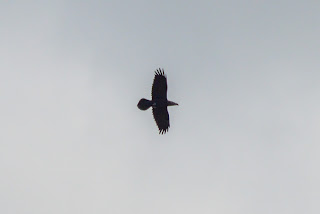
An hour at Hail's View on the way home was more productive, with highlights including three White Storks, two Great White Egrets, a fly-through White-tailed Eagle (mobbed by a Raven which was making the most extraordinary high pitched, wader-like call as it did so), two Marsh Harriers, two Green Sandpipers and a juvenile Hobby. What an unthinkable line-up most of those species would've been round these parts not so long ago!

White Storks and Great White Egret
Great White Egret (left), Little Egret (top) and White Storks
Raven and White-tailed Eagle
22nd September

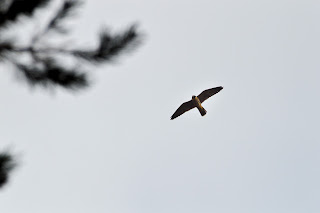
A walk from home in the morning was largely uneventful aside from a few Swallows and Meadow Pipits flying through south/south-west. Upon arriving home, a juvenile Hobby flew over the garden, mobbed by a Jackdaw. 
Hobby and Jackdaw
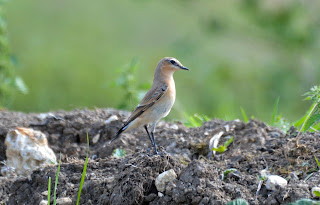
A session up at Amberley Mount late morning proved quite lively, especially for Meadow Pipits which must have numbered at least 300 across the various fields, with a few trickling south. Also on the move overhead were Swallow (78 south) and House Martin (255 west/south-west). Ten Red Admirals were also noted flying powerfully south. One of the adult White-tailed Eagles was drifting about over Rackham Hill then later flew straight overhead towards Arundel. Also of note were a Wheatear at Downs Farm and five Cattle Egret with the cattle down at Amberley Wildbrooks. 
Wheatear
White-tailed Eagle
A brief look at Waltham Brooks in the afternoon produced a single Little Grebe, two Snipe and four Tufted Duck at the main lake and a strong easterly movement of Swallows. 

23rd September

A beautiful early autumn morning saw me heading out from across the farmland towards the river, which was soundtracked by Meadow Pipits and Siskins overhead plus a heard-only Yellow Wagtail going south. Around 07:15 I was alerted by an unfamiliar call to a wader flying fast overhead heading south-west. It called again 'whet whet' and i managed a few seconds good views through bins of a relatively compact medium sized wader with long wings, greyish underwings but otherwise plain underparts and a medium length bill (longer than say Golden Plover but not as long as Dunlin). It took a while of checking calls online and my Collins app to be sure what I had seen and heard was a Knot - a wholly unexpected addition to the the local farmland hotspot and 1km year list! Amazingly, it's six years to the day since my only other local record of the species - when one was on the North Brooks at Pulborough in 2017.

Later in the day, highlights from the garden included a basking male Migrant Hawker and 33 of the White Storks from Knepp drifting over Amberley.
Reed Bunting
White Storks
Migrant Hawker
                                        
24th September

No real birding today thanks to skateboarding related misadventure which ended me up in hospital with a dislocated and fractured shoulder!

25th September

My first day of convalescing from my shoulder injury started with a short walk from home around the local farmland. Aside from a light trickle of Swallows and Meadow Pipits south/south-west it was relatively quiet on the bird front. Once the sun started to get up further the insects sprang into action and I ended up spending a good while watching a patch of ivy near home which was heaving with Ivy Bees, various wasps and hoverflies and a couple of Red Admirals.
Batman Hoverfly
Tiger Hoverfly
Red Admiral
26th September

Skywatching from the local fields mid-morning and early afternoon proved to be fairly quiet for the most part, with just a light trickle of House Martins south/south-west. The first vismigging Skylark of the season was nice though, heading west, as were ten Siskins (seven east and three south-west).

27th September

Another day restricted to birding on foot near to home which ended up being dominated by some fairly lively vismig. A morning session split between the high ground to the west of Watersfield and the farmland close to home yielded 252 House Martins, 95 Swallows and 27 Meadow Pipits south and a few Siskins in various directions. I'm unlikely to be able to use my proper camera for a while due to my knackered shoulder but photographic interest today came from the scenery and a Common Marbled Carpet moth which flew across the lane in front of me on my way home. 
Looking south from one of my local vismig spots
Common Marbled Carpet
A late afternoon session back out in the local fields started well with a flock of 12 Golden Plover south. A rush of Swallows east/south-east were followed by a Hobby which dropped down to just inches above the ground as it powered through, while at least 60 House Martin drifted through south-west as I was heading for home. 

28th September

A really enjoyable and lively couple of hours out this morning, a mix of vismigging combined with a check of the lake and the scrub at Waltham Brooks. At the latter, the highlights were three returning Wigeon (my first of the autumn) and around 80 Lapwings which took flight from Widney Brooks, plus two flyover Ravens. There were the usual two or three vocal Water Rails about plus a similar number of Cetti's Warblers.

Vismig was lively too and produced a few bits of interest, starting with two Woodlarks south over the farmland near home - my first record for this eBird hotspot (107 for the hotspot and my 127th species in my 1km from home recording area this year). This was followed by a little wave of Swallows heading east/south-east and a few House Martins south/south-west. Then, on the walk home, two Snipe flew high west - my first vismiggers of this species this autumn. Vismigging continued in the garden with two Yellow Wagtails north, another Snipe south-west and further little pulses of Swallows and House Martins.

29th September

Not much birding today but a brief skywatch from the local farmland produced a flurry of Swallows and Meadow Pipits south and two Reed Buntings south-west.

30th September

Seven Raven west over the garden first thing set the scene for another relatively lively early morning vismig session. Meadow Pipits were the main movers today, with 55 south in an hour plus a few Siskins and Swallows over and two Skylarks west. Water Rail and Kingfisher were heard along the river at a misty Thorndale Bridge. The Meadow Pipit movement continued throughout the day, when I was able to step outside and check, with direction of travel shifting to more of a west/south-westerly track late morning. A Hobby was over the fields near home late morning, taking the opportunity to harass some of the passing Swallows and House Martins. In the afternoon I checked Waltham Brooks which produced a female Marsh Harrier flying downriver and a few Swallows heading south-east. 
Looking east across the Arun from Thorndale Bridge


Monday, 25 September 2023

The Summer Ends

September can be a changeable month, both in terms of the weather and the birding. Sometimes it feels like an extension of summer, at other times autumn can start to bare its teeth a little early. Technically we're still in summertime as I write this, astronomically speaking, though of course ornithologically it's been autumn for quite some time and meteorological autumn began when September started. 

Weather-wise this ten day period saw a dramatic shift from some of the hottest weather of the year so far, to proper westerly, squally Atlantic conditions towards the end. It's also mid-September where the birds on offer locally takes a distinct turn towards autumn proper, and this year has been no exception, as the likes of Spotted Flycatcher, Whinchat and other passage passerines begin to ebb away, and one's thoughts turn towards the first thrushes, finches and Yellow-browed Warbler. Siskin has been perhaps the most frequently encountered species on many of my birding forays these past couple of weeks - an encouraging sign after a very poor winter for the species last year. 

Plus of course there was the star species, the Aquatic Warbler at Beeding Brooks, which delighted all who went to see it, me included.

11th September

I don't often twitch much these days but couldn't resist the urge when an Aquatic Warbler turned up just 20 or so minutes from home, found by Jamie Wilkinson on the 10th. 

After dropping B at nursery I headed down to Beeding Brooks where I found a group of around ten birders already gathered, most of whom had already seen the bird. It showed pretty quickly but only very briefly in flight a few times before giving fleeting perched views at 9.20 then going to ground for two hours. When it eventually reappeared at around 11.30 it proved a little more showy for a short time, deigning to stay in the open for as long as five seconds - enough to appreciate the warm ground colour, strong head stripes and tramlines on the back and relatively plain face. A world lifer for me - my first in the UK for quite a while. 

The bird never quite showed well enough from my angle to get any photos today, but see further down this blog post for pics from my second attempt.

Other highlights from the morning here included a flock of five Crossbills north-east, a Hobby south-west, at least one Kingfisher flying past three times (or three different Kingfishers!), heard-only Siskins and a couple of Ravens.
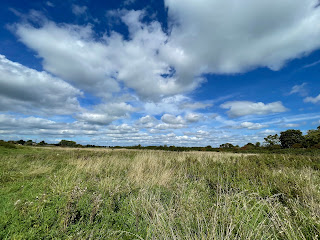
Beeding Brooks
Raven
In the evening a Barn Owl was heard calling near home. 

12th September

For the first time in quite a while I had a proper two hour session at Burton Mill Pond, checking all three water bodies (Burton Mill, Chingford and Black Pond). It felt distinctly autumnal in the misty, murky conditions, although still warm and very humid. The selection of passerines encountered was rather less summery, with three each of Firecrest and Marsh Tit the highlights among the usual tits, Nuthatches and a few Chiffchaffs and Blackcaps. Very vocal adult and juvenile Hobbies were flying around over the trees at Newpiece. In terms of water birds, Chingford Pond was where the action was happening - as is often the case here - with minima of 70 Gadwall, 40 Tufted Duck, 15 Teal, 10 Shoveler and half a dozen Pochard. The water level has been dropped to allow work to be carried out on the outflow channel, so the margins are looking perfect for waders. Unfortunately, none were to be found today, though there were workmen and a photographer present around said margins. 
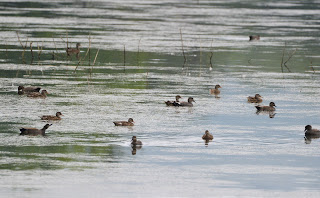
Gadwall

Hobby
Early afternoon, a short walk round the local farmland and brief skywatch produced just the faintest whiff of autumn vismig starting to pick up, with around 150 hirundines (mostly House Martin) west/south-west, a single Meadow Pipit south and a heard-only Siskin - the latter recorded locally for the third consecutive day. 

13th September

A return visit to Beeding Brooks this afternoon after a morning co-leading a garden safari at Knepp. Thankfully, the juvenile Aquatic Warbler proved much more showy than on Monday, showing well within ten minutes of my arrival and several more times in the next hour before going to ground again for a while. I even managed to get a couple of record shots this time! A search further upriver for the reported Red-backed Shrike proved sadly fruitless but other bits of note from a couple of hours here included a Green Sandpiper which flew up from the pool by the river and off east (apparently quite a good record here according to local birders I spoke to), two Ravens west and at least five Yellow Wagtails over. 
Aquatic Warbler
14th September

A morning safari in the Walled Garden and orchard at Knepp produced Hobby and Spotted Flycatcher plus Blood-vein and Brindled Green among the usual suspects in the moth trap - although it has to be said the catch was fairly minimal owing to the overnight temperature dropping into single figures for the first time in quite a while. Brrr! 
Blood-vein
On the way home I stopped off at Chantry Hill for a walk round. It was rather quiet but very pleasant nonetheless with highlights including two Wheatears, two Common Whitethroats, singles of Stonechat and Lesser Whitethroat, a Hobby worrying a flock of around 40 House Martins and at least one flyover Yellow Wagtail. 
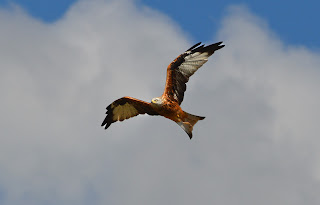
Red Kite
Wheatear
15th September

Not much birding today, though the moth trap produced Frosted Orange and Pale Mottled Willow, both new for the garden. A quick look at Waltham Brooks on the way home from Knepp early evening revealed two Stonechats in the scrub near the road and the usual selection of Gadwall, Shoveler and Teal on the main lake. A small group of Gadwall were also heard flying over the garden in the evening.
Frosted Orange
16th September

Another day without much birding, though a short skywatch in the garden early morning produced a little trickle of Siskins heading south/south-west, a theme that continued at our allotment later in the morning, with more heading over. Also of note here were a Common Gull flying west and a Willow Emerald Damsefly in nearby trees, a species that is rapidly spreading across West Sussex.
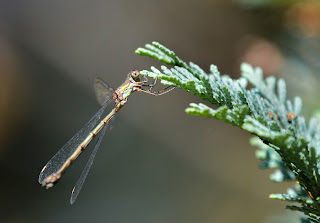
Willow Emerald
A walk at Knepp with friends early afternoon yielded 15 White Storks, a couple of Red Kites and Buzzards and other usual fare. In the evening, a short walk/skywatch on the local farm fields produced a little flurry of southbound Swallows. 

17th September

An early start this morning for WeBS day. Sadly the low cloud and north-easterly didn't produce a tasty wader at my private reservoir site over near Petworth, or any waders at all for that matter, with even the recent lingering Common Sandpipers having moved on at last. Highlights on the water were three Shoveler, 11 Pochard, 52 Egyptian Geese and a site high count of 126 Coot. It was fairly lively on the passerine front with Yellow Wagtail and at least two Siskins heard flying over, plus a few Meadow Pipits.
Egyptian Geese
On the way home I dropped in at Burton and Chingford Ponds for a brief look. At least 52 Gadwall were on Chingford Pond and there was a light easterly passage of hirundines, otherwise highlights included a vocal juvenile Hobby again, 5 Red Kites circling together and a minimum of 50 Siskins. 
Continuing the vismig theme, a short stint in the garden mid-morning produced a little flurry of hirundines and a couple more Siskins, followed by a kettle of 19 White Storks which took a while to decide on their direction of flight before drifting strongly south-west, apparently later seen over Southampton. 
White Storks
Late morning saw us heading up to Surrey to meet friends for a quick walk at Thursley Common before lunch. Perhaps unsurprisingly the first bird I heard as soon as I got out of the car was Siskin and their 'pew' calls soundtracked what turned into a pretty short walk, as our storm chaser friends alerted us to the rush of wind preceding a torrential downpour, meaning we thankfully got to shelter before the rain hit (Amazingly, an inch of rain fell in the following hour!). Just prior to the rain I noted around 20 House Martins drifting east.

Back at home in the evening I took a short stroll out to Thorndale Bridge which produced a vocal male Tawny Owl (new for me at this hotspot) and 2-3 Water Rails squealing on the Amberley side of the Arun. 
 
18th September

The morning after the storm before. A midnight thunderstorm of biblical proportions which brought down trees in the local area and blew out the bulb in my moth trap (that will teach me to bodge a rainguard with a garden umbrella...). Unsurprisingly, all the moths had vacated the Skinner by the morning, with just a few Willow Beauties scattered about and a new for the garden Garden Carpet doing a rubbish job of trying to camouflage against some nearby woodwork. 
Garden Carpet
After dropping B off at nursery I popped by Pulborough Brooks for a brief scan of the North Brooks which produced my first Pintail of the autumn (at least five among hundreds of Teal) plus 3 Ruff, 5 Snipe and a perched adult Hobby. 

With more rain on the way and a bit of a window of opportunity I decided to dash back over to the reservoir near Petworth, in the hope that the storm had dropped something in. It proved to be a very worthwhile decision as I approached the rim of the reservoir and peered over to be greeted by the sight of two juvenile Black Terns hawking up and down over the water - not just a first for this hotspot but a first for me anywhere in my local area and, indeed, anywhere in inland Sussex. For the next hour or so I delighted in watching them feeding over the water and occasionally resting on the buoys at the southern end. A truly wonderful bird to encounter in this unlikely location in the middle of rural West Sussex, following on from the lingering Long-tailed Duck here last winter. What next! 

Other highlights here this morning included a showy Wheatear on the fence by the reservoir and a Lesser Whitethroat in nearby scrub, the latter actually a hotspot tick but rather overshadowed by the terns!
Black Terns
Black Tern
Wheatear
19th September

Another distinctly autumnal morning with drizzle in the air and a brisk south-westerly wind. While driving through Houghton/Amberley this morning I noticed an adult Great Black-backed Gull on the river bank near Houghton Bridge. Not a regular sight round these parts, especially not on the deck. After dropping B at nursery I decided to head back over to Petworth to check if the Black Terns were still around. They weren't but, frustratingly, I did have another tern flying away from me heading purposefully south-west, but didn't get good enough views to clinch the ID. It seemed fairly uniform grey on the back and very buoyant, but unfortunately will have to go down as one that got away. 

There was a bit of House Martin passage going on with at least 110 birds powering straight into the wind during my 90 minutes here. Otherwise, highlights were restricted to ten Pochard and 14 Shoveler on the water and a flock of 20 Meadow Pipits overhead.

20th September

Very little birding today, as I was leading a garden safari at Knepp in the morning and heavy rain set in by mid-afternoon until nightfall. Passing glances at Waltham Brooks and Southlands Farm, West Chiltington on my way to and from Knepp, respectively, revealed much the same species on offer at both sites. 20 Shoveler were on the main lake at Waltham Brooks plus a few Gadwall and a lone Grey Heron perched on the post in the water, while Southlands hosted 10 Shoveler and five Teal. The almost total absence of waders at both these sites in recent weeks reflects what a generally poor wader autumn it's been everywhere, combined with higher water levels than we were experiencing this time in 2022. 

Saturday, 24 June 2023

Dust and lowering skies

Given that this is supposed to be the relatively quiet period in the birding year, the past fortnight or so has actually been one of the most enjoyable periods of 2023 so far for me, from a local birding perspective. The clear highlight, of course, was finding a Marsh Warbler just a few hundred metres from home, which was still present at the time of writing (update: it has since departed, it seems).

Otherwise it's been a fairly steady stream of waders, Cuckoos and various less common breeding species, plus some of the first high summer butterflies and odonata of the year.

Weather-wise, it's been a relief to get some much-needed rain in the past week or so, including some particularly impressive thunderstorms. I have been once again reminded how spectacular lightning is when it flashes around the South Downs, as storm fronts slowly approach Sussex from the English Channel.

12th June

A fairly brief whizz round Pulborough Brooks this morning produced a pleasing selection of species including 3 Little Ringed Plover, Cuckoo, Dunlin, 10 Avocet, my first Redshank chick of the year, a single White Stork on the North Brooks and at least three Nightingales still singing. 

13th June

I was out of the house before 05:30 this morning (not something that has happened often lately) with my plan being to head up the Arun to Waltham Brooks then back via the sewage works. In the end I never even made it as far as the river as around 500m from home my attention was drawn to an odd Acro song coming from an area of mixed rank vegetation right next to the railway line at Thorndale Bridge. I've often heard Cetti's Warbler in this spot but not Reed Warbler as far as I can remember, so it instantly stood out as rather out of context. This, combined with the fact I was hearing elements of mimicry (including Goldfinch, Swallow, Blackbird, Blue Tit and even Bee-eater) immediately rang alarm bells and my thoughts quickly turned to Marsh Warbler. I positioned myself near the railway bridge and, over the course of the next hour, hoped that the bird would show itself well enough to get some record shorts and audio recordings, which it dutifully did, and I left site at 07:00 very happy I had self-found my first Sussex Marsh Warbler and, indeed my first anywhere in the UK for around ten years!

Marsh Warbler


14th June

A decent session at Burton Mill Pond this morning produced 43 species in 100 minutes. Highlights included a female Mandarin with young on the outflow near the mill house, the Great Crested Grebe pair feeding three young on the main pond and a Little Owl hunting along the fenceline at Burton Park Farm. Two Siskins over Newpiece Moor were also noteworthy, given what a poor first half of the year it's been for the species. Apparently, they were once known as 'barley birds' owing to their tendency to reappear around the onset of high summer (i.e. the time that barley is ripening for harvest), presumably due to dispersing young birds and post-breeding adults.

15th June

Not much birding today aside from an hour or so at Thorndale Bridge in the evening, where I bumped into Michael and Dan Booker, hoping to connect with the Marsh Warbler. Sadly, we didn't have any luck this time, despite a Reed Warbler doing its best to convince us otherwise, by throwing in occasional bursts of Goldfinch mimicry into its song - strange, considering I hadn't heard Reed Warbler here before, but a quick Google search on my phone brought up a BB paper which suggested Reed Warblers which spend any length of time in the vicinity of Marsh Warblers have been known to incorporate mimicry into their songs. A Barn Owl kept us entertained, hunting around Wharf Field, while there were again plenty of Swallows flying about overhead and a Nightingale called briefly by the railway line as I was heading for home. 

16th June

An early two hour session at Pulborough this morning proved to be quite lively. Highlights included all three egrets (9 Little Egret and one each of Great Egret and Cattle Egret), two each of Ringed Plover and Little Ringed Plover together on the North Brooks (which was a bit confusing at first as it's very unusual to see these two species together here at this time of year), singles of Dunlin, Black-tailed Godwit and White-tailed Eagle and three White Storks (GB0S, GB6S and GB3U from Knepp). There was still plenty of birdsong around including Yellowhammer and Stonechat near Winpenny and a few bursts of Nightingale around the main trail. There were plenty of young birds about too, especially Whitethroat, with at least three family groups seen. 
White Storks
In the afternoon, I headed down to Worthing with B for a walk around Brooklands Park where the highlights were a newly fledged Reed Warbler, a few Swifts and House Martins, two Cetti's Warblers and two Great Black-backed Gulls. On the way home we dropped in at Knepp to watch a bit of the White Stork ringing.
Reed Warbler

White Stork ringing
17th June

Not much birding today other than a short local walk in the morning which was uneventful. While I was at Knepp in the afternoon and evening, news emerged that the Marsh Warbler had been rediscovered along the riverbank at Waltham Brooks so I swung by on my way home in the hope it might still be singing well after sunset. Sadly no luck, just the odd burst of song from Sedge and Reed Warblers. It was quite impressive and more than a little unnerving to be out on the riverbank as lightning flickered distantly all around, but I was glad to get home before the big storm hit in the small hours!

18th June

WeBS day today so I headed over to the private reservoir near Petworth, which produced the usual fare on the water - Coots, Tufted Ducks, Mallards and singles of Mute Swan and Great Crested Grebe - plus two Little Ringed Plovers on the shore. The best in this area though was discovering an active Barn Owl nest in a farm building, with an adult seen leaving a box which I was able to see contained three small chicks.

The owl theme continued later in the day, as a dusk safari at Knepp produced heard-only Barn Owl and at least two squeaking juvenile Tawny Owls near the campsite. Anecdotally, it seems to have been an excellent year for breeding Tawny Owls, as I've been seeing and hearing them all over the place, especially at Knepp, where at least three pairs have bred in the Southern Block. Also of note this evening was a Peregrine over the Southern Block, not a raptor I see here all that often. 

19th June

Not a great amount of birding today due to other life stuff.

20th June

The first butterfly safari of the season at Knepp this morning produced my first White-letter Hairstreaks of the year, but otherwise not a massive amount of lepidopteran interest, as it was decidedly cool and grey, with even a bit of light rain in the air at times.

21st June

An hour early afternoon checking out the local fields near home for the first time in a while didn't produce much in the way of birds, but it was great to discover a colony of White-letter Hairstreaks in some hedgerow Elms just a couple of hundred metres from the house - in an area I had actually earmarked for the species a few weeks back. It's always nice when that happens! Typically they were either whizzing about at high speed above the trees or hidden up in the foliage, so no useable photos really...

An evening session at Thorndale Bridge and the very south-western corner of Waltham Brooks produced a great selection of species, most notably the Marsh Warbler singing in reeds/willow on the south side of the river. This is the first time I've managed to catch up with this elusive bird since finding it last week. It does seem to be splitting its time between the original location and this spot along the river. It was really belting out its song this evening, until just before 22:00 when it went quiet. Mimicry included Goldfinch, Swallow, Wren, Bee-eater, Blue Tit and Nightingale. 
22nd June

Proving the old adage that it's better to get in the field for a few minutes than not at all, this morning I dropped in at Waltham Brooks for all of 15 minutes on my way to Knepp, but it turned into a surprisingly great little session. The Cuckoo was still singing away along the river, my first 1k Little Grebe for a while was on the main lake but, best of all, a Common Sandpiper was perched up on the post in the middle of the lake before taking flight and disappearing out of view towards the western end. A 1k year tick for me, taking the local total to 116 (146 for the wider 10k). Also my first locally for four weeks - too early to call it the first returning bird of autumn?
Song Thrush
After a great butterfly safari at Knepp which yielded my first Purple Emperors of the year, an evening session in the Beaver enclosure produced some equally breathtaking encounters with the resident pair, including a spectacular tail slap just as we were about to leave! It really is astonishing what a great job they have done of engineering the wetland habitat in this part of the estate in the past 18 months or so. Avian highlights here included multiple singing Chiffchaffs, a couple of croaking and whistling Nightingales and what sounded like at least two fledgling Bullfinches calling in the scrub.
Purple Emperor
 
The Beaver enclosure at Knepp

23rd June

The planned early start didn't happen this morning but, after dropping B at nursery, I headed over to Amberley for an hour walk from the castle entrance up to the river bank and back. A pleasing selection of 40 species were recorded including Cuckoo, Hobby (putting the wind up around 40 Swifts gathered over the castle) and a Mute Swan pair with seven cygnets.
Mute Swans
An evening session up the river from home to Waltham Brooks sadly didn't produce the Marsh Warbler, but three singing male Cuckoos were pretty remarkable to hear so late in June (as reported by Pete Hughes the previous evening too), and a female Mandarin with eight ducklings on the main lake represented my first confirmed breeding for the site.