Showing posts with label gadwall. Show all posts

Monday, 25 September 2023

The Summer Ends

September can be a changeable month, both in terms of the weather and the birding. Sometimes it feels like an extension of summer, at other times autumn can start to bare its teeth a little early. Technically we're still in summertime as I write this, astronomically speaking, though of course ornithologically it's been autumn for quite some time and meteorological autumn began when September started. 

Weather-wise this ten day period saw a dramatic shift from some of the hottest weather of the year so far, to proper westerly, squally Atlantic conditions towards the end. It's also mid-September where the birds on offer locally takes a distinct turn towards autumn proper, and this year has been no exception, as the likes of Spotted Flycatcher, Whinchat and other passage passerines begin to ebb away, and one's thoughts turn towards the first thrushes, finches and Yellow-browed Warbler. Siskin has been perhaps the most frequently encountered species on many of my birding forays these past couple of weeks - an encouraging sign after a very poor winter for the species last year. 

Plus of course there was the star species, the Aquatic Warbler at Beeding Brooks, which delighted all who went to see it, me included.

11th September

I don't often twitch much these days but couldn't resist the urge when an Aquatic Warbler turned up just 20 or so minutes from home, found by Jamie Wilkinson on the 10th. 

After dropping B at nursery I headed down to Beeding Brooks where I found a group of around ten birders already gathered, most of whom had already seen the bird. It showed pretty quickly but only very briefly in flight a few times before giving fleeting perched views at 9.20 then going to ground for two hours. When it eventually reappeared at around 11.30 it proved a little more showy for a short time, deigning to stay in the open for as long as five seconds - enough to appreciate the warm ground colour, strong head stripes and tramlines on the back and relatively plain face. A world lifer for me - my first in the UK for quite a while. 

The bird never quite showed well enough from my angle to get any photos today, but see further down this blog post for pics from my second attempt.

Other highlights from the morning here included a flock of five Crossbills north-east, a Hobby south-west, at least one Kingfisher flying past three times (or three different Kingfishers!), heard-only Siskins and a couple of Ravens.
Beeding Brooks
Raven
In the evening a Barn Owl was heard calling near home. 

12th September

For the first time in quite a while I had a proper two hour session at Burton Mill Pond, checking all three water bodies (Burton Mill, Chingford and Black Pond). It felt distinctly autumnal in the misty, murky conditions, although still warm and very humid. The selection of passerines encountered was rather less summery, with three each of Firecrest and Marsh Tit the highlights among the usual tits, Nuthatches and a few Chiffchaffs and Blackcaps. Very vocal adult and juvenile Hobbies were flying around over the trees at Newpiece. In terms of water birds, Chingford Pond was where the action was happening - as is often the case here - with minima of 70 Gadwall, 40 Tufted Duck, 15 Teal, 10 Shoveler and half a dozen Pochard. The water level has been dropped to allow work to be carried out on the outflow channel, so the margins are looking perfect for waders. Unfortunately, none were to be found today, though there were workmen and a photographer present around said margins. 
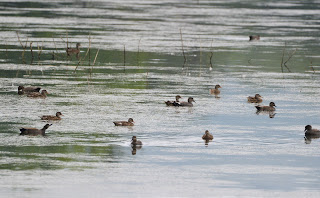
Gadwall

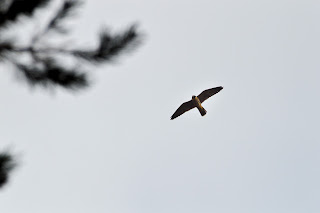
Hobby
Early afternoon, a short walk round the local farmland and brief skywatch produced just the faintest whiff of autumn vismig starting to pick up, with around 150 hirundines (mostly House Martin) west/south-west, a single Meadow Pipit south and a heard-only Siskin - the latter recorded locally for the third consecutive day. 

13th September

A return visit to Beeding Brooks this afternoon after a morning co-leading a garden safari at Knepp. Thankfully, the juvenile Aquatic Warbler proved much more showy than on Monday, showing well within ten minutes of my arrival and several more times in the next hour before going to ground again for a while. I even managed to get a couple of record shots this time! A search further upriver for the reported Red-backed Shrike proved sadly fruitless but other bits of note from a couple of hours here included a Green Sandpiper which flew up from the pool by the river and off east (apparently quite a good record here according to local birders I spoke to), two Ravens west and at least five Yellow Wagtails over. 
Aquatic Warbler
14th September

A morning safari in the Walled Garden and orchard at Knepp produced Hobby and Spotted Flycatcher plus Blood-vein and Brindled Green among the usual suspects in the moth trap - although it has to be said the catch was fairly minimal owing to the overnight temperature dropping into single figures for the first time in quite a while. Brrr! 
Blood-vein
On the way home I stopped off at Chantry Hill for a walk round. It was rather quiet but very pleasant nonetheless with highlights including two Wheatears, two Common Whitethroats, singles of Stonechat and Lesser Whitethroat, a Hobby worrying a flock of around 40 House Martins and at least one flyover Yellow Wagtail. 
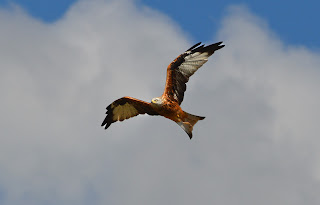
Red Kite
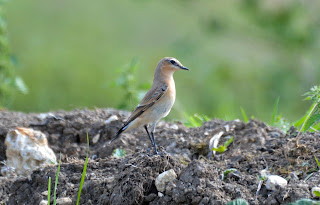
Wheatear
15th September

Not much birding today, though the moth trap produced Frosted Orange and Pale Mottled Willow, both new for the garden. A quick look at Waltham Brooks on the way home from Knepp early evening revealed two Stonechats in the scrub near the road and the usual selection of Gadwall, Shoveler and Teal on the main lake. A small group of Gadwall were also heard flying over the garden in the evening.
Frosted Orange
16th September

Another day without much birding, though a short skywatch in the garden early morning produced a little trickle of Siskins heading south/south-west, a theme that continued at our allotment later in the morning, with more heading over. Also of note here were a Common Gull flying west and a Willow Emerald Damsefly in nearby trees, a species that is rapidly spreading across West Sussex.
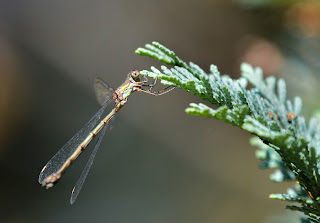
Willow Emerald
A walk at Knepp with friends early afternoon yielded 15 White Storks, a couple of Red Kites and Buzzards and other usual fare. In the evening, a short walk/skywatch on the local farm fields produced a little flurry of southbound Swallows. 

17th September

An early start this morning for WeBS day. Sadly the low cloud and north-easterly didn't produce a tasty wader at my private reservoir site over near Petworth, or any waders at all for that matter, with even the recent lingering Common Sandpipers having moved on at last. Highlights on the water were three Shoveler, 11 Pochard, 52 Egyptian Geese and a site high count of 126 Coot. It was fairly lively on the passerine front with Yellow Wagtail and at least two Siskins heard flying over, plus a few Meadow Pipits.
Egyptian Geese
On the way home I dropped in at Burton and Chingford Ponds for a brief look. At least 52 Gadwall were on Chingford Pond and there was a light easterly passage of hirundines, otherwise highlights included a vocal juvenile Hobby again, 5 Red Kites circling together and a minimum of 50 Siskins. 
Continuing the vismig theme, a short stint in the garden mid-morning produced a little flurry of hirundines and a couple more Siskins, followed by a kettle of 19 White Storks which took a while to decide on their direction of flight before drifting strongly south-west, apparently later seen over Southampton. 
White Storks
Late morning saw us heading up to Surrey to meet friends for a quick walk at Thursley Common before lunch. Perhaps unsurprisingly the first bird I heard as soon as I got out of the car was Siskin and their 'pew' calls soundtracked what turned into a pretty short walk, as our storm chaser friends alerted us to the rush of wind preceding a torrential downpour, meaning we thankfully got to shelter before the rain hit (Amazingly, an inch of rain fell in the following hour!). Just prior to the rain I noted around 20 House Martins drifting east.

Back at home in the evening I took a short stroll out to Thorndale Bridge which produced a vocal male Tawny Owl (new for me at this hotspot) and 2-3 Water Rails squealing on the Amberley side of the Arun. 
 
18th September

The morning after the storm before. A midnight thunderstorm of biblical proportions which brought down trees in the local area and blew out the bulb in my moth trap (that will teach me to bodge a rainguard with a garden umbrella...). Unsurprisingly, all the moths had vacated the Skinner by the morning, with just a few Willow Beauties scattered about and a new for the garden Garden Carpet doing a rubbish job of trying to camouflage against some nearby woodwork. 
Garden Carpet
After dropping B off at nursery I popped by Pulborough Brooks for a brief scan of the North Brooks which produced my first Pintail of the autumn (at least five among hundreds of Teal) plus 3 Ruff, 5 Snipe and a perched adult Hobby. 

With more rain on the way and a bit of a window of opportunity I decided to dash back over to the reservoir near Petworth, in the hope that the storm had dropped something in. It proved to be a very worthwhile decision as I approached the rim of the reservoir and peered over to be greeted by the sight of two juvenile Black Terns hawking up and down over the water - not just a first for this hotspot but a first for me anywhere in my local area and, indeed, anywhere in inland Sussex. For the next hour or so I delighted in watching them feeding over the water and occasionally resting on the buoys at the southern end. A truly wonderful bird to encounter in this unlikely location in the middle of rural West Sussex, following on from the lingering Long-tailed Duck here last winter. What next! 

Other highlights here this morning included a showy Wheatear on the fence by the reservoir and a Lesser Whitethroat in nearby scrub, the latter actually a hotspot tick but rather overshadowed by the terns!
Black Terns
Black Tern
Wheatear
19th September

Another distinctly autumnal morning with drizzle in the air and a brisk south-westerly wind. While driving through Houghton/Amberley this morning I noticed an adult Great Black-backed Gull on the river bank near Houghton Bridge. Not a regular sight round these parts, especially not on the deck. After dropping B at nursery I decided to head back over to Petworth to check if the Black Terns were still around. They weren't but, frustratingly, I did have another tern flying away from me heading purposefully south-west, but didn't get good enough views to clinch the ID. It seemed fairly uniform grey on the back and very buoyant, but unfortunately will have to go down as one that got away. 

There was a bit of House Martin passage going on with at least 110 birds powering straight into the wind during my 90 minutes here. Otherwise, highlights were restricted to ten Pochard and 14 Shoveler on the water and a flock of 20 Meadow Pipits overhead.

20th September

Very little birding today, as I was leading a garden safari at Knepp in the morning and heavy rain set in by mid-afternoon until nightfall. Passing glances at Waltham Brooks and Southlands Farm, West Chiltington on my way to and from Knepp, respectively, revealed much the same species on offer at both sites. 20 Shoveler were on the main lake at Waltham Brooks plus a few Gadwall and a lone Grey Heron perched on the post in the water, while Southlands hosted 10 Shoveler and five Teal. The almost total absence of waders at both these sites in recent weeks reflects what a generally poor wader autumn it's been everywhere, combined with higher water levels than we were experiencing this time in 2022. 

Monday, 10 July 2023

Long days and short nights

A rather brief summary of the last week of June and first couple of days of July, and my last UK birding for a little while as we headed off to Spain for a week on the 3rd (blog post on that trip to come in due course).

It's been another rewarding period in the birding year though. Particularly pleasing was being able to confirm local breeding of two less common duck species, one of them a RBBP listed species: Shoveler and Gadwall.

Weather-wise, it's not been quite as fiercely hot, with a rather more 'normal' temperature range and a pretty dominating west/south-westerly element to the wind. 

24th June

An early check of my private WeBS site over near Petworth produced 2 Little Ringed Plover and a Barn Owl, but otherwise usual fare. I then headed over to Knepp later in the morning for a butterfly safari, the highlight of which (aside from lots of juicy Purple Emperor action!) was a Curlew flying high north-west over the Cow Barn as I and fellow guide Mark McManus arrived to set up - a Knepp tick for both of us!

25th June

Not much birding today, although some great Purple Emperor and Turtle Dove action again at Knepp in the morning. On the way home a check of Southlands Farm in West Chiltington produced a Green Sandpiper on the roadside pool there.

In the evening I headed over to Lord's Piece/Coates Common for my second Nightar survey visit, which proved to be quite successful, despite much of the habitat having been cut down since my previous visit. The first bird as I arrived was a Hobby hawking over the east side of the heath. By 21:40, the Nightjars started churring, with a total of two males on the main heath and at least 1-2 others across the fields on the clearfell area east of Sutton Common. One of the males on Lord's Piece itself responded well to a few of my handclaps and buzzed right over my head a couple of times. Always an amazing experience! Also of note here this evening were at least four Tawny Owls - two hooting males and two squeaking juveniles.

Hobby
                                            

26th June

After dropping B at nursery this morning I stopped off at Pulborough for a check of the South Brooks and Black Wood. A Green Sandpiper was on the pool out from Hail's View - my first returning bird here this... season (I won't say autumn, just yet!) while the lingering Great White Egret was still on West Mead Pool and a Spotted Flycatcher was along the path just west of Black Pond. 

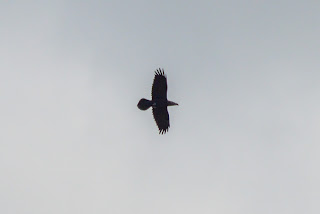
A lunchtime walk round the local farmland produced quite a few Swallows (12+), a flock of at least 180 Starlings, a few Swifts and one of the White-tailed Eagles being mobbed by a Hobby high over towards Amberley.

27th June

A brief look at Waltham Brooks on my way to Knepp this morning proved to be a fruitful one, as I discovered a female Shoveler on the main lake with four ducklings in tow. I've suspected the species might be breeding here, as there were a few records of drakes kicking about earlier in the summer/late spring, but it was nice to prove it today.

Shoveler female and ducklings

28th June

A check of local water bodies this morning proved quite productive. At an undisclosed site, Little Ringed Plovers were back on eggs after a failed breeding attempt earlier in the year. 

Burton Mill Pond was on particularly fine form, with 52 species recorded in a little under two hours. Spotted Flycatchers were at Lodge Green and New Piece, along with a Willow Warbler and two Marsh Tits loosely tagging along with my first roving mixed flock of the season in the latter area. Also at New Piece, a Hobby was noisily flying about and carrying food, which was encouraging to see. A Firecrest was singing near the north-west corner of Burton Mill Pond itself, while the usual Little Owl was again out on the fence at Burton Park Farm. A Peregrine and at least 25 Sand Martins were over Chingford Pond. The best of the ducks, meanwhile, were single female Gadwall and Mandarin on Chingford Pond with nine and four ducklings, respectively. 

Gadwall female and ducklings

Little Owl
Peregrine

29th June

A check of Southlands Farm, West Chiltington on my way to Knepp again produced a Green Sandpiper plus an impressive 60 Mallards squeezed onto the little pool there.

In the afternoon a short walk from home through the local farmland out to the river at Thorndale Bridge proved fairly quite, aside from a Hobby high over Amberley Wildbrooks and a mixed flock of around 30 Swallows and Sand Martins feeding over the river.

Back at Knepp in the evening for a dusk safari which turned into a mini owl-fest, with Barn Owl seen a couple of times around the white route, and a Tawny Owl in flight just west of the campsite. Rather more out of context was a Reed Warbler singing in dense sallow in the stork enclosure, while I popped by to watch some of the team ringing another stork nest.

30th June

Half an hour on the tea terrace at Pulborough this morning, scanning the South Brooks. It was an enjoyable and productive session including one of the White-tailed Eagles perched up on a gatepost, the lingering Great White Egret at West Mead and two Hobbies flying over Hollybush Hill towards the heath. 

An enjoyable safari at Knepp this morning, the highlight of which was finding a Turtle Dove for my group of students (who'd never seen one), which gave prolonged views of its singing and preening. 
Turtle Dove
A rare foray into Surrey in the evening for the Surrey Bird Club AGM saw me dropping into one of my old haunts - Papercourt GPs. Not a huge amount of interest here aside from 26 Egyptian Geese roosting near the sailing club, and two Ring-necked Parakeets flying over (only my fifth UK record this year!)

1st July

A short walk and skywatch round the local farmland this morning didn't produce much aside from a Peregrine low and fast over north towards Lodge Hill.

Early afternoon I headed over to Pulborough Brooks with Kate and B to catch up with my old friend Steven. A couple of hours around the main trail proved enjoyably productive, with highlights including the Great White Egret still with at least five Little Egrets at West Mead, the two White-tailed Eagles, two White Storks on the North Brooks along with 24 Black-tailed Godwit, at least 9 Little Ringed Plover and a lone Green Sandpiper. A rather late Cuckoo flew over Uppertons Field, followed later by a Hobby, while a female Tufted Duck with six ducklings at West Mead represented my first breeding record here. 
Great and Little Egrets at Pulborough
Ringlet

2nd July

No birding today. 

Sunday, 5 February 2023

The home straight of winter...

A change in the weather in the two weeks since my last blog post, with the ice having all melted and relatively little rain having fallen the ground conditions in the Arun Valley are remarkably not too muddy now and have allowed for some exploration of areas that have been impassable for weeks thanks to the flooding and the big freeze. We've been treated to some glorious days of spring-like sunshine too which have really helped lift the spirits as we finally reach the end of the hard slog of January and head into February - the home straight of winter!

24th January

Feeling strangely mild (although still barely above freezing), on the first frost-free morning in over a week. In that time the water levels locally have mercifully receded enough to allow me to access the southern entrance to Waltham Brooks, via Thorndale Bridge and the bank of the River Arun. This is where I headed this morning for a little scan of the river and the north-western corner of Amberley Wildbrooks beyond. As I passed under the bridge I noticed an adult Great Black-backed Gull powering north up the river - my second locally in two days! Across the river, a Kingfisher flew away from me up the drainage ditch flowing out of Amberley Wildbrooks. For a second I thought I heard a Water Pipit call but just the one squeak and I didn't see it or hear it again, so wrote it off. Otherwise, it was usual fare here, with a Water Rail squealing somewhere unseen and a few Wigeon, Teal and Shoveler flying up from the river and the wildbrooks. 

Shoveler

25th January

The day began with a Peregrine low over Watersfield first thing, followed by a walk from home to Waltham Brooks. Grey and misty, still very cold but ice gradually thawing. There had been a noticeable increase in ducks on the main lake but still not exactly spectacular for the time of year. Two Red Kites and a Raven were airborne over Amberley Wildbrooks, while at least three Cetti's Warblers were making themselves heard and a Chiffchaff was singing half-heartedly along the river just south of the reserve. 

26th January

Another grey and frost-free morning, after some overnight rain. A check of farmland over near Petworth finally produced my first Yellowhammer of the year (in an area that's normally very good for them and I've already visited twice in January), along with a flock of ~80 Goldfinches and a Grey Wagtail.

27th January

No birding today.

28th January

A half-hour check of Waltham Brooks at lunchtime proved quite lively, with my first Shelduck here this year on the main lake, along with a female Pintail and 300+ dabbling ducks, mostly Teal but also at least 80 each of Shoveler and Wigeon. Overhead, a Raven cronked its way west while two Marsh Harriers flew north.

Early afternoon we found ourselves in the Arundel area so spent a little while up at the Offham viewpoint which produced distant views of the six adult Bewick's Swans feeding down in the water meadows below.

Gadwall
Shelduck and Wigeon
Raven
29th January

A couple of hours at Burton Mill Pond from first light produced quite a lively session. Following on from Mike Dale's report on Twitter of 13 Little Egrets there on the 25th today I found at least 22, all gathered around Chingford Pond along with the now regular Great White Egret (more on that later). The reason for this gathering of egrets (along with several Grey Herons) is evidently due to the water level at Chingford having dropped dramatically since my last visit, exposing lots of lovely mud around the edges, especially at the southern end. It's such a drastic drop in level that it must have been done deliberately and, indeed, there was a guy fiddling with one of the outflows today, and the main outflow out of the dam was dry.

Back to the Great Egret, which I noticed was bearing a red darvic ring on its left leg. I couldn't see any digits on the ring but a bit of online detective work led to the discovery that this bird had probably been ringed on the Avalon Marshes in Somerset. 
Also of note on Chingford Pond were at least 40 Pochard; by far my highest count of the species here, or anywhere locally, so far this winter.
Little Egrets, Great Egret and Grey Heron
Great Egret (with red leg ring)
Extra excitement in the afternoon as I was doing the obligatory Big Garden Birdwatch from our bedroom window and not recording a huge amount when a small flock of Starlings swirling around a little way down the road caught my attention. Just as I thought to myself 'it's a shame I can't count those' they suddenly all jinked sharply in one direction as a fast pointed shape appeared out of the sky from the west and lunged directly at them, missing completely, before continuing off to the east. The compact size, sharply pointed, rapidly flickering wings could only belong to one species: Merlin! An amazing garden and 1k tick that I certainly was not expecting when I sat down to count the Blue Tits. Amazingly, it returned about 15 minutes later, powering back west, quite high, but as I reached for my camera I lost it, unfortunately. 

30th January

Not a huge amount of birding today although I did manage a couple of short walks at Ashdown Forest as I was over there for work purposes. Very quiet here though, despite the pleasantly warm spring-like sunshine, with just the odd Siskin of note among the many Coal Tits and Wrens.

On the way home I popped in at Weir Wood Reservoir where I bumped into local patch watcher Alastair Gray. I didn't have my scope unfortunately but Alastair let me use his to see the lingering two female Wood Ducks and the 51-strong flock of Barnacle Geese. It was also nice to see Grey Herons carrying nest material up to the heronry. Spring is getting closer by the day.

31st January

A pleasantly mild morning. I dropped in to Waltham Brooks again for half an hour as I was passing. The lake again yielded lots of wildfowl including three Shelducks (two of which flew off towards Pulborough) and a pair of Pintail.
Best of all though was a male Yellowhammer which flew in from the south and briefly dropped into the scrub and allows near the lake. My first record here and only the second within my 1k area since moving to Watersfield in September last year.
Yellowhammer
Late morning I headed up to Surrey to meet Ed, mostly to work on the book, but we managed to squeeze in a bit of birding in his 1k area. A Peregrine over Eashing Fields was the highlight, although I actually had seven hotspot ticks here including singing Coal Tit. A walk along the river a bit later in distinctly spring-like conditions produced Grey Wagtail, Sparrowhawk, Red Kite and a flycatching Goldcrest.
On the way home I decided to stop at Burton Mill Pond for a little dusk session which actually turned out to be a very sensible decision. As has become a bit of a thing here lately, the first bird I saw was a Great White Egret flushed from the reeds near the road, although I think a different bird to the one on Sunday, as I couldn't see a red ring on this bird. Little Egrets were trickling over in ones and small groups, heading south to roost, with a single Cattle Egret among them. A Kingfisher darted low over the water towards the outflow channel. Just as the light was fading to its last I had two unexpected Burton Mill Pond ticks in close succession. First, a Goshawk which I picked up late flying lower over the pond before disappearing into the trees on the west side - the whole experience lasting a matter of seconds, but no doubt about the ID. The second was another 'flying away from me by the time I got on it' moment, as I noticed a lone duck flying southwest, the long neck and whirring wingbeats so diagnostic of a Goosander.
Cattle Egret

1st February

I didn't have time for lots of birding today but managed a late morning walk around local farmland and woodland. Lots of singing Song Thrushes, Mistle Thrushes and others, but the highlight was a Peregrine over Lodge Hill and Coldwaltham Farm, presumably the same bird that I've seen a few times since Christmas, so is presumably wintering in the area.
Peregrine
2nd February

I headed over to Pulbrough Brooks this morning for the first time in a couple of weeks (I'm ashamed to say!). There was no sign of the Avocet found by Chris and Juliet Moore yesterday but two Ruff among the many hundreds of Lapwing were a year tick. Also among the Lapwing was a striking leucistic Lapwing which really caught the eye. Otherwise highlights from an hour here were two Snipe, Peregrine, Marsh Harrier and the highest count of ducks I've seen here this winter, including at the very least 80 Pintail.
Leucistic Lapwing

Ruff with Lapwings
3rd February

Not a lot of birding today but anecdotal highlights included five Little Egrets in the wet meadow next to the River Rother in Fittleworth, seen from the car, and the two local White-tailed Eagles (still sounds weird to think of them like that) soaring over the Downs, viewed from my office/bedroom window in the afternoon. Also seen from home was the now daily Raven flying low over the hamlet. I'm sure there must be a pair nesting somewhere in my 1k area but haven't worked out where yet.

4th February

This morning I joined members of Shoreham and District Ornithological Society for a walk round Henfield Levels, led by local birder Val Bentley. This was primarily for the purposes of researching the book, as it's not an area I know well and, last time I visited, most of it was underwater and many of the paths impassable!
Henfield Levels
We had a productive morning with highlights including a Water Rail and several Chiffchaffs at the little pond north of Rye Farm and good numbers of Lapwing (~500) and Teal (400+) along with smaller numbers of Wigeon, Pintail and Shoveler.

Sunday, 25 March 2018

Pulborough, 23rd-25th March

A day off work on Friday saw me make a couple of visits to the Brooks in between other appointments, the overnight rain and rather more southerly winds filling me with hope for some new arrivals. The morning visit was a chilly affair but boosted by at least five singing Chiffchaffs around the nature trail; the most I've heard here, or anywhere for that matter, so far this year.
Chiffchaff
A hunting Peregrine caused havoc at West Mead and very nearly caught a Lapwing before coming down on the grass closer to the Arun. From Winpenny were a pair of Redshank, while a loud 'choo-wit!' which seemed to echo around the whole hide could have only come from a Spotted Redshank, but try as I might I couldn't locate the bird - I suspect it may have flown straight over. On the North Brooks were a single Dunlin, two Little Egrets and just seven Black-tailed Godwits. Gull numbers were higher than usual with at least 35 each of Common Gull and Herring Gull through during the morning visit, slightly fewer Black-headeds and five Lesser Black-backed Gulls. Sadly, try as I might, I couldn't find a Little Gull with them...
Peregrine
The afternoon visit, meanwhile, produced a pair of Stonechats and a squealing Water Rail at Hails View, and a single Redshank on the North Brooks, but best of all was a ringtail Hen Harrier hunting over towards the village - my first of the year here so grateful thanks indeed to the couple I was chatting to who alerted me to its presence. It briefly disappeared from view before we picked it up again, higher up and being chased towards the river by a Carrion Crow. The Harrier ducked and dived to evade the corvid and eventually disappeared around the corner towards the Mid Brooks.
Hen Harrier from Winpenny Hide, photo by Chris and Juliet Moore ©
A rather quieter visit on Saturday morning again produced at least five singing Chiffchaffs but also my first singing Meadow Pipits of the year with a couple of males performing display flights out on the Mid and South Brooks. Notable by their absence were Black-tailed Godwits - aside from during the very cold weather my first Godwit-less visit to the Brooks since the autumn. Three Redshank put on a good display from Winpenny and West Mead, constantly calling and occasionally flying around, while a single Ruff was feeding out with the Wigeon in front of Hails View. Shelduck numbers remain high with a conservative count of 29 onsite. After the first two of the year mid-month, Coot numbers reached a personal patch record count of six today. Still a few Fieldfare (7) and Redwing (12) around too while the session ended with a mating pair of Kestrels at Wiggonholt.
Redshank
I only had time for a couple of hours on the reserve early doors on Sunday but it was good to notice another increase in Chiffchaffs to at least eight singing males including an odd aberrant one on the path down to Nettley's. Slowly but surely spring is coming, although it's hard to believe it's the last weekend of March and I've still yet to see Sand Martin or Wheatear! Another species noticeable by its increase in number was Gadwall with five present today.
Gadwall pair at West Mead. There were another three on the North Brooks today
At least two Redshank were again vocal on the Mid Brooks while after yesterday's absence there were two Black-tailed Godwits on the North Brooks. The undoubted highlight though was the Great White Egret I picked up from The Hanger. I assumed it to be the same bird that's been doing the rounds locally for a while and Gary and I saw on Wednesday but thanks to a heads-up tweet from Emily Summers I was alerted to the presence of TWO on the North Brooks later in the day which I was able to get from the attic window!
Great White Egret through the mist from The Hanger this morning
A pretty productive weekend in all, taking both the garden total and patch year lists to 106.