Showing posts with label nightingale. Show all posts

Saturday, 20 April 2024

Floodgates?

11th April

Just brief bits of birding today as I was back at my desk after a week off. An early walk out from home proved very rewarding though, with two 'new in' singing male Nightingales setting the tone for what turned into a great hour or so session. There had clearly been an arrival of Sedge Warblers overnight, with at least six singing males around the reserve at Waltham Brooks. Other bits of note here included singing Cuckoo, Willow Warbler and two male Tufted Ducks on the main lake. Best of all though, as I left the reserve and headed back out across the fields towards home I heard the unmistakable sound of a reeling Grasshopper Warbler in a bramble clump a short distance west of Coldwaltham sewage works. A 10km and 1km area year tick and a first for the local hotspot, it was also the first singing male I have found for a few years. Clearly there has been a pretty huge arrival of this species in recent days, with birds turning up all over the place (five already in Surrey this month, which is remarkable really).
Later in the morning I checked the scrape over at Hadworth/Bignor Park which held another new Willow Warbler, four Tufted Duck, and a couple of House Martins feeding in among at least eight Sand Martins. 

12th April

Another early start this morning and it was already pleasantly mild as I headed out just before 06:00. There was sadly no sign of yesterday's Gropper, unsurprisingly, but there was still plenty of song again from Cuckoo, Nightingale, Whitethroat and multiple Sedge Warblers. New for the year in the reeds at Waltham Brooks was a rather hesitant Reed Warbler.
Sunrise at Waltham Brooks
As it turned into a beautiful spring day, I couldn't resist getting out again in my lunch break. First up I checked the scrape at Bignor/Hadworth which is rapidly drying up now it's finally stopped raining. The long-staying Green Sandpiper seems to have finally departed as do the deep water birds such as Tufted Duck. A pair of Teal were still present along with a single drake Gadwall. 

A stroll round the woodland at nearby Waltham Park was very pleasant but relatively unremarkable on the bird side of things, aside from eight Redpolls and a Raven flying over. In the now warm sunshine, however, invertebrates were much in evidence including Tawny Mining Bee, various bumblebee species and lots of butterflies including Peacock, Red Admiral, Brimstone and Orange-tip (including my first female of the year). A Holly Blue was also enjoying the Ceanothus in our garden when I got home.
Holly Blue
Late afternoon I received a message from Chris and Juliet Moore alerting me to a beautiful male Pied Flycatcher they had just found at Black Wood at Pulborough Brooks. Once I had finished work I dashed over and was very pleased to catch up with the bird still flitting about in the pines there, at times elusive but typically posing well from time to time. After spending an enjoyable half hour with the bird I made my way down to Hail's View to check out some of the waders on offer on the South Brooks including my first local Grey Plover of the year, two Ruff, at least 20 Black-tailed Godwits - many looking resplendent in their breeding plumage - and a heard-only Little Ringed Plover. 
Pied Flycatcher
13th April

A tour of a few water bodies this morning. First up, the reservoir near Petworth which was quiet aside from a couple of Swallows. Burton Mill Pond proved rather more lively with highlights of Kingfisher, Woodlark, 50 Tufted Duck, Gadwall, two Red-legged Partridge and a 'singing' Water Rail). Finally, the scrape at Bignor Park which continued hosting the Green Sandpiper but also two each of Gadwall, Tufted Duck, Teal and Little Egret, and five each of Swallow and Sand Martin. 

The best of the bunch from a late morning session at Pulborough (tea terrace/visitor centre area only), meanwhile, were six Avocet, a single Ruff and a singing Nightingale.

14th April

An early session at Pulborough Brooks this morning with Steve Baines produced 63 species including my first local Ringed Plover (4) and Common Sandpiper (2) of the year among the usual breeding waders - three pairs of Avocet again on the South Brooks, multiple Lapwings and Redshanks and a heard-only Oystercatcher. There were still three Snipe kicking about too, including one flying low over the Hanger viewpoint. A flock of 24 Mediterranean Gulls north over the South Brooks was quite an impressive sight, sadly a bit too far away for us to hear them! Nightingales were much in evidence and making themselves heard as were multiple Sedge Warblers and a couple each of Whitethroat and Willow Warbler.
Nightingales
Mid-afternoon I again met up with Steve B and Paul D for a walk up at The Burgh. All the usual species were much in evidence including at least half a dozen pairs of Lapwing, 15 Red Kite, 20+ Skylarks and a few Yellowhammers. Bird of the afternoon though was a ringtail Hen Harrier quartering the fields near the dew pond. 

15th April

A classic April day of spells of very pleasant sunshine interspersed with some very squally showers, sometimes with added hail! A check of Bignor Park scrape before work produced the lingering Green Sandpiper again, while at the River Rother in Fittleworth I found a Swallow, singing Whitethroat and a flyover Little Egret. There was also a pair of Mallard with ducklings, with a Grey Heron in tow...

A brief check of Amberley en route to Woods Mill yielded another single Swallow and a pair of Egyptian Geese with eight young. Duck numbers are still fairly high here with minima of 90 Shoveler and 80 Teal, plus smaller numbers of Wigeon and a pair of Pintail. 

A lunchtime walk in the sunshine at Woods Mill produced only my second Reed Warbler of the year and my first Lesser Whitethroat of the year plus a pair of Common Whitethroat. 

After work I stopped off at Pulborough briefly which was unbirdable in high winds and heavy rain. Just a few minutes down the road though, I found Waltham Brooks bathed in pleasant sunshine, the rain and wind having already moved through here. A 25-minute whizz round near the lake and roadside scrub produced a Nightingale singing near the railway, two each of Swallow and Sand Martin, three Sedge Warbler, and three Tufted Duck on the lake. 

16th April

A leisurely check of Hadworth Farm and Burton Mill Pond before work took a wholly unexpected turn when news broke of a drake Green-winged Teal on the North Brooks at Pulborough, found by young RSPB volunteer Toby Stapleton. A bird I had always dreamed of finding there (or elsewhere locally), the first in the Arun Valley for 19 years, and in fact a UK tick for me. There was no way I was going to miss this! Luckily I had a bit of a window of opportunity so dashed straight over and soon joined Toby himself and Marc Read at Jupp's View where we enjoyed good views of the bird swimming about in the open with a few Eurasian Teal and Shoveler. 
Green-winged Teal
Other bits of note from my hour on the reserve this morning included four Avocet, two Black-tailed Godwit and singles of Ruff, Little Ringed Plover and Common Sandpiper. 

A brief lunchtime walk round the local farm fields proved fairly quiet aside from four Swallows whizzing around near the stables - the first proper little flock I've seen back in the 1k area this year. 

17th April

I was down in Brighton for a work event for most of today but did manage a quick hour out in the 1k before I left. Waltham Brooks was relatively quiet aside from a couple of Nightingales and at least six singing Sedge Warblers. A pair of Shoveler were still around on the lake along with four Gadwall and three Tufted Duck. I wonder if one or more of these species will attempt to breed here again this year after last year's successful Shoveler breeding. The bird of the session here though was a Barn Owl which cruised through the main grassland area of the site and off towards Greatham Bridge. Always nice to get a surprise dawn Barn Owl!
Barn Owl
Bird of the morning though, was reserved for the very smart male Redstart in one of the paddocks on River Lane - in fact the very same paddock I saw a male in on 12th April last year. Redstart can be a tricky bird to encounter round here in the spring so I made sure to relish the moment. Having grown up close to some major heathland sites, it's all too easy to take them for granted, but they really are one of the best looking spring migrants, for my money. 
Redstart
18th April

Another check of the fields near home this morning failed to turn up any more migrant surprises, though it was nice to see several Swallows about, including one back on its favourite perched on a telegraph wire a stone's throw from home.
Swallow
A brief look at Amberley Mount on the way to Woods Mill proved similarly quiet, two Common Gull flying north indicative of the fact that we are not quite free from more wintry species just yet, and the keen north wind a good reminder of the same! Other bits up here included an immature Peregrine which flew north-west and a Kestrel checking out a nest box at Downs Farm.

Despite the cold wind on the Downs, by lunchtime it had turned into a glorious spring day and a lunch break stroll at Woods Mill was almost more notable for the butterflies than birds. A Siskin flying north-east as a Lesser Whitethroat rattled in a nearby hedgerow was an interesting clash of seasonal sounds. Brimstone, Holly Blue, Orange-tip, Peacock, Comma and a White (probably Green-veined White) were all noted on the wing. 
Holly Blue
Chiffchaff
A check of the scrape at Bignor on the way home revealed the water level to have dropped considerably since I last checked in here earlier in the week. I couldn't find the Green Sandpiper (or any other waders for that matter) but it was great to see some 25 Swallows flying about and generally being very vocal, with a couple of Sand Martins and House Martins mixed in with them. 

19th April

An early check of a few local sites proved reasonably fruitful. At the private reservoir near Petworth I found two Common Sandpipers and a single Little Ringed Plover - my first proper little 'fall' of waders here this year. The intriguing mixed singing Willow Warbler was still present and singing away, still seemingly yet to attract a mate. A scan of Burton Mill Pond from the northern shore yielded usual bits, although new in was my first Reed Warbler of the year at this site and only my second anywhere in my local recording area. Finally, the scrape at Bignor which is now rapidly drying up to just a muddy puddle but which today produced the birds of the morning: a group of three Tree Pipits flying north-west overhead, qiuite high but calling. 
Willow Warbler
En route to a work event in East Sussex I stopped for a short while at Waltham Brooks which I found to be teeming with hirundines, the bulk of which were Sand Martins (some 150 or so) and a few House Martins and the odd Swallow. 

20th April

A very early start this morning for the first Knepp dawn safari of the year. Nightingales were in fine voice as were multiple Lesser Whitethroats and my first Garden Warbler of the year. 

Tuesday, 11 April 2023

And back to April

Swift and Swallow carry me
Above the deepest sea
And back to April...

- lyrics from 'April' by Hope & Social

I've always loved April. Perhaps it's because it's my birth month. Perhaps it's because it's when the summer birds really start coming back in numbers. Either way, it's a month that's full of promise, flowers and, often, the first real warmth of spring. 

We've had a bit of all the above in the past couple of weeks. In fact, on the 7th Pulborough recorded the highest temperature anywhere in that UK that day. The yearlist is also steadily creeping up; it's that wonderful time when almost every day brings a new arrival or two.

1st April

Not a huge amount of birding today due to various other commitments. A family walk at Burton and Chingford Ponds mid-morning was largely pretty quiet, aside from at least 7-8 singing Chiffchaffs and singing Woodlark and Firecrest. Three Great Crested Grebes were on Burton Pond while a lone drake Mandarin was on Chingford Pond. 

2nd April

A much more encouraging start to the day, with cloud, some light drizzle and a bit of a north/north-easterly breeze, making it feel quite a bit colder than the 7 Celsius air temperature. I headed out early for a whistle-stop tour of local sites. First up, the private reservoir over near Petworth which proved fairly lively, with a single Swallow among at least 40 Sand Martins, 2 Little Ringed Plover and my first Willow Warbler of the year, singing softly in trees nearby. It was a bit of a seasons collide moment here, as there were still a dozen Redwings and a couple of Fieldfares about too.

Fittleworth Water Meadows got a look-in briefly in passing but yielded little, although it is looking cracking for Garganey at the moment - three Shoveler were the best ducks I could find today.

An hour at Waltham Brooks was particularly good, producing 46 species, including my first two House Martins of the year feeding over the main lake with around 50 Sand Martins and 2-3 Swallows. There had clearly been another fall of Chiffchaffs, with at least a dozen singing around the place. Nothing spectacular, but my liveliest local morning of the spring so far, with two 10km year ticks, while the House Martins were my 100th species within 1km of home this year. 

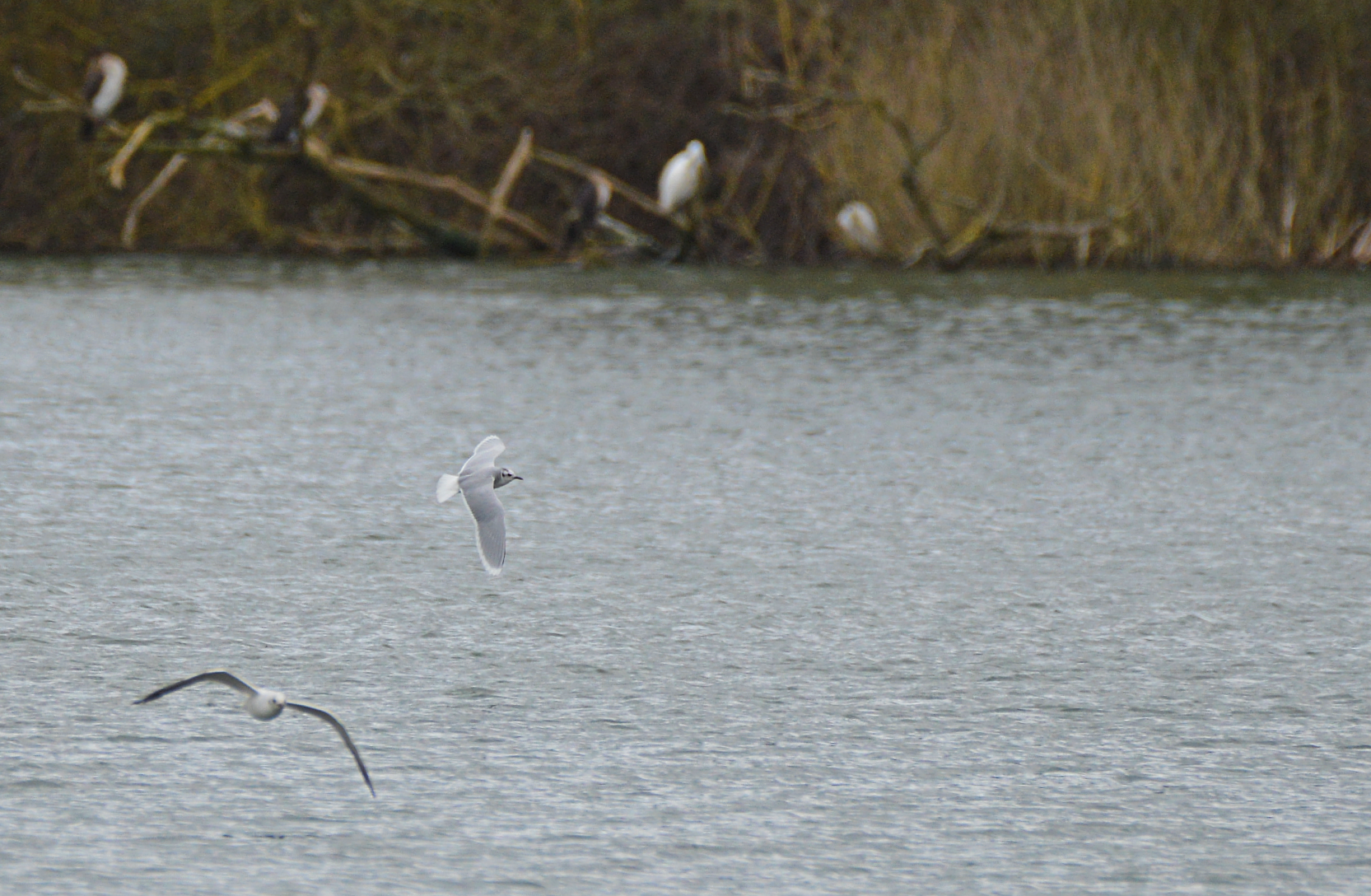
By late morning the cloud was beginning to clear a bit, as forecast, and news broke of an Alpine Swift down at Chichester GPs. Normally, I would resist the urge to twitch but, as it was a Sussex tick just 20 minutes from home, and Kate and I were out anyway, we decided to pop down. Typically, I arrived to find that it had flown off strongly about half an hour beforehand, but it was still great to see my first two Little Gulls of the year feeding over West Trout Lake.

Little Gull
3rd April

The first frost for a little while. I headed over to Pulborough Brooks for a bit of a session there this morning, which began with promise in the form of a Swallow over the visitor centre then a singing Willow Warbler down the ZigZag. The North Brooks seemed quiet aside from a scattering of the usual ducks, but then Juliet Moore text to inform me of a drake Garganey on the South Brooks. I hurried to the viewpoint behind the Hanger and managed to get very distant views of it, right over by the river bank. Heading round to Winpenny, I caught up with Juliet, Chris and Alan there, where we enjoyed brief views of a Water Pipit (presumably the same individual that has been around since January) as well as 2-3 Swallows and at least 10 Sand Martins feeding out over the water. A Chiffchaff was noted nest building near the hide and on the way back up top I saw a Woodlark briefly song flighting above Uppertons Field before dropping back down into the grass.

A lunchtime 1k walk was very pleasant indeed in the now warm sunshine but largely uneventful aside from a Brimstone butterfly, a clear fall of Chiffchaffs and a 'new in' Blackcap singing on the edge of Lodge Hill. 

4th April

Another cold and frosty start and a day in which I hadn't planned to do much birding, due to work commitments. Sometimes though, those end up being the best days! A dawn walk around the local farmland proved to be really enjoyable. A hunting Barn Owl down at Wharf Field near Thorndale Bridge was followed by a singing Blackcap and a rather late Redwing, then, best of all, my earliest ever singing Nightingale in scrub between River Lane and Waltham Brooks.

Barn Owl
It only gave a few phrases but it was unmistakable. Sadly, when I tried to get a bit closer, it stopped singing and there was no further sign. Garden birding on and off during the day produced lots of Buzzard action and a few Swallows flying over. 

5th April

A cloudy start to the day after a couple of days of easterlies seemed like good fall conditions. I headed out early on foot, through the local farmland towards Waltham Brooks. Yesterday's Nightingale was still present and singing on and off, while there seemed to be even more Chiffchaffs around the place. At Waltham Brooks there were at least 3 Sedge Warblers singing in the vicinity of the main lake, with two engaging in some territorial scuffling. A Stonechat was singing near the railway crossing too. Gulls were in evidence, moving overhead, including Mediterranean Gull - first a very vocal flock of 19 which flew north-west from Amberley towards Lodge Hill, followed by at least four in with a flock of Black-headeds going north. 
Grey Wagtail

Mediterranean Gulls
6th April

A bit of overnight rain, followed by low cloud and a brisk south-westerly had me thinking it was a water body kind of morning. I headed over to the private site near Petworth which quickly produced a Little Ringed Plover flying around calling over the farmland, followed by ~35 Sand Martins, 2 Swallows and a House Martin feeding over the reservoir; the latter my first of the year here. Best of all though, was a Redshank which announced itself first by its mournful call (don't they always?) before I got eyes on it on the far bank. After a little while it took flight through the cloud of hirundines and disappeared purposefully east. Amazingly, considering I have recorded Spotted Redshank and Greenshank here, this was my first site record of Redshank!
Redshank
A check of Burton Mill Pond on the way home produced 29 species in 20 minutes including a squealing Water Rail and a lone drake Mandarin. 

A walk round the hamlet and local fields at lunchtime produced a pair of Swallows on wires - my first 'local' pair seemingly back on territory, as they proceeded to feed merrily over the nearby horse paddock for the rest of my walk. Also of note were a Brimstone and my first Dark-edged Bee-fly of the year.
Swallows
7th April

It was a clear and still morning so I decided to head to local woodland for another go at Lesser Spotted Woodpecker. Sadly I didn't connect, but did have at least four Mediterranean Gulls flying over Coldwaltham Farm, heading high west, calling. 

In the evening I was back at Knepp for my first proper safari of the year, the clear highlight of which was the first Nightingale of the year there, singing very briefly in the Southern Block while I was pouring drinks for the safari guests. This was followed later on by a rather incongruous Woodcock, flying out of the stable yard at New Barn Farm through the headlights of the 4x4 buggy I was driving. 

8th April

My birthday and I was dropped off at Pulborough Brooks fairly early where Steve B and Paul D were waiting for me, later joined by other friends, and we did a full circuit of the nature trail. Sadly the thick fog was slow to clear but, when it did, we enjoyed good views of three pairs of Avocet on the North Brooks and my first Whitethroat of the year along Adder Alley. Late morning we headed down to Rackham Viewpoint where we quickly found one of the White-tailed Eagles along with a lone drake Garganey (there were at least three here yesterday).

A short walk round the local fields in the evening produced the Nightingale singing again. It seems to be getting gradually more vocal by the day.

9th April

Another rather misty start but thankfully nowhere near as bad as yesterday. I headed out early across the local farmland towards Waltham Brooks. The Nightingale was in good voice in the scrub near Besley Farm. Highlights at Waltham Brooks, meanwhile, were my first 1km Whitethroat of the year, at least three Sedge Warblers and a single Snipe. 
Roe Deer

Whitethroat
10th April

A very wet start so I didn't get out straight away. A late morning walk round the 1km area was largely without any fireworks until near the end when I found a singing Nightingale up Sandy Lane on the edge of Watersfield Common - my second 1k record so far this spring. As it's our first spring in the area, it's going to be really interesting to see how many of these guys breed locally.

Early afternoon I headed over to the farmland and private reservoir near Petworth. There wasn't much of note on the reservoir itself aside from an increase in Tufted Duck (20), a lone Great Crested Grebe and a few Swallows and Sand Martins. Passerine interest in the surrounding fields was better through with (at last!) my first Wheatears of the year (both male and female) hopping about in a potato field, and a singing Willow Warbler nearby.
Wheatear
11th April

A fine but breezy start to the day. I decided to venture out on foot from home to do the loop to Waltham Brooks via the river and the local farm fields. The farmland and river didn't produce much but a nice selection of warblers awaited me at Waltham Brooks including my first two Reed Warblers of the year (already reported by Wes A on Sunday), along with at least three Sedge Warblers and two each of Whitethroat and Willow Warbler. Around 60 Sand Martins were hawking around over the main lake. Heading towards the railway line I could hear a Nightingale singing and, as I got nearer, I realised it was two males engaging in a bit of a vocal duel. Unusually, I got brief views of both them, perched out in the open in a willow before they disappeared back into the scrub.

Later in the morning two House Martins flew west over the house and a singing Skylark was audible from the garden - the first time that's happened since we moved in. 

Saturday, 11 April 2020

Crepuscular delights

As much as I've been enjoying the BWKM0 garden birding challenge, this time last week I still hadn't actually had any new additions to the garden list as a result - unlike many others taking part. All that changed in the past few days though, with three garden ticks, one of which was in fact a new species for me in the UK!

It started on Monday morning with the classic drizzly, misty conditions producing the hoped-for Little Gull out on the North Brooks scoped, of course, from the attic. The day soon turned dry and the very calm, chilly evening seemed a good opportunity to get the nocmig recording gear out again. As I did so heard a 'twit twit twit' call which, although immediately familiar, I just couldn't place. A few minutes later I heard it again and the penny dropped, or at least sort of. I text Ed Stubbs to ask if it would be too early for a Spotted Crake, to which he replied 'early but not impossible'. Sure enough, going through the recording the next day I was able to confirm it was indeed a Spotted Crake, which sang several times up until 22:30, after which it wasn't heard again. What an amazing 'garden' record, and a lifer to boot! It's hard to imagine how I can better that on the lockdown list really.
The final garden tick of the week came on Good Friday morning. Mrs Matt and I had decided to get up extra early to listen to the dawn chorus from home. No sooner had we sat down in the garden with coffee and blankets than I heard what sounded like a Nightingale giving its 'huweet' call. Now, obviously the species breeds on the RSPB reserve, so it's always been one I'd hoped to hear from home one day, but I still struggled to contain my excitement when this one started belting out its song from the scrubby bank just below and along from the garden. A Red-legged Partridge 'singing' somewhere beyond the Arun wasn't a new one for the garden but represented an equally welcome lockdown tick. Added to a singing Goldcrest this morning, the BWKM0 list now stands at 89, out of a garden total of 129. What next, I wonder?

Tuesday, 29 May 2018

Bank Holiday birding

I made two visits to the Brooks on Friday to see if the ongoing waderfest had any more surprises in store. At Winpenny in the morning there were five Greenshank and sixteen Ringed Plover while in the evening I bumped into Anna Allum and Graham Jenner and we all enjoyed good views of a spangly Wood Sandpiper. A Water Vole swam across the pool in front of the hide which was a nice bonus. I ended the day with a watch across the Mid Brooks from behind the visitor centre which produced an impressive 75+ Rooks flying west to roost, then wandered over to the heath where a single male Nightjar churred near Black Pond and a couple of Stag Beetles flew around. Thankfully I remembered my insect repellent this time - the Pulborough midges are ruthless!
On Saturday morning I spent a couple of hours at Winpenny with Alan Baker where I finally caught up with the very smart summer plumage male Grey Plover reported the previous couple of days along with the first summer bird, now present for its sixth day. It's good to see several Redshank and Lapwing chicks around now - apparently seven pairs of the former and twenty pairs of the latter have bred onsite this year, which is great news.
Grey Plover
Also here were four Greenshank and three Ringed Plover. The North Brooks held a single Black-tailed Godwit and a couple of Shoveler and Teal, while at Hail's View I found a hawking Hobby, and the regular Great Spotted Woodpecker pair still busy feeding young. By the time I headed home it was getting very warm so I stopped at Black Pond for a bit to take in the impressive numbers of dragonflies here, mostly Four-spotted Chasers but also the odd Hairy Dragonfly and others too quick for me to identify! (Odonatology is not my strongest subject but I'm determined this year to try and learn more as Pulborough is a perfect place to do so).
Four-spotted Chaser
Just a couple of fairly brief visits on Sunday and Monday morning were enough to show the wader extravaganza was coming to an end with 'just' four Greenshank, eight Black-tailed Godwits and two Ringed Plover on Sunday and just the Godwits again on Monday. Still, it was exhilarating while it lasted, and perhaps there's still one more gem to come before things really quieten down into the summer months? But then, if birding teaches us anything, it's to expect the unexpected!
Greenshank
I spent most of Monday exploring some famous but hitherto unknown to me sites in East Sussex, trying to help Charlie Peverett with his attempt to record 110 species in the Newhaven/Hailsham area in a single day. I joined Charlie a few hours into his marathon at Splash Point where the sea proved to be very quiet but we still managed to add Sandwich Tern, Gannet, Rock Pipit and Kittiwake to the day list, along with a few other common bits. I'd never been here before so the Kittiwake colony on the cliffs was quite a sight to behold.
Kittiwakes
Our travels later took us to Charlie's patch of Pevensey Levels, a remarkable East Anglian-style landscape, where fellow patch watcher Chris Ball had earlier found a Rose-coloured Starling, which we soon caught up with, along with Yellow Wagtail and Hobby for the day list. We then headed to Arlington Reservoir, hoping the gathering storm clouds would drop a Black Tern or something special, but in the end the best birds here were Little Egret, Common Sand and Nightingale, plus a singing Yellowhammer which was another day tick. Charlie and I parted ways early evening and he went on to notch up 87 species in total; really not too bad for the time of year and the limited area in which he was recording. Perhaps we can try again next year with a bit more success!
Rosy Starling, Horse-eye Level - the fourth time I've seen this species but the first time in near full adult plumage

Sunday, 20 May 2018

May so far...

It's been a busy couple of weeks and, with the days getting longer, computer time has now inevitably taken a backseat to time in the field - hence the rather reduced amount of blog posts recently, particularly when it comes to the patch stuff.

It's fair to say it's been a challenging spring for birders (unless you happen to have been lucky enough to be on Shetland this past week!) and, indeed, birds. Many species have been arriving later than usual, in reduced numbers or in some cases not at all.

At Pulborough the lion's share of migrant species have arrived or passed through now, it seems, although numbers do seem rather low in many cases. There certainly seem to be three Nightingale territories as far as I can ascertain, but seemingly no more. A couple of weeks ago we were all hopeful that they and many other birds were just delayed and on their way but it does now seem as though many birds just aren't coming back this year, which is a little worrying.

Wader passage has been rather slow to get going too. After the excitement of the Black-winged Stilt at the end of April and a little flurry of LRPs, Common Sandpipers and the odd Whimbrel and Wood Sandpiper, there's wasn't much of note during the first half of May aside from the lingering Avocet pair and a couple of Greenshank. Singles of Ringed Plover and Spotted Redshank on Friday provided a little more promise though - hopefully spring has a few more tricks up its sleeve yet. In more positive news it was good this week to see the first Lapwing chicks appearing on the Mid Brooks, hopefully to be followed soon by young Redshanks.
Avocets
Probably the standout bird so far this month was a long overdue drake Garganey found by Alan Baker at Winpenny on the 17th. Perhaps half of a pair that has bred nearby, they're a species I never tire of seeing - particularly the males. Typically, I missed the bird first thing as I'd opted to check out Hail's View and Black Wood before work, where I did at least find my first patch Spotted Flycatcher of the year, but thankfully the Garganey stayed until the evening. Indeed, as of yesterday it was present for its third day but there were no reports of it today.
Spotted Flycatcher
Garganey - distant but unmistakeable!
One of the male Cuckoos (there were definitely two singing for a short while a couple of weeks ago) has now paired up - if one can call the rather half-hearted relationship that Cuckoos engage in 'pairing up'! I saw them both together in Fattengates Field on the 5th and the male has not been singing quite so much this past week. The local Dunnocks must be getting nervous now! After a brief lull it was good to see and hear Lesser Whitethroats along Adder Alley and at The Hanger again this week. Also encouraging via Liam Curson was a singing male Redstart in Black Wood on the 16th. A species still absent from my Pulborough list, hopefully it sticks around and finds a mate, if not I'll probably have to wait until the autumn to catch up with one.

An evening vigil on the heath on the 13th produced my first Pulborough Nightjar, with one briefly churring rather distantly to the south of The Clump around 21:20. It actually sounded like it was probably just south of the Greatham road, but a patch tick is a still a patch tick! My Pulborough year list now stands on 137 with still all to play for, with Yellow Wagtail, Osprey and various waders still among the 'easy' additions to the list in what's left of spring.
Tawny Owl - the popular family near West Mead seem to have moved on now after the RSPB wisely chose to temporarily shut the path for the birds' protection

Kestrel at Winpenny
Away from the patch, and possibly one of my most memorable birding moments to date came on Bank Holiday Monday when, a couple of hours into an otherwise rather unremarkable visible migration watch from Leith Hill Tower, Wes Attridge clocked four 'interesting' birds tracking east along the North Downs. We Leith Hill-ers always joke about Wes's extraordinary abilities to not only pick up birds at distance but also to identify them before most of us have even got eyes on them, so for him to hesitate at the ID on these four immediately hinted at them being something a bit special.

Sure enough, I'd barely got my scope on them before he'd already ruled out Cormorant/gull/wader and exclaimed 'Are these...Skuas?!!'. As they banked around in front of Box Hill and the London skyline and started powering south past Leith Hill towards the coast, we could clearly make out the broad but pointed wings with white flashes towards the tip, the overall dark colouration, the bulky head and barrel chest and short tail of GREAT SKUAS. A Surrey lifer for me, and totally unprecedented. We had them in view for over ten minutes before they eventually disappeared into the mist towards the Shoreham Gap. Totally unforgettable and one of those heartstopping moments every birder dreams of.
The view from Leith Hill Tower on what shall forever be remembered as 'Bonxie Day'
The memory of that day was still fresh in the mind when Wes and I convened with Ed Stubbs and Stuart Cossey pre-dawn on the 12th to attempt to defend our title as Mole Valley Bird Race champions for the third year running. Despite the very worst conditions - heavy rain all afternoon - on top of the aforementioned disappointing spring, we still managed 89 species which I'm pleased to say was enough for us to secure the hat trick. As is always the way though with bird races, there's always some odd omissions - we spectacularly failed to find a Sparrowhawk all day and, rather more worryingly, not one of the teams managed to record Tree Pipit, despite the heath at Leith Hill being a failsafe location for them in all previous years. On a positive note though Cuckoo numbers seem up this year, particularly at Leith Hill where there must have been at least four or five singing males.
Tawny Owl chick, ringed in Capel by Wes and Stu during a brief break in the bird race
Finally for this round-up, I couldn't resist a bit of an excursion to the furthest corner of East Sussex yesterday to see the Terek Sandpiper at Rye Harbour. A new bird for me, it showed beautifully in the sunshine for all present. On the odd occasion I do bother to twitch it's always an added bonus to run into some friendly faces as well as the target bird, and yesterday was no exception as it was a pleasant surprise to see Oliver Simms and Steve Gale down there.
Terek Sandpiper
 

Whether or not May is still to deliver a flood of very late migrants or a nice local overshoot (Little Bittern please!), it's reassuring to remember the days start getting shorter again in just over a month which means the start of return migration is just a few weeks away... You're welcome!