21st March
An initially atmospherically misty start to the day quickly turned into a thick peasouper and put paid to my attempt at a dawn check of Waltham Brooks. I could just about make out 22 Tufted Duck on the lake and there were plenty of Chiffchaffs singing around the place, but otherwise not much to report.
After dropped B off at nursery I quickly headed up Amberley Mount to see if the top was above the fog, which it was. 20 minutes in glorious sunshine up here proved rewarding with Skylarks in fine voice and my first Wheatear of the year - a female - briefly posing well at Downs Farm before disappearing over the rooftops of the farm buildings. It struck me while I was up here that it's been quite some time since I saw a Little Owl up here, as the cow sheds at the farm used to be a reliable spot for them a year or two ago.
 |
| Skylark |
 |
| Wheatear |
Late afternoon I headed out again after work for a quick sweep of a couple of local sites. First, the scrape at Bignor Park which held the lingering Green Sandpiper, three Little Grebes and two drake Tufted Ducks, the latter a first for me here. The private reservoir at Petworth didn't hold any surprises, just a handful of Gadwall, a Little Grebe and the usual singing Skylarks and Yellowhammers around and about.
22nd March
An early walk out from home to the river via Thorndale Bridge proved productive with first a singing Blackcap by the railway bridge, followed by a Redshank calling out towards Amberley West: All three of those species new for the year list! Up at Waltham Brooks there were again 22 Tufted Duck on the main lake but little else of note. The biggest surprise came in the form of a softly singing Willow Warbler in the scrub by the lake, equaling my earliest ever record of the species following on from one at Pulborough Brooks on 22nd March 2020.
Early afternoon I headed out again for an early afternoon check of a few more local sites. The scrape at Bignor Park held the lingering Green Sandpiper and Egyptian Geese pair with their four young. Amazingly, as I scanned the water, the sound of another singing Willow Warbler drifted into my peripheral hearing. I made my way over to where the sound was coming from and found it flitting about in the hedgerow willows.
 |
| Willow Warbler |
23rd March
No birding today as I was up in Chelmsford speaking at the Essex Birdwatching Society Conference on the subject of Avian Reintroductions: Past, Present and Future.
24th March
Out at dawn this morning for a full loop of Pulborough Brooks before a busy day of non-birding stuff. It was another cold day, particularly in the brisk north-westerly, but pleasant enough in the sunshine out of the wind. As was the case yesterday, it felt like a good day for large/soaring birds, so I actually had Spoonbill or
Common Crane in the back of my mind as I set off round the trail. West Mead and Winpenny hides proved rather quiet, with just two each of Dunlin and Avocet out on the South Brooks (I missed the mini wader-fest here on Friday which included Grey Plover, Golden Plover and Ringed Plover - a great day for Chris and Juliet Moore et al). Moving round to the Hanger and, amazingly, almost the first bird I picked up (after a Great White Egret) was a second year Spoonbill busily feeding on the back pool. It continued feeding very actively up until I left soon after 7:00, even giving a little flight across the pool at one point. Evidently it was refuelling to continue its journey, as it wasn't seen by a number of other birders who visited later in the morning. Also on the North Brooks were my first Little Ringed Plover of the year and at least five more Avocets.
 |
| Spoonbill |
 |
| Cetti's Warbler |
25th March
I had a work trip down to the New Forest today but managed to squeeze in a very quick look at the Bignor Park scrape before I left, where I found the lingering Green Sandpiper still present along with a couple of Snipe, a single Little Grebe and a Willow Warbler softly singing in the roadside hedge; presumably the same early arriving bird I heard here on Friday. Also singing nearby was a Blackcap, my first for this hotspot.
On the way home I checked a couple of local sites, first up the private reservoir near Petworth which seemed very quiet until I picked up a
Little Ringed Plover lurking on the far shore - my first here this year. Next up, I stopped for a look at Waltham Brooks. This seemed even more quiet, with not a hirundine or wader in sight. Four Tufted Duck were on the main lake, as was a nest-building Coot.
 |
| Little Ringed Plover |
26th March
A loop of Waltham Brooks before work produced 34 species including an immature Peregrine circling overhead before drifting towards Lodge Hill - amazingly only my second record locally this year, not including Pulborough. Other bits of note included eight Tufted Duck on the main lake, at least ten singing Chiffchaffs and a Grey Heron which flew high south-east.
 |
| Peregrine |
What was presumably the same Peregrine was seen again later in the morning, drifting over the garden. After a pleasant start to the day, the forecast rain eventually arrived around lunchtime and the conditions felt good for dropping some migrants, so expectation was high as I headed out to check a few water bodies in my lunch break. In reality though, it was all a bit of a damp squib. The Egyptian Goose family were still at the scrape at Bignor/Hadworth Farm, while the private reservoir near Petworth held a few more ducks than on recent visits (three Shoveler, two Gadwall, four Tufted Duck) but there were no newly arrived migrants to speak of really. The water meadows at Fittleworth held four Lapwing but not a lot else.
 |
| Egyptian Geese |
27th March
An early walk from home out to Thorndale Bridge and up the riverbank to Waltham Brooks at dawn. There were plenty of Chiffchaffs and the odd Blackcap about in the first section of the walk, and a male Stonechat was singing quietly at Thorndale Bridge. As I neared the lake at Waltham Brooks I picked up a lone Sand Martin flying towards me, later joined by five others, all busily feeding overhead. Despite the brisk wind, I was also able to pick out the unmistakable song of my first Sedge Warbler of the year singing in the reeds by the lake; my earliest ever arrival date for this species. A Willow Warbler was also sub-singing nearby, with a second bird in sallows near the sewage works. It really is extraordinary how many seemed to have arrived so early this year.
 |
| Waltham Brooks |
Later in the day I headed back out to check the scrape at Hadworth Farm/Bignor which held the long-staying Green Sandpiper but little else of note. At the private reservoir over near Petworth I was surprised to see a male Shelduck on the far bank with an Egyptian Goose. A long overdue first for me at this site. It didn't stay long after I arrived, before it flew off south-west. Another Willow Warbler here takes my March total so far to at least five different birds at three sites.
 |
| Shelduck |
28th March
As forecast, today was a mixed bag on the weather front. Although it started relatively calm and dry after overnight rain, it didn't take long for more rain to arrive and the wind to strengthen, reaching gale force by the afternoon. I didn't get out birding early this morning, instead opting to start working relatively early and take advantage of my booked afternoon off by heading out after lunch. The scrape at Bignor was relatively quiet aside from the usual bits, although I did note a Coot on a nest here. At the reservoir near Petworth, it was encouraging to see ten Sand Martins feeding over the choppy waters; my highest count of the species anywhere so far this year. A quick check of the Rother at Fittleworth produced six Little Egrets, and two pairs of Lapwing, one angrily berating a Grey Heron.
 |
| Pied Wagtail |
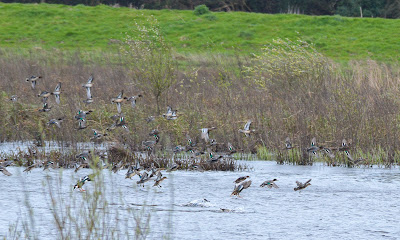
Finally I headed over to Waltham Brooks for a quick check of the main lake. By now the wind was very strong and it was hard to hold my bins steady. Four hirdundines came in from a northwesterly direction which I initially took to be Sand Martins before realising they were all Swallows! They didn't hang around and flew straight through towards Amberley. Immediately after this, all of the ducks on-site suddenly exploded into flight (flushed by a Marsh Harrier I realised a bit later, when it flew off over the trees towards Amberley). I had previously only noticed a handful of Shoveler, Teal, Wigeon and Tufted Duck but soon realised there was in excess of 150 in total. Realising there had to be a chance of a Garganey in among them, I quickly fired off as many photos as I could and, sure enough, when I looked on the camera screen, there were in fact two Garganey - a male and a female - in among the flight of Teal. Fantastic! Despite sticking around a while longer, I never actually saw them again, but did hear the male croaking a couple of times.


 |
| Spot the Garganey! |
29th March
I was at Pulborough Brooks soon after dawn this morning where I caught up with Paul Davy and Steve Baines. The South Brooks had the bulk of the action, certainly wader-wise, with two Avocet and a single Black-tailed Godwit here among the breeding Lapwing and Redshanks. Three Dunlin were seen in flight but we couldn't locate the lingering Water Pipit seen by Harry Ramm. A pair of Peregrines flew through low. Moving round to the North Brooks where, from the Hanger, we saw the usual selection of dabbling ducks still hanging on, in significantly reduced numbers since my last visit. 2-3 Swallows were feeding among a dozen or so Sand Martins. Around 40 Herring Gulls and a few Common Gulls were gathered on the spit between the two main pools (with at least another 30 Common Gulls drifting overhead).
30th March
A misty start to the day as the wind shifted to south-easterly overnight. I headed out early for a sweep of some water bodies. The reservoir over at Petworth held a lone Great Crested Grebe, and three Lesser Black-backed Gulls flew high north-east. The mixed singing Willow/Chiff was still present, but otherwise it was a quiet affair here. In fact, the bird of the morning was a Barn Owl which flew low over the road near Bury. The Rother at Fittleworth had fully overtopped again, completely flooding the water meadows, which held little of interest aside from my first Mallard ducklings of the year (one female with eleven in tow!). The scrape at Bignor/Hadworth Farm was still hosting the lingering Green Sandpiper as well as Little Grebe, five Tufted Duck, and multiple Coots (including one sitting on a nest).
Mid morning we headed down to Arundel to feed the ducks at Swanbourne Lake. Two Shelduck which flew off the water and over towards the WWT were my first here, while other bits of note included at least five Mandarin and a pair of Egyptian Geese with two young. As the day was beginning to warm up, so insects began to become more apparent, including Brimstone and Peacock butterflies seen here.
Later on, back at home, I headed out for a little walk around the local fields and added Speckled Wood to the year list, with two doing their courtship dancing flight through a garden on River Lane. A check of several of the local fields and paddocks failed to produce any migrants, aside from a couple of singing Blackcaps. Back at home, Blue Tits were busy nest-building in our garden nestbox.

 |
| Mandarins |
 |
| Lesser Black-backed Gull |
31st March
A mixed bag today, taking in various local spots. A return family visit to Swanbourne Lake for a go on one of the rowing boats produced an unexpected local year tick in the form of an adult Great Black-backed Gull chilling towards the northern end of the lake. This species often proves to be a bit of a low key tricky one to find locally, with perhaps 2-3 records most years, so it's always a reassuring one to get on the year list relatively early in the year.
 |
| Great Black-backed Gull |
Later in the day I checked out some of the other local water bodies. First up, the private reservoir over near Petworth which held a lone Dunlin but was otherwise quiet aside from the Willow/Chiff still singing. The scrape at Bignor Park/Hadworth Farm, meanwhile, produced just a pair of Teal of note.


