Showing posts with label marsh harrier. Show all posts

Wednesday, 20 December 2023

Dark days

11th December

As is typical for the time of year, the darkness creeps ever more into my available birding time, but I managed to squeeze in a couple of short sessions before work and at lunchtime today. First, a 45-minute venture out to the local farmland near home which yielded 40 species including a few Teal and Wigeon on the flooded fields and singles of Chiffchaff and Cetti's Warbler in the bushes. Small groups of Fieldfare and Stock Dove were noted flying south/south-west overhead.

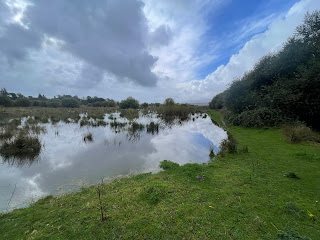
Watersfield living up to its name
Mid-morning I caught sight of a Peregrine circling over Watersfield before drifting off towards Amberley. 

A lunchtime check of Waltham Brooks produced the usual species, with a distant Marsh Harrier over towards Amberley probably the highlight. A male Stonechat in the scrub between the lake and the road was notable only for the large white spot on its face. I'm not sure what it was exactly. At least five Tufted Ducks were still on the main lake. 

Stonechat
12th December

A look at Waltham Brooks this morning en route to work produced an impressive array of ducks on the main lake, including at least 90 Shoveler and 10 Tufted Duck. A Marsh Harrier briefly stopped for a look, flushing 5 Snipe in the process, while 27 Fieldfare flew out of roost. 

Marsh Harrier
13th December

I was down in Rye today for a SWT staff meeting. Conditions weren't great but we had an enjoyable hour's walk round the reserve early afternoon led by new reserve manager Paul Tinsley-Marshall. The lingering Spoonbill was still roosting on Flat Beach which also held good numbers of Shoveler, a few Pintail and half a dozen or so Tufted Ducks. Well over 400 Cormorants flew over into roost as we were walking around, and around 50 Curlew did the same, coming in from the north-east as we were heading back to the car park. 
Cormorants
The obligatory sleeping Spoonbill photo
                              
14th December

Shoreham-by-Sea was the destination for today's work meeting, so I decided to swing past the harbour and Southwick canal while I was down there, hoping to connect with the lingering Great Northern Diver that's been in the ship canal for a couple of weeks now. 45 minutes of trekking around the area between the canal gates and Barrett Steel proved fruitless, as did a walk out to the seafront but I eventually got the bird just as I was leaving, along with the juvenile Eider that has also been around a while. Sadly neither gave as good views as the Turnstones on the sea wall!
Turnstones
15th December

After enjoying a Firecrest in the garden first thing this morning, I just had time for a quick circuit of the local farmland before starting work. This proved unremarkable aside from at least one heard-only Golden Plover flying overhead, seemingly heading east/north-east.
Firecrest
Late afternoon I headed over to Burton Mill Pond for a last light vigil from the viewing platform which produced 27 Little Egrets heading to roost plus 43 Cormorants, ~500 Starlings (dropping in to the reeds on the eastern side where two Sparrowhawks were patrolling), 2-3 Water Rails and a Kingfisher. 

16th December

An unusually free morning saw me taking a tour of various local sites, starting with the private reservoir near Petworth for the WeBS count there, where I found the Long-tailed Duck present again, having apparently gone AWOL on my last visit here a few days ago. Otherwise, waterbird numbers were really poor, with just 11 Tufted Duck, a lone female Pochard, a few Coots and a single Little Grebe. 

A check of the water meadows and farm fields by the Rother in Fittleworth produced seven Little Egrets around the cattle at Street Farm, a Chiffchaff calling at the sewage works and a male Stonechat in the scrubby field nearby.
Fittleworth Water Meadows
Then it was on to check the farm scrape at Hadworth Farm which held a pair of Gadwall, a few Coots and Mallards and a lone Cormorant perched in the dead trees behind the flood (another flew over heading east). Perhaps most notable here was the flock of ~250 Stock Doves which flew up from the fields to the south-west. 

Later in the morning I took a stroll out down the road from home which produced a Peregrine and at least nine Snipe flying high overhead.
Snipe
17th December

A morning walk round the local farmland proved fairly quiet aside from the now almost daily Peregrine circling high over Watersfield, and around 55-60 Fieldfares flying towards Coldwaltham.
Peregrine
Late afternoon I headed over to Thorndale Bridge for a scan from the railway embankment here (flooding made the walk under the railway bridge to the river bank impassable), the highlight of which was a Barn Owl hunting over the southern end of Waltham Brooks. At least 60 Redwings and 30 Fieldfares flew to roost, and at least four Water Rails were calling around the area. A Merlin flew low and fast over River Lane as I was walking down. 

18th December

A brief stop off at Waltham Brooks on my way to work this morning where highlights included an impressive 28 Tufted Ducks on the main lake (certainly my highest count of the species here), four Red Kites together over Quell Farm and a single Marsh Harrier flying north. Redwings were noticeably moving overhead, with 150 west in the 25 minutes or so I was on-site. 
Quite a lot of Tufted Ducks!
A lunchtime stroll at Woods Mill also proved reasonably lively for the time of year, with 30 Common Gulls over, a Water Rail showing very well but very briefly swimming across a ditch, and a Kestrel which was surprisingly a reserve tick for me!
Moorhen
19th December

A pretty rancid day, weather-wise. I did manage a brief lunchtime walk from home over to Waltham Brooks and back, but there wasn't much on offer there to write home about. Yesterday's bumper count of Tufted Duck had reduced to just a single drake, six Pintail and a single Raven flew north/north-west and nine Siskins flew into the Poplars near the lake. 

20th December

A quick dash up Amberley Mount before work proved to be quite lively, with as many as ten Red Kites, three Buzzards and 50+ Common Gulls all distinctly displeased by the arrival on the scene of a juvenile White-tailed Eagle which powered north low over the tumulus, briefly disappearing over the northern slopes before returning and drifting around over the vineyard towards The Burgh. It still blows my mind to see the size of these things in direct comparison to a Buzzard!
White-tailed Eagle
Red Kite
A lunchtime stroll at Woods Mill produced a similar number of Common Gulls to Amberley Mount and a reasonably showy Cetti's Warbler in the scrub along the stream.
Cetti's Warbler

Monday, 20 November 2023

Halfway through November

I saw a thing on Facebook recently about November days being weird as it increasingly feels as though there is no afternoon, just morning, lunchtime, and night-time. By the middle of the month that creeping darkness really eats away at both ends of the day and any residual early morning light we borrowed back after the clock change has already fizzled away. The days are short, and so is time for birding. What November does offer though is the first taste of winter, both in terms of crisp, frosty mornings, breathtaking sunsets and the arrival of winter visitors. It certainly looks like we are set to experience a long overdue influx of various species this winter, from Short-eared Owls to Waxwings to Mealy Redpolls. What's been apparent locally in this ten-day period has been a gradual increase in the background species, with the likes of thrushes and winter ducks noticeably climbing in number, plus some impressive movements of Woodpigeon on the days when the wind and rain have abated.

11th November

The first crisp, frosty and bright morning for a while so I decided to head out on foot from home, in the hope of relocating the probable Hume's Warbler at Waltham Brooks. It was clear fairly soon after arriving there was a fair bit of stuff moving overhead, with a couple of biggish (200+) flocks of Woodpigeons and decent numbers of Fieldfares (160+) moving south-west. It was still pretty cold around the sewage works and not super lively with passerines.

As I passed to the north of the works though and headed up towards the road, I again heard the call which caught my attention earlier in the week, coming from a block of sallow just to my right. I moved over to get closer and to get on the sunny side of the trees. Just as I did so and set about trying to pin down the bird, there was a great commotion, alarm calling and a burst of feathers as a Peregrine dived low through the sallows and narrowly missed catching a Fieldfare. A small passerine flew pretty much over my head, into the bushes on the other side of the railway line and, unhelpfully, straight into the sun from where I was looking. I realised from the continued calling that it was the same bird, but there was no way I was going to pick out any plumage detail from this side and in this light. After a couple of minutes I decided to walk around and try and get a better look and there began a merry two hour goose chase trying to pin down the bird again. Despite my best efforts, I only heard it again a couple of hours later, just before 10:00, in sallows right by the sewage works. Gareth James and Mark McManus showed up mid-morning and I decided to leave them to it at this point, as birding fatigue was setting in! I really don't know what to make of this bird, the recordings today don't sound as convincing for Hume's as the one in the week, and I am beginning to wonder if it isn't just a weird Chiffchaff. 

A late afternoon stroll round the local farm fields with B proved quite productive with a flock of 23 Redpoll flying high south, lots of ducks in flight over Waltham Brooks, including 24 Pintail north, and four Little Egrets and a single Great White Egret flying south-east towards Amberley, the latter an eBird tick for this hotspot. 

Pintail (and single Wigeon)

Distant Great Egret flying over Watersfield
12th November

In sharp contrast to yesterday, this morning it was back to grey, wind and rain. No birding in the morning aside from a short local walk with B which did include my first singing Song Thrush of the season (albeit a slightly hesitant one). 

Early afternoon we all headed over to Pulborough Brooks for lunch and I took the opportunity to scan from the South Brooks from the tea terrace, hoping to find the Spotted Redshank reported earlier in the day. There were a lot of birds to sort through, not least in excess of 300 Black-tailed Godwits, and it was proving difficult until all the godwits and wildfowl took to the air and I heard the unmistakable 'chu-it' call of the target species coming from somewhere in the melee. It took a while of sorting through once they'd all landed but I did eventually pick out the bird - my 160th local species of the year! While all this was going on an adult Little Gull also appeared among, hawking over the South Brooks briefly before continuing on south, while other waders of note were a Green Sandpiper flying over the tea terrace towards the heath and two Dunlin which dropped in among the Black-tailed Godwits. A male Marsh Harrier came powering in from the north-east and continued out over the South Brooks, while a juvenile type was over Widney Brooks, west of the Arun.
Little Gull
Marsh Harrier
Mixed flock airborne over the South Brooks - prize to anyone who can pick out the Spotted Redshank!

13th November

Another howling windy and wet start to the day today so no chance for pre-work birding, unfortunately. A lunchtime walk around Woods Mill in much more clement conditions produced a single Marsh Tit, half a dozen Fieldfares, three Redwings and a dozen Common Gulls flying over. A Red Admiral was also out and about enjoying the late autumn sunshine. 
Marsh Tit
Red Admiral
14th November

Another wet morning. I stopped off at Pulborough on the way to work, for a half hour scan of the South Brooks from the tea terrace. There was no sign of Sunday's Spotted Redshank but the Black-tailed Godwit flock had increased to at least 470, their loud chattering calls audible even from several hundred metres away. There were lots more Pintail too, at least 120 that I could see. 

A brief lunch break look at Waltham Brooks proved similarly routine, though it was nice to flush a mixed flock of Redwings and Fieldfares from the scrub nearest the lake - numbers of winter thrushes are definitely creeping up a bit locally now. Almost a daily occurrence here these days, but always nice to see, two Great White Egrets flew upriver.
Great White Egret
15th November

Two bites of the cherry at Amberley Wildbrooks today with short (15-20 minute) watches from Cross Gate on the way to and from work at Woods Mill. The morning session produced three Ruff, a single Dunlin, adult and juvenile White-tailed Eagles on some of the exposed patches of land in the flood, plus a flyover Brambling. I missed the three White-fronted Geese which have been around for a while and were seen by Paul this morning, but did manage to find them late afternoon. 
Very distant White-tailed Eagle on the island at Amberley
16th November

Another grey and wet day, no real birding of any note today. 

17th November

An absolutely dreamy late autumn/early winter morning at Burton Mill Pond where I notched up 54 species in just under 90 minutes. It was lively from the get-go with plenty of thrushes and finches about around New Piece, including a flyover Brambling and several Fieldfares (remarkably an eBird hotspot tick here!). As usual, Chingford Pond held the bulk of the waterbirds, with ten Little Egrets still at roost in the trees (following on from six which flew over early doors) and a Great White Egret stalking round the water's edge. Wildfowl-wise, highlights were 40 or so Tufted Duck and 25 Pochard plus a few Gadwall and heard only Mandarin. Woodpigeon movement suddenly picked up overhead at around 07:40, with 2,800 flying south-west between then and just after 08:00.
Great Crested Grebes
Woodpigeons
Little Egret
After work a brief stop at Waltham Brooks produced little of note aside from a Marsh Harrier and two Little Egrets, plus the usual selection of wildfowl on the main lake. 

18th November

Not much birding today, partly due to other commitments, but also hampered by the foul weather. Thankfully the rain eased off enough early afternoon for a little 1k area walk out round the local farmland. It was generally pretty quiet (not helped by the wind) until I stumbled across a lively passerine flock in the scrub south of Thorndale Bridge which held at least two Firecrests plus singles of Cetti's Warbler and Chiffchaff. There were also at least 14 Redwing and 18 Fieldfare around in the same area.
Firecrest
19th November

WeBS day today so I was out and about bright and early to check the private reservoir near Petworth, which still hosted the female Long-tailed Duck, sheltering among the usual Aythya flock. Tufted Ducks were represented by a modest 27 individuals but the Pochards had increased to a record breaking 57 - not just my highest count here but my largest total of the species anywhere locally. Otherwise it was usual fare, though the regular duo of leucistic Egpytian Geese were present among a group of 75 on the shoreline. 
Long-tailed Duck
I checked a few other water bodies on my way to and from the reservoir, including Burton Mill Pond (basically empty), Hadworth Farm (likewise) and the flooded Rother at Fittleworth which held just a couple of Mute Swans, a few Mallards and a flyover Little Egret, though it was nice to hear my first Song Thrush of the season properly belting out its song. 

20th November

More wind and rain this morning, but it eased sufficiently for me to grab an hour at Waltham Brooks before starting work, which proved to be a worthwhile decision. I'd only been there ten minutes or so when I heard the flight call of a Dunlin and looked up to see one powering north high overhead - a first for me on the reserve - not long after a flock of eight Pintail went the same way. The water levels have receded here quite a bit now so there's plenty of Snipe habitat about. I counted 21 this morning, helpfully being kept airborne for longer than usual by a Marsh Harrier hunting over the main lake. No Jack Snipe yet though. 
Otherwise it was business as usual with a selection of 35 Shoveler, 15 or so Wigeon, 50 Teal and a few Gadwall on the main lake. Thrush numbers seem to be gradually increasing, with at least 25-30 Fieldfare around on the reserve plus maybe half that number of Redwing, and a few Fieldfares on the walk home too. 
Fieldfare
Late morning, while working at home, I glanced out of an upstairs window to see a V formation of birds heading towards the house. Grabbing my bins just in time, I realised they were Golden Plover - around 90 of them - seconds before they disappeared over the house towards Fittleworth. Late afternoon/early evening, a Barn Owl flew low over the garden, calling, while the regular male Tawny Owl was also calling nearby. 

Monday, 6 November 2023

The season of letting go

So then, farewell to October. At a pinch one of my absolute favourite months of the year and which this year produced five local year ticks and a pleasing selection of memorable moments, in spite of birding with my arm in a sling for the most part and being unable to drive. 

This last ten-day period of the month always feels somewhat tinged with melancholy. It's hard not to feel as though autumn has peaked somewhat by the last week of October and that we are inescapably careering into the long darkness of winter, especially when the clocks change and any last hopes of evening birding are extinguished for the next three or four months. 

This year, October went out with a bang, as a series of Atlantic weather systems brought torrential rain which, combined with a period of spring tides, saw the Arun overtopping its banks in many places in the Pulborough area. The flooding in turn attracted my first local Little Gull of the year on the 31st - just a couple of days after my second local record of Long-tailed Duck in two years - and I finally joined the Short-eared Owl party in what looks to be the best autumn/winter for the species in several years. 

21st October

Not loads of time for birding today owing to family stuff but the loop from home to Waltham Brooks and back through the farmland produced a few bits of interest. Over 200 ducks were on the main lake at Waltham, mostly Teal and Mallard though with a handful of Shoveler (2), Gadwall (3-4) and Wigeon (8) mixed in. They were very flighty and at one stage had a single Snipe among them as they flew circuits around the place. Oddly, the only raptors noted were two rather distant Red Kites, so I'm not entirely sure what the wildfowl were getting upset about! A few Siskins and Redpolls were about and there were two Stonechats in the scrub near the railway line.

Wigeon
                                            
Teal
22nd October

No real birding today but notable by their movement at both Bignor and Fittleworth during family activities were a steady stream of Red Admirals moving through, mostly south-west.

23rd October

I was at Knepp all day today for an excellent beaver workshop so not much birding time, but of note here were three Fieldfares and a single Siskin over towards the western side of the estate (near the beaver enclosure, in fact). 
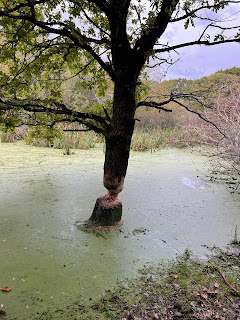
Here be beavers!

24th October

A mixed bag this morning started with 80 minutes' vismigging from the high ground above Watersfield. It was generally fairly quiet, certainly in terms of thrushes and finches, though there was a distinct increase in Woodpigeons and Stock Doves moving south-west, though still only modest numbers (150 and 69, respectively). Best of all were 20 Pintail (15 south/5 north) over Lodge Hill which may have been local wintering birds arriving in the area, but it was still quite cool to see them 'migging' over open country.

A stroll over to Waltham Brooks later in the morning produced a Great White Egret dropping in near the main lake, a few Skylarks and Siskins over, and a flock of 40 Wigeon flying towards Widney Brooks. A Woodlark flew north-east over the farmland near home. My seventh record of this species within the 1km area in the past four weeks - pretty remarkable!

An evening vigil at Thorndale Bridge proved to be enjoyable but didn't yield the hoped-for Short-eared Owl, despite one seen upriver near Pulborough this afternoon. At least six Marsh Harriers flew past to roost, while one of the adult White-tailed Eagles was upsetting the geese over at Amberley and a Yellowhammer flew over among the many Reed Buntings heading to roost. 

25th October

Rain early morning was slow to clear but mid-morning I headed up to Alban Head for a couple of hours' vismigging which proved quite lively. Highlights were two more single Woodlarks east, 54 Wigeon north (20, 11 and 23), 31 Fieldfare north/north-west and a few Redpolls about. I also heard Crossbill but didn't see it. Back home for lunch and another Woodlark flew north/north-east past the bedroom window. It really is remarkable how many records of this species I've had locally recently.

Another late afternoon session on the river bank at Thorndale Bridge wasn't quite as exciting as yesterday but produced a single juvenile Marsh Harrier, a White-tailed Eagle in the usual tree over at Amberley, around 100 Teal flying upriver and a pair of Mandarins flying downriver. 

26th October

A late start this morning owing to unwelcome rain which put paid to any planned attempts at another proper vismig session. I decided instead to head to Waltham Brooks via the local farmland. Almost immediately I realised there were actually a few bits moving after the rain with first a couple of Grey Wagtails west followed by a Peregrine circling briefly overhead before flying towards Amberley. Even better, this was followed around ten minutes later by a smart adult Mediterranean Gull cruising south with a couple of Black-headed Gulls - my fifth 1km area record this year and the first since June. 

As I approached the railway line at Waltham Brooks I heard a Golden Plover calling somewhere to the east but never got eyes on it. Still, it was my 133rd species for the reserve. It proved quite lively here this morning, with 57 species recorded in two hours including Kingfisher, Marsh Harrier, Water Rail and two Stonechats. Wigeon numbers have really increased locally now, as evidenced by the flock of ~200 which flew north, in addition to the 11 kicking about on the reserve. A distant second winter Great Black-backed Gull south-west over Lodge Hill was only my second record for the reserve. 
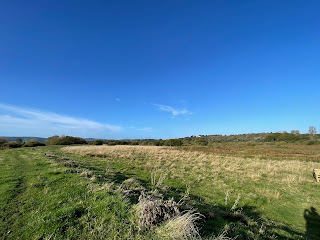
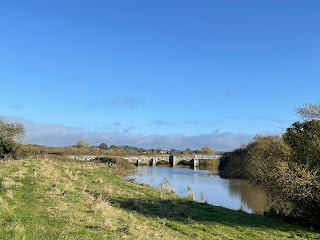
Looking west from the river bank at Waltham Brooks
Greatham Bridge
Late afternoon I again headed over to Thorndale Bridge in the hope of a Short-eared Owl but no such luck. In fact the only real highlight here was a lone juvenile Marsh Harrier which powered south over Amberley, presumably heading to roost.

27th October

Kate kindly dropped me at Pulborough Brooks this morning for a couple of hours, my first visit here for almost three weeks! It's amazing to think that once upon a time I could barely tolerate missing a day here. The water levels had increased a great deal since my last visit and all the action was on the now very wet South Brooks which held two Ruff, five Dunlin and around 80 Black-tailed Godwits among the usual Lapwings and wildfowl. It was nice to see quite a few Pintail among the ducks here (at least ten) including my first proper smart drakes of the season. At least five each of Redpoll and Fieldfare were about around the trail while the North Brooks was curiously quiet save for a couple of hundred Canada Geese and a lone Shelduck. 

Another early evening stakeout on the river at Thorndale Bridge again proved fruitless on the owl front but I was rewarded for wading almost up to welly depth through flood water by a smart adult male Marsh Harrier (plus sub-adult male and juvenile) hunting just the other side of the river, flushing 25 Snipe in the process. 
Marsh Harrier
Snipe
Nocmig has been very quiet so far this autumn, but last night the microphone picked up a nice Barn Owl calling close to the garden. 

28th October

Family stuff today so no real birding but a short local walk early afternoon produced a Marsh Harrier briefly circling over Watersfield before drifting north-west over Lodge Hill. 

29th October

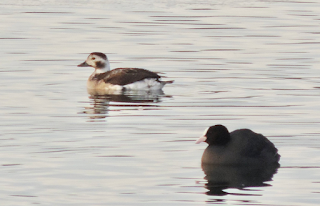
A very wet night gave way to a morning of sunny spells and squally showers. A short break in the downpours allowed for a quick check of the private reservoir near Petworth (thanks to a lift from Mrs Matt) which produced a couple of surprises. Firstly, a late Swallow over the ploughed field to the north of the reservoir which also held 25 Pied Wagtails and a few Meadow Pipits and Linnets. Secondly, a Long-tailed Duck on the reservoir itself. This was particularly unexpected, as it's coming up a year to when I found one here during a WeBS count in November 2022, that bird went on to stay until the end of December. I really struggle with aging and sexing female type Long-tailed Ducks in winter garb, so would welcome any comment, but have included photos below of today's bird and last winter's bird. Could it be the same one? If so, the likelihood is it surely must be a roaming feral bird. If not, perhaps today's is a genuine storm-blown individual which by some extraordinary coincidence has found its way to the same site as its predecessor. Otherwise, it is was usual fare on the reservoir, though a Great Crested Grebe was my first here since July. 
Today's Long-tailed Duck
And the 2022 bird...
Pied Wagtail
30th October

More heavy rain this morning delayed me heading out on foot from home, and scrapping my planned attempt at a vismig session. Instead I did the full loop out to Waltham Brooks, around the main lake and down the river bank. The water levels had increased dramatically since my last visit, with some of the paths entirely impassable (I had to get out onto the road in order to access the river bank from the north-western corner of the reserve. Avian highlights included a late group of eight Swallows feeding over the river and the north-western side of Amberley, a flock of ~40 Fieldfares over Greatham Bridge and good numbers of ducks - perhaps unsurprising given the water! Around 90 Wigeon flew north while at least 140 Teal were flying about plus a few Shoveler and Gadwall. As I was heading bak from the river bank towards the sewage works a Hummingbird Hawkmoth whizzed past heading purposefully south towards Amberley. 
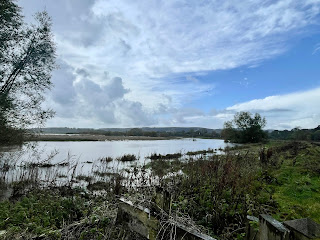
Looking across the swollen River Arun towards Amberley
A very flooded Waltham Brooks
Continuing the theme of summer migrant stragglers, while working on the computer at home mid-afternoon I glanced up and out of the window towards Waltham Brooks and noticed a bird that on initial appearance seemed to be moving like a large hirundine. When I got bins on and realised it was a falcon and that it was clearly feeding on flying insects, the penny dropped that I was looking at my latest ever Hobby in the UK! I watched it for a minute or two before it drifted off south and I lost it behind trees. 

Late afternoon I decided to attempt my first drive for over a month. I didn't go far but had a quick look at the now very flooded scrape at Hadworth Farm in West Burton (my first check of this site since it dried up back in May) which produced a distant Green Sandpiper, a pair of Gadwall and seven Red-legged Partridge - the latter a good bird this close to home. I don't tend to see many of them away from the Downs round here. I then carried on a bit further to Burton Mill Pond, for my first visit here since before my accident (so around six weeks). An hour stakeout from the viewing platform produced the usual Cormorants flying in to roost (51 tonight) plus a few Little Egrets (9), Pied Wagtails (at least 25), Starlings (70) and Jackdaws (230). Two Water Rails were squealing in the reeds and a Kingfisher flew across the pond a couple of times.
Green Sandpiper
Little Egrets
31st October

A mostly fine morning after overnight rain and seemingly the last calm one of the week, with stormy conditions on the way as October gives way to November. I started this morning's local birding session with a relatively short vismig session up at Alban Head to the west of Watersfield. Despite the clement conditions, there really didn't appear to be much moving at all, despite some large counts of Woodpigeon in other locations in the south this morning. Highlights from 90 minutes here were singles of Crossbill and Yellowhammer north-west and a few Skylarks going in various directions, and two Red Admirals

I decided to head up to Watersfield Common and Waltham Park for a bit of a change, in the hope of finding some finches and other passerines. Watersfield Common delivered straight away with a single Crossbill and a flock of at least 15 Lesser Redpoll, followed by two showy Firecrests. Crossbill featured again at Waltham Park with one flying south at the same moment two late House Martins flew high south-east - not quite my latest ever in the UK but it's still pretty remarkable I've had Hobby and two hirundine species on the last two days of October! Other bits from here were seven Siskin and 11 Redpoll flying over, presumably all Lesser.             

A great little afternoon session up at Pulborough proved to be a perfect way to finish my October local birding campaign. I'd actually just popped up to the village to get a few bits from the shops when news broke of a Little Gull over the floodwater between the North Brooks and the village hall. I dashed down to near our old house and quickly picked up the gull - an adult - resting on the water, before taking flight again and hawking for a few minutes. It repeated this routine a few times before eventually flying off with a small group of Black-headed Gulls. While this was going on my attention was drawn to a bird sailing right over my head which I quickly realised was a Short-eared Owl! Steve Chalmers reported one from his nearby garden a few days ago and presumably the same bird was seen over the North Brooks at the weekend, so it wasn't a surprise to see, but something about an SEO always gets the blood pumping! It dropped in towards the river bank where it was promptly chased off by a Magpie, then it gained height and flew towards the North Brooks. Here it continued to gained height, with an irate Rook in tow, until it was just a dot, then drifted off south - presumably in search of somewhere less flooded to hunt.
Short-eared Owl
Little Gull