11th March
I had the day off today and the weather looked exciting so I ended up having a fairly big morning session. Starting off at Amberley, I found the visibility to be less than ideal, with the mist fairly low and precluding decent observation. Highlights from a relatively short stay here were a Great Crested Grebe (actually an Amberley tick for me!), 15 Tufted Duck and a Great White Egret.
Next up, I headed to Pulborough Brooks. The water levels here were still very high, with much of the reserve still entirely flooded. It was encouraging to see some land exposed on the South Brooks though, and the Lapwings, Redshanks and Skylarks were taking full advantage and singing and displaying enthusiastically. The long-staying Water Pipit was again in the wet grassland between Winpenny and West Mead hides, and a few Dunlin were lurking among the Lapwings (I only actually saw one but up to 12 were reported by others). A lone Great Crested Grebe was still on the North Brooks and at least four Chiffchaffs and three Cetti's Warblers were singing around the trail.
-2.jpg) |
| Wren |
On the way home I stopped for a brief check of Waltham Brooks which actually proved to be a really good call. Pretty much the first bird I saw as I scanned the lake from the riverbank was a Great White Egret in full breeding plumage. A Skylark singing rather distantly to the east was a 1k area tick for this year, as was the Mediterranean Gull(s) calling as I got back to my car, which I never actually saw. A Lesser Black-backed Gull flew north with Herring Gulls.
.jpg) |
| Lesser Black-backed Gull |
 |
| Great White Egret |
Later in the day I popped back out for an hour or so to check a couple of other sites. The scrape at Bignor Park/Hadworth Farm held singles of Green Sandpiper and Little Grebe, while my private WeBS site near Petworth revealed a Dunlin feeding along the shore - my first proper migrant wader here this year and an encouraging sign of things to come!
12th March
No birding first thing today owing to the pouring rain. I had put my moth trap out overnight though, so spent a bit of time checking through what was a reasonably decent haul, despite the weather. 20 moths of six species, with the highlights being singles of Early Thorn and Early Grey.
 |
| Early Grey |
At lunchtime I popped out for a check of a couple of local water bodies. First up, the scrape at Bignor Park which was business as usual really, with only a Little Grebe and a pair of Gadwall of note. Next up, the private reservoir at Petworth which, while still not providing any migrant goodies, was considerably more birdy than it has been in my past few visits, with a single Tufted Duck my first here for a while along with a pair of Great Crested Grebes, six Gadwall and a lone Mute Swan.
13th March
I had a short window of birding opportunity this morning before heading over to Woods Mill but wasn't 100% sure where I would go. In the end, the decision made itself when Chris and Juliet Moore circulated news of
Spotted Redshank and Oystercatcher from West Mead hide at Pulborough - both decent year ticks there, especially the latter which is less than annual. I dashed over and down to the hide and was kindly shown the Spotted Red through Juliet's scope, while the Oystercatcher strutted about within spitting distance of the hide. After a few minutes, the
Spotted Redshank flew across from the back of the pool and more or less joined the Oyc in the same bins view for a brief time. A duo of species I've actually never seen together here before! There were also a few showy Snipe lurking in the grassy margins in front of the hide.
 |
| Oystercatcher |

 |
| Spotted Redshank |
 |
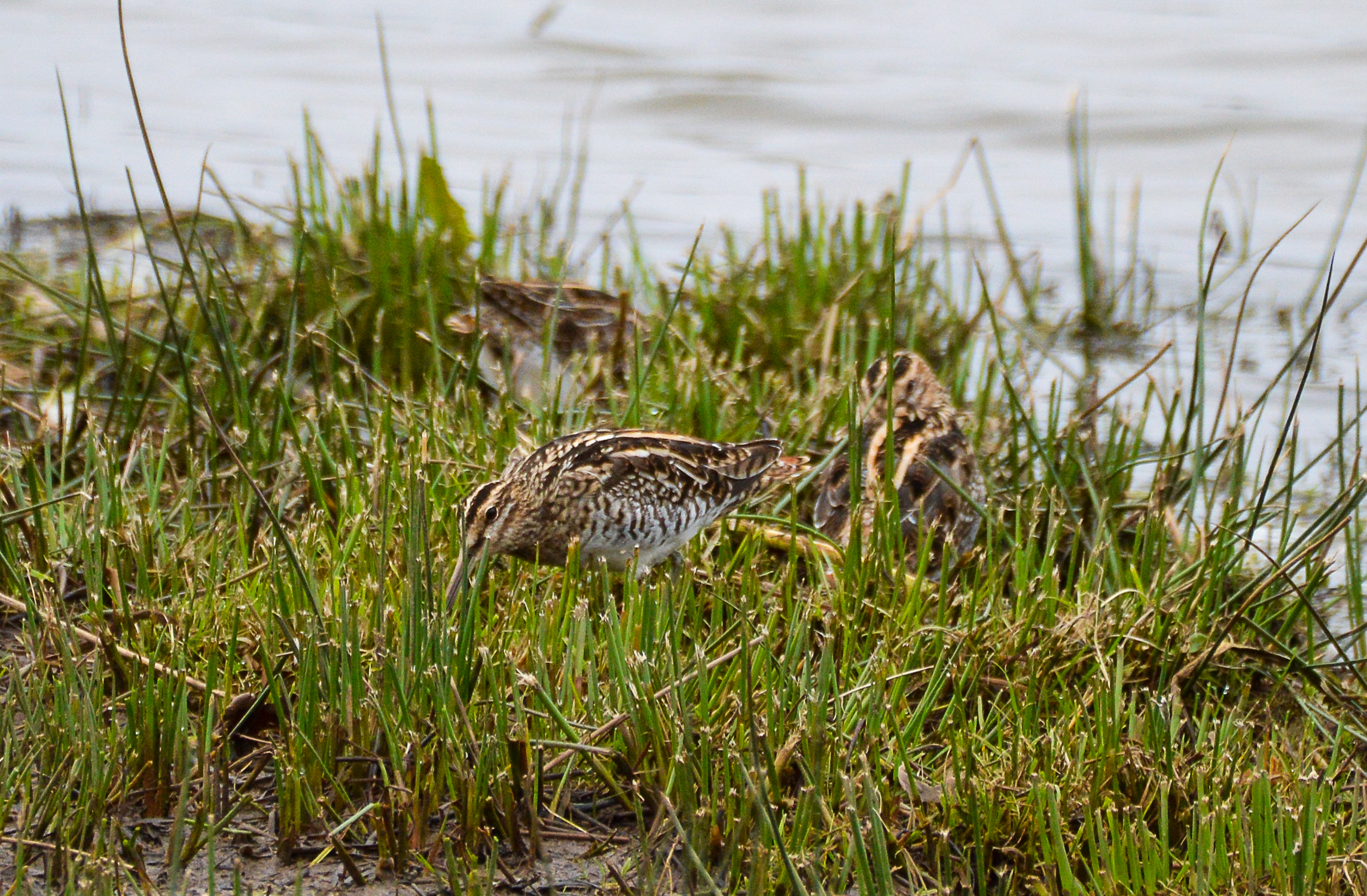
| Snipe |
A lunchtime walk at Woods Mill proved fairly lively with a definite trickle of Meadow Pipits north (at least 15 in 40 minutes or so) and a Peregrine circling high overhead, the latter a new bird for me here, taking the office bird list to 70 species.
14th March
This morning I woke up in Exeter, having driven down yesterday evening for a Natural England Beaver training workshop. As I had a couple of hours to spare before the training started, I decided to head to RSPB Bowling Green Marsh and the Exe Estuary, just down the road from where I was staying. I had never visited this area for birding before but I was immediately taken with it, the main reserve reminding me of a mini Pulborough, but with the added bonus of the estuary and tidal lagoons on the outer edges. A singing Blackcap greeted my arrival, my first of the year. The apparently long-staying two Spoonbills were still on the marsh, mostly sleeping, along with a single Avocet and some 350 Black-tailed Godwits, 250 Redshank, five Dunlin and a heard only Greenshank. The tide was rapidly coming in in the estuary so there were scant waders to be found out there, but two drake Red-breasted Mergansers were a nice bonus here. The Goose Moor tidal lagoons proved rewarding, with my first Common Sandpiper of the year among four Greenshanks and a couple of Curlews. A Raven flew over, as did a trickle of half a dozen Lesser Black-backed Gulls heading north.

 |
| Spoonbills |
The Beaver training session itself was excellent, and it was just superb to see the effects that England's only officially licenced wild population of the species (on the River Otter) have had in this area in just a decade or so.
 |
| Scenes from some of the beaver activities on the River Otter |
After the training session was done for the day I decided to drop back in to Bowling Green Marsh again, which proved to be a good decision as, within minutes of arriving, I picked up first two Sand Martins and then a Swallow hawking over the reserve. Needless to say, my first records of either species this year! The Spoonbills were still about too. The tide was out now so the estuary channels on both the eastern and western sides of the reserve were busy with waders including around 25 Grey Plover, 60 Avocets, ten Bar-tailed Godwits and a few Oystercatchers and Curlews among the hundreds of Dunlin and Redshanks.
15th March
My second and final day in Devon and I again headed out to the Exe Estuary and Bowling Green Marsh early doors. The tide was still out but coming in fast as I arrived, and I was able to notch up ten species of wader out on the mud flats, including some 50 or more Bar-tailed Godwits, 30 Knot, 60 Grey Plover, 180 Black-tailed Godwits and 500 or more Dunlin.
 |
| Bar-tailed Godwits |
The two Spoonbills were still present on the marsh, rather less expected were two
Black Swans swimming about on the water behind them. Not sure I've ever had those two species in the same scope view before! By the time I was leaving the reserve the tide had come in on the estuary and upwards of 300 Black-tailed Godwits and 250 Redshank were gathering to roost on the marsh.
 |
| Wigeon |
 |
| Spoonbills |
 |
| Black Swans and Spoonbills |
16th March
Not much birding today but a brief session at the private site near Petworth started auspiciously with a
Peacock butterfly on the wing. The reservoir was quiet but, just 15 minutes or so after I arrived and with multiple Buzzards and Red Kites getting up on the thermals it was perhaps not entirely surprising to see an immature female Goshawk get up from the trees near Duncton Common. I watched it for the following ten to fifteen minutes as it climbed stratospherically high, briefly sparred with a Buzzard before stooping down at high speed in the rough direction of Burton Mill Pond. As it disappeared behind the tree line there, a cloud of corvids and Woodpigeons exploded into the air. Walking back to my car I saw my first
Comma of the year on the wing, while on the drive home I noted at least three male
Brimstones from the car.
 |
| Goshawk - very high by this point! |
 |
| Peacock |
17th March
Rain and a southerly wind to start the day so I hit up various local water bodies, sadly without much reward for my drenching. Perhaps the most lively were the scrape at Bignor Park which held a pair of Mandarins (a site tick for me here) and Waltham Brooks where eleven Tufted Ducks were persisting on the main lake.
Later in the day we met friends in Arundel for a walk and lunch at Swanbourne Lake. This picturesque site is always worth a visit and is included in
mine and Ed's book for good reason, as it is pretty consistently busy with gulls and wildfowl, thanks in no small part to the amount of willing visitors buying and emptying bags of bird seed! Duck highlights today were some 50 Tufted Duck, 40 Gadwall and a single Pochard. A singing Blackcap on the north side of the lake was my first locally this year, while a Peregrine was circling high overhead as we left.
18th March
An hour dash round Pulborough Brooks this morning proved reasonably fruitful, producing 56 species in total. Highlights were a pair of Avocets and an impressive 16 Shelduck squabbling at West Mead. Two pairs of Great Crested Grebe were displaying out on the South/Mid Brooks while a fifth bird was on its own on the North Brooks. Easily my highest count of this usually scarce species here, it just goes to show how high the water levels have been here for a pretty long period of time. A dozen Tufted Ducks would likewise normally be a pretty remarkable count here, but seems fairly routine at the moment. Other bits of note included a Blackcap singing at the top of Green Lane, a male Stonechat on the fence near Redstart Corner and at least eight singing Chiffchaffs around the trail.
-2.jpg) |
| Shelducks |
-2.jpg) |
| Shelducks, Avocets and Canada Geese |
A check of Waltham Brooks at lunchtime didn't reveal any lurking summer migrants (that I could see). In fact, aside from a couple of singing Chiffchaffs it felt rather wintry, with 22 Tufted Ducks on the main lake probably the standout birds.
19th March
I was in Kent this morning for work, at a woodland site in the High Weald. There were good numbers of finches around, especially Siskins and Redpolls, and I heard what sounded like at least a couple of Crossbills flying over too.
Heading back into Sussex early afternoon in intermittent light rain and a light south-westerly, I decided I had to check out a couple of local water bodies in my lunchbreak. The private reservoir at Petworth was disappointingly quiet, but I had better luck at the flooded Rother in Fittleworth which held five Little Egrets and a Kingfisher busily feeding. The scrape at Bignor Park, meanwhile, was still hosting a Green Sandpiper and the lingering Egyptian Goose family. Just as I thought it was going to be another blank session in terms of any summer migrants I heard the distinctive chattering call of Sand Martin and looked up to see two flying west overhead. They didn't even drop in to feed over the water, despite the rain.
An after work look at Waltham Brooks proved relatively quiet aside from at least eight Tufted Duck on the main lake. Two Marsh Harriers flew downriver in close succession, including a very smart looking male.
.jpg) |
| Marsh Harrier |
20th March
The Spring Equinox. Always a momentous day in the calendar and this morning held promise with a light south-easterly breeze and a touch of haze in the air. In short, the air felt rare. After dropping B off at nursery I popped by Amberley. Garganey was a species I had in mind as I scanned through the many ducks. After a couple of passes with the scope I looked again and was delighted to see a very smart drake dabbling about with a female Wigeon, to which he displayed a few times! Always a highlight of the year seeing the first drake Garganey and it was nice to find one at a different site, having spent many hours trying to find one at Waltham Brooks in recent springs. Funnily enough, I also realised it was exactly six years to the day since
I found a pair at my old patch of Shalford Water Meadows near Guildford. Typically for Amberley, it was hundreds of metres away, so I only managed to get some very ropey record shot photos and videos through my scope.
 |
| (Very distant) Garganey |
After the early mist cleared it turned into an absolutely beautiful early spring day, with the mercury rising to 16 degrees Celsius; more than enough to coax out multiple butterflies and other inverts, including my first female
Brimstone of the year.
 |
| Brimstone |
After work I headed out for another little evening session, by which time the temperature was still well into the teens! First up I checked the scrape at Bignor Park which held a pair of Little Grebe, half a dozen Teal and the lingering Egyptian Goose family. An hour at Burton Mill Pond produced 37 species including six Sand Martins feeding overhead before heading off south, five Little Egrets flying south to roost, and the usual Great Crested Grebe pair and 23 Tufted Duck on the water.
.jpg) |
| Sand Martin |
-2.jpg)
.jpg)




-2.jpg)
-2.jpg)
.jpg)


.jpg)


