Wednesday, 15 February 2023

A sunny day at the end of every freezing night

The changeable winter continues, despite us being into the dwindling weeks of the meteorological season. Temperatures took a tumble again early in February with some very icy starts to the days in this two week period, and also some pesky foggy mornings which took until lunchtime to lift. Still, in the days of sunshine there has been a noticeable increase in birdsong and early breeding activity like raptors soaring and resident passerines carrying nest material and inspecting likely nesting spots. February can be a tough slog sometimes but on the best days it can also be full of hope.

5th February

An early morning walk round the local farmland didn't produce too much of note but there was some notably spring-like behaviour from some of the local resident species, including a Starling singing its quirky song from our rooftop and various House Sparrows flying to and from the neighbours' eaves.

A dusk walk over to the riverbank near Thorndale Bridge produced a Barn Owl hunting over Waltham Brooks and four Egyptian Geese quarreling over Amberley Wildbrooks. Mainly though, it was just a welcome novelty to be heading out for a birding session at 5pm and still managing to get in 40 minutes or so.

Song Thrush

6th February

The first frosty morning in a couple of weeks and I decided to drop in for a look at Amberley Wildbrooks as I was passing. Scanning from Cross Gate on the southern side, I was amazed at how much the water levels had dropped since my first proper visit here for a fortnight or more. There were still 80 or so Lapwing dotted about the place but otherwise no water birds at all really aside from a Little Egret, a few Grey Herons and a couple of Mute Swans. Just as I was thinking about leaving after about 45 minutes or so, my attention was drawn by a group of corvids mobbing another bird quite high over towards the western side. Getting the scope on the melee, I realised the bird causing the consternation was a ringtail Hen Harrier, which gained height for a while before dropping down onto the western side where it started hunting up and down before powering over the eastern side. My second in the 10k this year, and in fact it could be The Burgh bird relocating, as I don't think there have been any records of that bird for a while now.

Very distant Hen Harrier, with escort
Herring Gulls
7th February

Thick fog this morning precluded my planned visit to Burton Mill Pond so I instead dropped in the check the lake at Waltham Brooks, with a view to the birds being closer. The fog still made it difficult to pick out much on the water, although a calling Little Grebe was my first in the 1k area this year. Also on the lake were a drake Pintail and two Shelduck, while a lone Snipe flushed up from the shore as I passed. At least two Cetti's Warblers were calling in the bushes, one of which obligingly popped up and showed quite well briefly (for a Cetti's Warbler anyway...).
Cetti's Warbler
An early afternoon skywatch from local farmland produced three Ravens heading east but not much in the way of raptor action despite the sun breaking through.

8th February

Another very foggy start wasn't conducive to birding first thing so I cracked on with work and headed out for a lunchtime stroll. I walked over to the bank of the Arun at Thorndale Bridge to scan the sky and Amberley Wildbrooks, but it had turned into such a beautiful day I decided to carry on up to Waltham Brooks and walk home from there. Not a huge amount to report here really, although at least three Red Kites and two Buzzards were up and enjoying the sunshine and two Ravens flew east. At least three Water Rails were squeaking away, including one in the reedbed on the Amberley side of the river. At the sewage works I found at least 25-30 Chiffchaffs flitting about and flycatching from the bushes around the fence line and up the concrete track. Not quite as impressive as Bernie Forbes' report of 56 yesterday but still lovely to see.
Buzzard

9th February

Mercifully no fog this morning but still very cold. I got out early (light enough for birding by 7am  now!) and headed over to Pulborough for a quick circuit of the reserve. Highlights here from an hour and a half included singing Woodlark over the heath, at least five Ravens raucously flying over, Marsh Harrier, Peregrine, 1200 Lapwing and at least 90 Pintail among ~1000 Wigeon and Teal, mostly on the North Brooks. No eagles or other wader species for me (Avocet, Black-tailed Godwit and Dunlin were reported earlier in the week) but still an enjoyable session. Most noticeable, both at Pulborough and at home were the Dunnocks, which seemed to have universally decided that today was the day to ramp up their singing and courtship behaviour. They seemed to be everywhere around the trail at Pulborough!
Teal
10th February

Another foggy morning so I decided to head up the Downs - Kithurst Hill, specifically, which I haven't visited for a while. Corn Buntings and Yellowhammers were in fine voice, particularly around the dew pond just west of the Chantry Hill car park. There were plenty of singing Chaffinches about too and a lone Marsh Tit. A single Grey Partridge was with a little covey of Red-legged Partridge south of the dew pond, while the usual Ravens and Red Kites were patrolling around the hillside. A nice bonus local year tick on the way back to the car park in the form of an adult winter Mediterranean Gull among 200+ Black-headed Gulls and Common Gulls swirling around over a ploughed field.
Kestrel
Corn Bunting
Back home it was nice to see a resplendent breeding plumage Starling singing on our chimney. The resident species are definitely full of the joys of spring now!

11th February

A bit of a tour of a few North East Sussex sites today, starting with Ashdown Forest, where I met a couple at Old Lodge for a South Downs Wildlife walk. It was a decent little walk here, given the time of year, with flyovers of Woodlark and two Ravens, a Dartford Warbler and a singing Mistle Thrush. Most numerous though were the Coal Tits which seemed to be in almost every tree!
Raven
After saying goodbye to the guys here I decided to stop at Weir Wood Reservoir in passing, which produced nine Pochard, 23 Tufted Duck, Marsh Tit and lots of activity from the nesting Grey Herons and Cormorants in the trees at the western end.

Final stop on the way home was Red House Common, part of the the Chailey Commons complex. This was a new site to me and one I've literally just written about for the 'Where to Watch Birds...' book. I was impressed with it, especially the great views of the sky and the wider Wealden landscape. Not a huge bird list here today but I hope to return when the heathland migrants are back in. 

12th February

Another gloomy morning. Kate, B and I headed over to Pulborough Brooks mid-morning, having just heard news from former RSPB warden Pete that the regular young pair of White-tailed Eagles had been chasing and trying to catch an unfortunate Grey Heron. The show was still going on as we arrived and we bumped into Pete, Alice Parfitt and Gary Trew by the visitor centre. One of the eagles was perched up in a tree by the river but the other took off again chasing a Grey Heron which was flying over towards Hardham. I've seen WTE do this kind of hot pursuit before and am still amazed at their capability for speed when required. The eagle was clearly gaining height to get up to where the heron was flying, when suddenly the heron whiffled and dived, so the eagle did the same, straight after it. We couldn't see the outcome as they disappeared behind trees, but it was amazing to watch! 

Later on, we saw one of the eagles in the 'owl tree' on the North Brooks, viewed from the Hanger viewpoint. From here we also found singles of Dunlin (102 for the Local Big Year list) and Ruff with the many hundreds of Lapwing and at least 8 Shelduck - my highest count of the species locally so far this year (plus at least 3 on the South Brooks).
White-tailed Eagle
13th February

The first day of the year when a coat almost felt like an optional extra with the temperature well into double figures by lunchtime. In the morning I was at Knepp for my first safari of the year. There was plenty of birdsong around the place including lots of Song Thrushes and Dunnocks, and several of the resident White Stork pairs were busy feathering their nests and generally looking very cosy and loved up.

The Hammer Pond held the usual Great Crested Grebe and a few each of Teal, Shoveler and Gadwall, while a check of the Mill Pond on the way home produced a couple of Great Crested Grebe, a single Little Grebe, three each of Shoveler and Teal, six Pochard, five Tufted Duck and 15 Wigeon.

14th February

Another foggy morning with the murk very slow to clear. Eventually, by early afternoon the sun had started to break through though so I took a lunchtime walk up to some local woodland which produced plenty of singing resident species including Coal Tit, airborne Buzzard and Red Kite and a vocal flyover Raven. I also inadvertently flushed a Woodcock from an area of low bramble and bracken which gave possibly the best ever flight views I've had of this species to date, lit up beautifully in the sunshine though, of course, too brief an encounter to get a photo.

15th February

A misty start to the day but not too cold and with the promise of warm sunshine burning through relatively early on. That sounded like ideal conditions to find Lesser Spotted Woodpecker so I headed out to a likely area of woodland (location withheld) and was delighted to hear one calling in an area of birch not long after I arrived. This one did a disappearing act pretty quickly but an hour or so later I found the same bird or another one (this one definitely a male - the previous one unsexed due to being backlit) drumming enthusiastically a couple of hundred metres away. Wonderful!

Marsh Tits were in fine voice too as were several Song Thrushes, Great Spotted Woodpeckers and all the common tits. As I was about to head home I flushed my second Woodcock in two days. All in all a pretty great morning!
Marsh Tit
Lesser Spotted Woodpecker
By lunchtime it had really turned into an absolutely stunning day so Kate and I headed out for lunch and a brief walk at Fittleworth Common. This was a really unexpected gem, with Marsh Tit again, several Red Admirals on the wing and also a completely unexpected arboretum hidden away among the Sweet Chestnut coppice.

Sunday, 5 February 2023

The home straight of winter...

A change in the weather in the two weeks since my last blog post, with the ice having all melted and relatively little rain having fallen the ground conditions in the Arun Valley are remarkably not too muddy now and have allowed for some exploration of areas that have been impassable for weeks thanks to the flooding and the big freeze. We've been treated to some glorious days of spring-like sunshine too which have really helped lift the spirits as we finally reach the end of the hard slog of January and head into February - the home straight of winter!

24th January

Feeling strangely mild (although still barely above freezing), on the first frost-free morning in over a week. In that time the water levels locally have mercifully receded enough to allow me to access the southern entrance to Waltham Brooks, via Thorndale Bridge and the bank of the River Arun. This is where I headed this morning for a little scan of the river and the north-western corner of Amberley Wildbrooks beyond. As I passed under the bridge I noticed an adult Great Black-backed Gull powering north up the river - my second locally in two days! Across the river, a Kingfisher flew away from me up the drainage ditch flowing out of Amberley Wildbrooks. For a second I thought I heard a Water Pipit call but just the one squeak and I didn't see it or hear it again, so wrote it off. Otherwise, it was usual fare here, with a Water Rail squealing somewhere unseen and a few Wigeon, Teal and Shoveler flying up from the river and the wildbrooks. 

Shoveler

25th January

The day began with a Peregrine low over Watersfield first thing, followed by a walk from home to Waltham Brooks. Grey and misty, still very cold but ice gradually thawing. There had been a noticeable increase in ducks on the main lake but still not exactly spectacular for the time of year. Two Red Kites and a Raven were airborne over Amberley Wildbrooks, while at least three Cetti's Warblers were making themselves heard and a Chiffchaff was singing half-heartedly along the river just south of the reserve. 

26th January

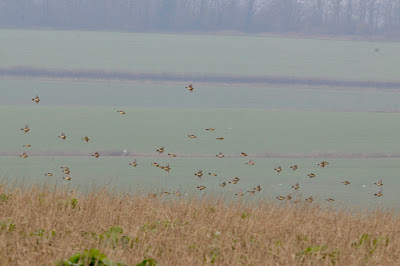
Another grey and frost-free morning, after some overnight rain. A check of farmland over near Petworth finally produced my first Yellowhammer of the year (in an area that's normally very good for them and I've already visited twice in January), along with a flock of ~80 Goldfinches and a Grey Wagtail.

27th January

No birding today.

28th January

A half-hour check of Waltham Brooks at lunchtime proved quite lively, with my first Shelduck here this year on the main lake, along with a female Pintail and 300+ dabbling ducks, mostly Teal but also at least 80 each of Shoveler and Wigeon. Overhead, a Raven cronked its way west while two Marsh Harriers flew north.

Early afternoon we found ourselves in the Arundel area so spent a little while up at the Offham viewpoint which produced distant views of the six adult Bewick's Swans feeding down in the water meadows below.

Gadwall
Shelduck and Wigeon
Raven
29th January

A couple of hours at Burton Mill Pond from first light produced quite a lively session. Following on from Mike Dale's report on Twitter of 13 Little Egrets there on the 25th today I found at least 22, all gathered around Chingford Pond along with the now regular Great White Egret (more on that later). The reason for this gathering of egrets (along with several Grey Herons) is evidently due to the water level at Chingford having dropped dramatically since my last visit, exposing lots of lovely mud around the edges, especially at the southern end. It's such a drastic drop in level that it must have been done deliberately and, indeed, there was a guy fiddling with one of the outflows today, and the main outflow out of the dam was dry.

Back to the Great Egret, which I noticed was bearing a red darvic ring on its left leg. I couldn't see any digits on the ring but a bit of online detective work led to the discovery that this bird had probably been ringed on the Avalon Marshes in Somerset. 
Also of note on Chingford Pond were at least 40 Pochard; by far my highest count of the species here, or anywhere locally, so far this winter.
Little Egrets, Great Egret and Grey Heron
Great Egret (with red leg ring)
Extra excitement in the afternoon as I was doing the obligatory Big Garden Birdwatch from our bedroom window and not recording a huge amount when a small flock of Starlings swirling around a little way down the road caught my attention. Just as I thought to myself 'it's a shame I can't count those' they suddenly all jinked sharply in one direction as a fast pointed shape appeared out of the sky from the west and lunged directly at them, missing completely, before continuing off to the east. The compact size, sharply pointed, rapidly flickering wings could only belong to one species: Merlin! An amazing garden and 1k tick that I certainly was not expecting when I sat down to count the Blue Tits. Amazingly, it returned about 15 minutes later, powering back west, quite high, but as I reached for my camera I lost it, unfortunately. 

30th January

Not a huge amount of birding today although I did manage a couple of short walks at Ashdown Forest as I was over there for work purposes. Very quiet here though, despite the pleasantly warm spring-like sunshine, with just the odd Siskin of note among the many Coal Tits and Wrens.

On the way home I popped in at Weir Wood Reservoir where I bumped into local patch watcher Alastair Gray. I didn't have my scope unfortunately but Alastair let me use his to see the lingering two female Wood Ducks and the 51-strong flock of Barnacle Geese. It was also nice to see Grey Herons carrying nest material up to the heronry. Spring is getting closer by the day.

31st January

A pleasantly mild morning. I dropped in to Waltham Brooks again for half an hour as I was passing. The lake again yielded lots of wildfowl including three Shelducks (two of which flew off towards Pulborough) and a pair of Pintail.
Best of all though was a male Yellowhammer which flew in from the south and briefly dropped into the scrub and allows near the lake. My first record here and only the second within my 1k area since moving to Watersfield in September last year.
Yellowhammer
Late morning I headed up to Surrey to meet Ed, mostly to work on the book, but we managed to squeeze in a bit of birding in his 1k area. A Peregrine over Eashing Fields was the highlight, although I actually had seven hotspot ticks here including singing Coal Tit. A walk along the river a bit later in distinctly spring-like conditions produced Grey Wagtail, Sparrowhawk, Red Kite and a flycatching Goldcrest.
On the way home I decided to stop at Burton Mill Pond for a little dusk session which actually turned out to be a very sensible decision. As has become a bit of a thing here lately, the first bird I saw was a Great White Egret flushed from the reeds near the road, although I think a different bird to the one on Sunday, as I couldn't see a red ring on this bird. Little Egrets were trickling over in ones and small groups, heading south to roost, with a single Cattle Egret among them. A Kingfisher darted low over the water towards the outflow channel. Just as the light was fading to its last I had two unexpected Burton Mill Pond ticks in close succession. First, a Goshawk which I picked up late flying lower over the pond before disappearing into the trees on the west side - the whole experience lasting a matter of seconds, but no doubt about the ID. The second was another 'flying away from me by the time I got on it' moment, as I noticed a lone duck flying southwest, the long neck and whirring wingbeats so diagnostic of a Goosander.
Cattle Egret

1st February

I didn't have time for lots of birding today but managed a late morning walk around local farmland and woodland. Lots of singing Song Thrushes, Mistle Thrushes and others, but the highlight was a Peregrine over Lodge Hill and Coldwaltham Farm, presumably the same bird that I've seen a few times since Christmas, so is presumably wintering in the area.
Peregrine
2nd February

I headed over to Pulbrough Brooks this morning for the first time in a couple of weeks (I'm ashamed to say!). There was no sign of the Avocet found by Chris and Juliet Moore yesterday but two Ruff among the many hundreds of Lapwing were a year tick. Also among the Lapwing was a striking leucistic Lapwing which really caught the eye. Otherwise highlights from an hour here were two Snipe, Peregrine, Marsh Harrier and the highest count of ducks I've seen here this winter, including at the very least 80 Pintail.
Leucistic Lapwing

Ruff with Lapwings
3rd February

Not a lot of birding today but anecdotal highlights included five Little Egrets in the wet meadow next to the River Rother in Fittleworth, seen from the car, and the two local White-tailed Eagles (still sounds weird to think of them like that) soaring over the Downs, viewed from my office/bedroom window in the afternoon. Also seen from home was the now daily Raven flying low over the hamlet. I'm sure there must be a pair nesting somewhere in my 1k area but haven't worked out where yet.

4th February

This morning I joined members of Shoreham and District Ornithological Society for a walk round Henfield Levels, led by local birder Val Bentley. This was primarily for the purposes of researching the book, as it's not an area I know well and, last time I visited, most of it was underwater and many of the paths impassable!
Henfield Levels
We had a productive morning with highlights including a Water Rail and several Chiffchaffs at the little pond north of Rye Farm and good numbers of Lapwing (~500) and Teal (400+) along with smaller numbers of Wigeon, Pintail and Shoveler.

Monday, 23 January 2023

Walk out to Winter

We've really had all weathers so far this winter. The proper cold snap before Christmas gave way to a typically mild, wet and windy Christmas and New Year period which lasted until the middle of this month, but the cold has returned again and the last week or so has produced some of the hardest frosts yet. As I write this, many of the local water bodies have partly or totally frozen again, which seems particularly odd now as the water levels were so high when the ice formed and now the levels have dropped, leaving sheets of ice hanging in thin air. There has been no great evidence of hard weather movement as a response to this cold spell, although a couple of odd records have occurred in recent days which I will detail below. I was going to talk about the absence of owls on my year list in this introduction as, at the start of this period I still hadn't connected with a single species so far in January, but I'm pleased to say that Tawny, Barn and Short-eared have since all made themselves available.

11th January

A bright and sunny (but windy) morning saw me heading to Burton Mill Pond for the first proper walk around the site I've done since before Christmas. One of the hoped-for species was literally the first bird I saw as I crossed the road from the car park, as a Great Egret sprang up out of the reeds right by the boat jetty, flushing a Kingfisher in the process, with both birds flying at their respective speeds across to the east side of the pond. The Kingfisher was typically vocal, whistling away as it went, but unusually so was the egret, making some very strange gutteral croaks and grunts as it flew. I'm not actually sure if I can recall ever hearing Great Egret call before.

Great Egret

Aside from this initial excitement, Burton Mill Pond itself was rather quiet so I headed off down the footpath towards Chingford Pond. Bits of note along the way included a singing Marsh Tit and several vocal but unseen Teal in the wet woodland past the vineyard, and at least 25-30 Redwings foraging in between the rows of grapevines. Round at Chingford Pond I found another Great Egret roosting in a tree and a Little Egret which flew right down to the southern end. Duck numbers were relatively very poor, with just 16 Tufted Duck, 19 Pochard and a handful of Gadwall and Mallard to be found. There were a couple of Little Grebes on Burton Mill Pond but I haven't seen Great Crested Grebe here for several weeks now - presumably the last cold snap before Christmas sent them all packing off to the coast and they've opted not to return just yet.. 

On the walk back I heard a Lesser Redpoll and noted one alighting briefly in a birch tree near Lodge Green, then a few minutes later the same bird or a second one was in another birch towards Black Pond. At Black Pond itself were just a few Mallards and a Grey Heron while a scan of Burton Park Farm sadly didn't produce the hoped-for Little Owl. My first Woodlark of the year, singing beautifully over New Piece, on the walk back was a welcome bonus though.

Lesser Redpoll

12th January

Foul weather today. No birding of any note.

13th January

This morning I headed to Waltham Brooks for the first time in a few days. The water levels here were now so high that access through from the railway line to the main lake was not possible. Instead I checked the main lake via the road, which produced 3 Pintail among the usual ducks, plus a Kingfisher fishing in what is normally a footpath! A quick check of the sewage works produced at least 20 Chiffchaffs busy flitting around the trees and bushes, while a Marsh Harrier cruised over the lake, flushing everything in the process.
An afternoon walk down River Lane from home didn't produce much of note, although a Marsh Tit was feeding on crab apples in a nearby garden as I walked home.
Marsh Tit
Something a bit different in the evening as I headed out for a short loop around the Watersfield Common area after dinner. The target species was Tawny Owl which I connected with at Alban Head Playing Field, with both male and female calls heard. More unexpected though was a couple of calls from a Barn Owl, unseen but presumably hunting over the rough grassland to the north of here.

14th January

Another awful wet and windy morning, but I dragged myself out for an hour or so mid-afternoon. Taking in one of my favorite areas of the 1km recording area so far, I managed a respectable 35 species, including year tick Mandarin Duck - my first record of the species so close to home - with both male and female calls heard emanating from the patch of flooded woodland near Thorndale Bridge. Also heard here were Gadwall and Moorhen while several Teal flew out from the tree cover as I passed and at least 3 Coots were on the flooded fields. This is a really interesting area which has also yielded Green Sandpiper and regular Woodcock records in recent weeks. It just screams Lesser Spotted Woodpecker to me, so I'll be sure to check it regularly in early spring. Local Big Year list now stands at 92 with the 1km from home total on 80.

15th January

A rather impromptu trip down to the Hampshire coast to see the Sabine's Gull that had been wowing the crowds for the past week or so. Here I met up with Ed S and Sam J, among various other familiar faces, and we walked along the seawall to find the bird sat on an island in the lagoon at Southmoor NR. After a little while it took flight and showed off its distinctive flight style and the black, grey and white upperwing. On the sea were a Black-necked Grebe and a few Goldeneye and Red-breasted Merganser, among other usual bits.

Sabine's Gull

In the afternoon I met up with Steve B and Josie N at The Burgh where we enjoyed great views of the 2-3 Short-eared Owls hunting near the new dew pond along with a Barn Owl. On the walk back to the car a ringtail Hen Harrier gave a flypast too, before disappearing over the hedgerows.

Short-eared Owl

16th January

Not much birding today aside from an hour's walk down the lane near home, scanning the fields and sky watching. The wet woodland west of the railway line and Amberley Wildbrooks (where I heard the Mandarin Ducks on the 14th) that I could hear plenty of Teal, a Moorhen and Coot calling from quite some distance away. At least two Red Kites were patrolling the area and a Raven called somewhere off to the south, unseen.

17th January

The first properly frosty morning since the cold spell before Christmas saw me crunching my way over the fields from home to Waltham Brooks. It was quite surreal seeing so much flood water combined with a hoar frost. The route from the railway crossing to the main lake was pretty much impassable so I walked round via the sewage works to the road and in the entrance on that side to check the main lake. Despite the expanse of mostly unfrozen water, there were remarkably few ducks. A Raven flew over, heading west, and the ever-present Cetti's Warbler and Water Rail were vocal, otherwise really not much to report here at all. Walking back by the sewage works, the morning sun had started to warm things up a little and there were plenty of passerines actively feeding in the bushes around the fenceline including 2-3 Bullfinch, a Goldcrest and at least 5 Chiffchaff.

Goldcrest

18th January

I was a bit short of birding time this morning so just pitched up at Greatham Bridge for a scan of Waltham Brooks and a sky watch for 25 minutes or so. Not a great deal to report, although the sight of so much water right up to the roadside, some of it starting to freeze over, was quite something. Best of the birds here were a Sparrowhawk which drifted overhead and two Pied Wagtail and a Meadow Pipit scurrying about on the ice.


A flooded and frozen entrance to Waltham Brooks and a Pied Wagtail on the ice

Despite the cold, it was feeling just the tiniest bit spring-like by mid-morning, with both Coal Tit and Mistle Thrush singing with gusto in earshot of the garden. 

Early afternoon, Kate and I went for a walk round the local farmland, which was largely uneventful bird-wise save for a Snipe which shot up from the footpath a little way in front of us and flew off towards Waltham Brooks. Clearly evidence of the cold weather affecting feeding opportunities.

19th January

Day three of this cold spell and I decided to take a walk north-west from home, up to Watersfield Common and back round via Lodge Hill, hoping to connect with some woodland species missing from the local year list - namely Brambling. Sadly no joy, with the best birds being a couple of flyover Ravens and at least 500 Lapwings whirling around over the fields between Stopham and Fittleworth. Despite the deep frost, the morning sunshine coaxed a few species to sing, including Song Thrush, Stock Dove (also seen displaying) and a couple of Great Spotted Woodpeckers drumming. 

Another short walk round local farmland early afternoon also didn't produce much, although a small flock of at least ten Meadow Pipits were restlessly flitting from tree to tree in the hedgerows down River Lane - not something I've seen here before.

20th January

A mid-morning wander up to the higher ground to the north-western side of my 1km recording area, optimistic of some raptor action or possibly some hard weather movement. Sadly there wasn't much of either, although a Woodcock in flight over Coldwaltham Farm was perhaps in search of some unfrozen ground.

Coldwaltham Farm - living up to its name!

21st January

A morning walk round the local farmland produced a Marsh Harrier flying west, perhaps another species displacing in search of feeding opportunities, with most of Pulborough and Amberley both still flooded/frozen over.

In the afternoon I headed back out to do my WeBS count at a private site near Petworth. The water here was thankfully still unfrozen which, perhaps surprisingly, didn't yield great numbers of wildfowl - with just 23 Shoveler, a few Tufted Ducks, 15 Coots and 4 Little Grebes present. This site sometimes produces well over a hundred ducks and almost as many Coots!

On the way home I briefly stopped at Burton Mill Pond which produced Kingfisher and around 35 Gadwall but not a huge amount else.

22nd January

An early morning stroll over to Waltham Brooks was rather more akin to exploring an Arctic wasteland. I didn't see a soul in the 90 minutes I was out and the walk was soundtracked by the eerie bangs and cracks of the ice sheets giving way around the lake and tree line. When I first heard it, as I entered the reserve, I actually thought for a minute that it was the sound of people working on the railway line, or even distant gunfire.
Ravens

Marsh Harrier
The lake itself is totally iced over again so there was nothing here aside from a rather forlorn looking immature Mute Swan. Most of the action initially, was from flyovers, with a Marsh Harrier north and five Ravens west. The river was where the ducks were all hanging out, with at least 300 Wigeon and Teal combined, plus a few Mallards and Shoveler. Looking across at Amberley, the other side of the river, at least 250 Lapwing were huddled on the ice. At least three Water Rails were calling and 3-4 Cetti's Warblers gave their explosive songs from the reedy areas.

Late morning Kate and I headed down to Arundel to meet family, so I suggested dropping by Burpham (sort of) on the way... From the church here we barely needed to get out of the car to see the six adult Bewick's Swans and two Cattle Egrets. Later on we also saw another Cattle Egret at Mill Road Watermeadows. This species is honestly more common round these parts than Little Egret now, I swear.
Tufted Duck


23rd January

I didn't get too much birding in today but a 40-minute or so skywatch from local farmland proved fairly productive and hinted somewhat at a bit of the hard weather movement that's been largely missing from this latest cold spell. Two parties of three Lapwing flew south and I thought I heard a Golden Plover at one stage, though later put this down to an odd Starling call nearby. Gulls seemed to be moving a bit, with a light westerly trickle of Black-headed Gulls and a few Herrings mixed in, and an odd couple of a Great Black-backed Gull and Lesser Black-backed Gull high southeast together. Amazingly, my first Lesser Black-backed anywhere this year, and my first GBBG in the 1km recording area.

Later in the day a garden-first Firecrest very briefly flicked its way through our front hedge before flying off to a neighbour's garden and I also heard Marsh Tit calling nearby again - it seems we have at least one individual of this species wintering in the neighbourhood.
Great Black-backed and Lesser Black-backed Gulls

Lapwing


Tuesday, 10 January 2023

New year, new list

Yes, I'm back blogging! After a very hectic but thoroughly enjoyable year in 2022 where blogging pretty much went out of the window, I've decided to try and ease back into it with semi-regular diary-type updates on my day-to-day birding. (Thanks to Ed for the inspiration and encouragement!)

1st January

A leisurely start to the new year campaign saw me strolling over to Waltham Brooks for a couple of hours. Water levels were the highest I've seen them so far this winter, which produced good numbers of ducks, including five Pintail. Passing Peregrine and Marsh Harrier flushed all the ducks as they headed over towards Amberley. A check of the sewage works produced the usual scattering of Chiffchaffs and a Grey Wagtail, while a Marsh Tit was calling in the woodland just to the south as I departed.

2nd January

In keeping with seemingly most of West Sussex I headed over to Pulborough Brooks mid-morning. The regular White-tailed Eagles put on a great show, tucking into a carp brunch on the North Brooks. Just as I arrived Steve B and former Pulborough stalwart Jon W had just found a Water Pipit from the Hanger which was still present and showed well (for Pulborough) during our stay at the viewpoint here. Also on show on the North Brooks were a Kingfisher and various other year ticks including Common Gull and three flyover Skylarks. Round on the south side I also caught up with the adult Great Black-backed Gull found by Paul Davy the previous day - almost as rare here as Water Pipit! At West Mead four Snipe showed nicely on one of the islands; another year tick.

White-tailed Eagle

Kestrel

Snipe

3rd January

I'd resigned myself to a non-birding day today after a couple of hours working at Knepp early morning followed by a dentist appointment. Just as I was leaving the dentist though, my phone pinged with a message from Pulborough RSPB volunteer Gary T, saying he'd just found two Bewick's Swans on the South Brooks. I dashed round (it was on the way home, after all!) and enjoyed distant views of them from behind the visitor centre. I tried to get a closer look from the Black Wood side a bit further down the road towards home but, evidently, by the time I got there, the birds had departed.

Bewick's Swans

4th January

A brief check of Burton Mill Pond first thing yielded a lone drake Pochard, four Little Grebes, a squealing Water Rail and two Ravens tumbling overhead. This was planned to be my only birding of the day but, just as I was about to head home, news broke via Chris and Juliet Moore of a Little Gull over at Pulborough, so I dashed over there for the second time in two days. A 15-minute scan from Hail's View sadly didn't produce any gulls at all, with just the standard wildfowl and four Red Kites on show. I decided to head home via a short stop at Greatham Bridge, in the hope that the Little Gull had relocated to Waltham or Widney Brooks, given the amount of flood water in the valley at the moment. It hadn't, but a Cattle Egret hunched on the riverbank was a nice consolatory year tick, as was a Nuthatch calling in the trees just to the east of the bridge.

5th January

Another early morning stroll over to Waltham Brooks from home produced two new species for the local year list. The first came just as I had crossed the railway line into the main reserve when I picked up three Little Egrets flying north together just beyond the Arun. The second only made its presence known as I was heading home past the same area about 40 minutes later and heard the distinctive chur call of a Dartford Warbler. After a little while it appeared, typically with a pair of Stonechats in tow. This was in the exact same spot I had a Dartford on 17th October, so it seems likely it's the same bird that's been wintering in the area. Other highlights from this morning included two Snipe flushed from the marshy ground a little way east of the railway crossing, at least three squealing Water Rail and nine Tufted Ducks on the main lake.

Dartford Warbler

Stonechat

6th January

Only the second sunny start to a day so far this week/year saw me exploring a stretch of local woodland which produced my first Firecrest of the year as well as a few early hints of spring, including drumming and squabbling Great Spotted Woodpeckers and a vocal pair of Mistle Thrushes.
Back home for work, I watched the weather gradually deteriorate through the window, but it didn't dissuade two young Red Kites from putting on a great show low over the rooftops of our neighbourhood, one even swooping down into a nearby garden before lifting back up clutching a wad of grass.

Firecrest
Red Kite


7th January

A wet and windy morning which didn't encourage me to get out early. Eventually I dashed over to Pulborough Brooks for the fourth time this week, mid-morning, to see the three Brent Geese found by RSPB volunteer, Rob King. Viewing from the edge of Black Wood, it didn't take long to pick them out among the grazing Canada Geese. After a blank year in 2022, these were my first local Brents since May 2021.
There didn't seem to be much else going on here so I headed down to Amberley to have a scan of the flood water there, hoping for a Little Gull or even a Kittiwake which had been turning up at a few inland sites in recent days. Scanning from near Rackham Mill I found a drake Goosander, Marsh Harrier and at least 2000 Lapwing. A message from Paul Davy alerted me to the presence of the two adult Bewick's Swans, which I wasn't able to see from my angle. I got him on the Goosander before heading up the hill to meet him at Cross Gate. Luckily I stopped a little way further up to have another scan and picked up the Bewick's, as by the time I got to Paul they had departed south-west (later seen by others at their popular haunt of Burpham Water Meadows near Arundel). It was still good to catch up with Paul though and from the higher viewpoint we also had the two White-tailed Eagles drifting over the reserve.
Brent Geese

8th January

Not loads of birding today but a walk down the lane this morning produced a Grey Heron rather incongruously feeding among the Rooks and Jackdaws in a horse paddock, followed by a flyover year tick Sparrowhawk. Late morning we headed over to Waltham Brooks which was relatively quiet aside from at least 20 Tufted Ducks on the main lake and a flyover Red Kite. The local year list now stands on 86, with 73 of those species recorded in the 1km from home recording area.
Grey Heron

9th January

A walk around local farmland up to Thorndale Bridge this morning didn't produce anything particularly out of the ordinary but a Marsh Harrier was flushing Teal from the marshland near the bridge.
Bird of the day was the Marsh Tit which visited our garden very briefly mid-morning, attracting my attention with its sneezing call while I was working in the house. It stayed a matter of seconds before flying off west. 

10th January

Another squally morning, and a check of some local water bodies first thing didn't produce much other than some very wet optics and the need for a full change of clothes when I got home. 
A stroll round the local farmland mid-afternoon in a break in the rain was similarly uneventful, although it was good to see several hundred Lapwing wheeling about over Amberley Wildbrooks. Otherwise, today definitely felt like a 'roll on Spring' kind of birding day!
Roe Deer

Tuesday, 18 January 2022

All change

 As I said in my 2021 Pulborough review, last year was a record breaking and memorable year in so many ways. I'd decided by the autumn though, once I reached my 150 target, that 2022 would be a year for change. Not least, in part, due to becoming a father in October, my priorities changed somewhat. It seemed rather a fruitless exercise to go through the same routine as last year and try to beat my own record Pulborough year list.

Instead, I decided this year would be about exploring, adventures and enjoying birding for its own sake. Indeed, I have made it my goal, within reason to visit as many new places as possible, and try to go somewhere different every day. Discovering new places and species right on my doorstep. Coincidentally, Birdwatch/BirdGuides then announced their #LocalBigYear challenge, which fitted perfectly with what I'd already been planning for the new year.

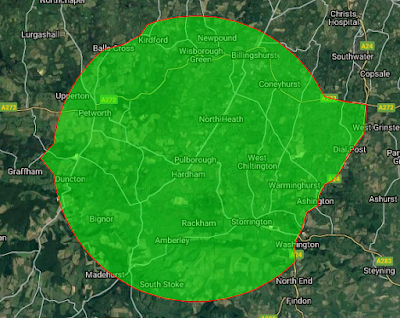
So, I set about studying maps and decided a rough 10km radius around Pulborough would offer plenty of interesting and diverse habitat to get stuck into. Some of it, like Pulborough Brooks, Waltham Brooks and Amberley Wildbrooks, I know very well or reasonably well, other areas I have been to far less, if at all. I also tweaked the radius slightly to include the Knepp Estate where I'll be spending a lot of time this year, as I start leading safaris there in the spring.

The new 'uber patch'

There are some good stretches of woodland, particularly to the northwest and southwest of Pulborough, and also various intriguing flooded patches along the various rivers that crisscross the recording area. The South Downs offer plenty of opportunities for sky-watching as well as some enticing patches of farmland. 

As of the time of writing I've already notched up 100 species within the recording area. Highlights have included a Little Gull on the flood behind the house on the 4th, a Hen Harrier at Waltham Brooks on the 1st, Cattle Egret and 3 Great White Egrets at Burton Mill & Chingford Ponds on the 10th, the eleven Bewick's Swans at Amberley also on the 10th, Merlin and Corn Buntings galore up Chantry Hill on the 15th and my first ever local Dartford Warblers at Lavington Common on the 17th.

After just under three weeks I already feel as though I have a greater understanding of the mosaic of habitats within this corner of West Sussex, and I'm excited to see what else I discover in the months to come.

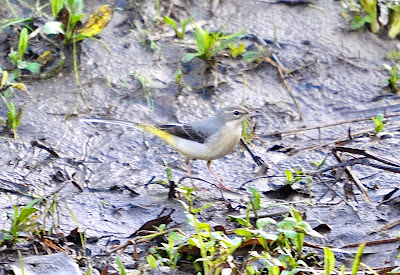
Grey Wagtail

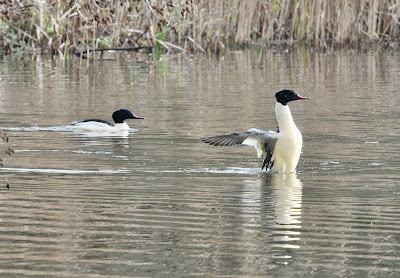
Goosanders

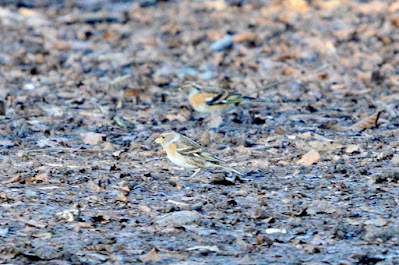
Bramblings

Corn Buntings

Little Gull